Short answer
Share of voice is a brand's measured activity divided by the total measured activity of its competitive set, multiplied by 100. A valid result must also state the period, market and unit being counted, such as spend, impressions, mentions or AI recommendations.
On this page
If a SaaS brand wins 20% in paid ads, 8% in organic search and 3% in AI recommendations, which number describes its position? The honest answer is all three, because each one counts a different kind of visibility.
What Share of Voice Means in Plain Terms#
What is share of voice in a buying situation? It's the portion of measured attention a brand receives within a defined market, compared with competitors over the same period. In its basic form, it's one brand's activity divided by the total activity of the competitive set, multiplied by 100.
Say a team is shortlisting project management tools. Buyers read review sites, comparison pages and AI answers, and each brand takes a slice of what they see. That slice is relative, so a brand can gain mentions and still lose share if rivals grow faster.
Nielsen defines traditional share of voice as a brand's media spending expressed as a percentage of all media expenditures in the category, market, channel and time period. That definition shows why every result must state what's being measured and where.
Terms readers often mix up#
- Brand awareness: Whether buyers recognize or recall a brand, usually measured through surveys.
- Total reach: How many people a brand may have reached, without comparing rivals.
- Sales share: Commercial outcomes such as revenue or customers, not communication activity.
For SaaS brands, share of voice now shows up mainly in paid ads, organic search and AI answers. Each place needs its own count.
The Share of Voice Formula With Worked Numbers#
The formula is simple:
Share of voice = brand activity / total competitive-set activity x 100
The numerator and denominator must use the same unit and scope, or the result means nothing. The standard calculation described by Momos divides a brand's measured activity by total measured activity for the selected competitive set, then multiplies by 100.
In a paid media example, a brand receives 2 million impressions out of 10 million category impressions, which gives 20%. In a mention example, a software brand gets 240 qualifying mentions against 1,200 across the tracked SaaS category in the same period, which also gives 20%.
That result describes the measured corpus, not the whole market, unless the data covers the whole market. Adding or removing a competitor changes every brand's percentage even when the underlying mention counts stay the same.
| Channel or unit | Numerator | Denominator | Worked example |
|---|---|---|---|
| Paid media impressions | Brand impressions | Total category impressions | 2 million / 10 million = 20% |
| Tracked mentions in a SaaS category | Qualifying brand mentions | Qualifying mentions for the full competitor set | 240 / 1,200 = 20% |
| Organic search visibility | Brand keyword visibility | Keyword visibility summed across all tracked brands | Same keyword set and dates for every brand, then divide and multiply by 100 |
| Media spend (Nielsen definition) | Brand media spend | Category media spend in the same market and channel | Brand spend / category spend x 100 |
| AI answer mentions | Answers naming the brand | Answers across the same prompt set and engines | Named answers / total answers x 100 |
A quick check helps. Recalculate with the same unit and scope, then confirm the shares across the full competitor set add up to 100%.
Why the Channel Changes the Number#
The numerator means something different in each channel. Paid share counts bought exposure such as impressions or spend. It answers a narrow question: how much paid presence did money buy during a set period?
Organic share counts keyword visibility across a defined search set. Social share counts mentions or engagement in conversation. HubSpot's glossary entry on share of voice notes that paid measurement may use spend or impressions, organic measurement may use keyword visibility, and social measurement may use mentions or engagement.
Nielsen also warns that broad nationwide or cross-channel figures can hide important differences. That's not a technicality. Mixing units creates false precision.
Say a project management competitor buys heavy paid placements but earns few recommendations on review sites and community threads. Its paid share can look strong while its organic share looks weak, and both numbers can be correct. They aren't interchangeable.
Cross-channel share isn't usually comparable without normalization. Compare each channel against itself over time instead.
A short scorecard keeps reporting honest:
- Query set: The buyer questions or keywords included.
- Market and channel: Geography, engine or media channel.
- Time window: Start and end dates, kept consistent.
- Competitor universe: Every brand in the denominator.
- Counting rule: Any mention, or only an explicit recommendation.
How to Set Your Counting Rules Before You Measure#
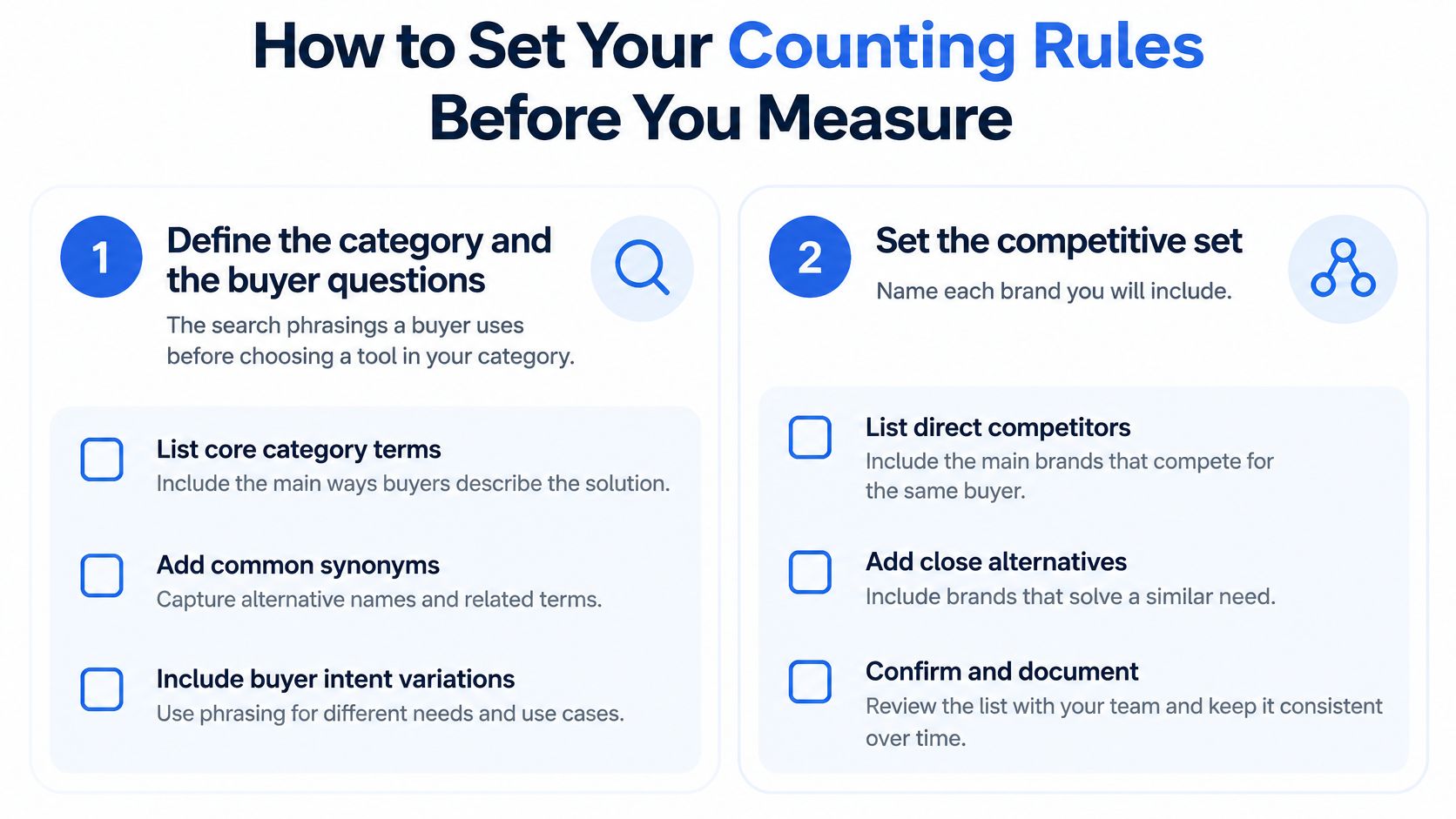
A formula alone doesn't make a study defensible. The counting rules described in the Humes glossary cover category, included brands, geography, audience, dates, channels, measurement unit and treatment of paid, owned and earned media.
Six decisions to lock down#
- Define the category and buyer questions. Start with phrasings buyers use before choosing a tool, such as best help desk software for a small team. The common slip is tracking branded terms only, which flatters known brands.
- Set the competitive set. Name each included brand and explain why it competes for the same buyer. Changing that list between reports breaks comparability.
- Choose one unit. Pick qualifying mentions, impressions, spend or another unit for both numerator and denominator. Don't switch mid-study to chase a better number.
- Lock market, geography and time window. Keep every period the same length. A launch week shouldn't be compared directly with a quiet month.
- Decide how duplicates count. Specify treatment of syndicated copy, duplicate articles, automated posts and a brand's own domain. One syndicated article can inflate apparent visibility, and a brand's own blog isn't independent coverage.
- Write the rules down. Store them in a short document and rerun them unchanged each period.
Those rules also need a decision on irrelevant content. A software name that matches a common word, for example, shouldn't count unless the context clearly names the product. For AI prompts, a practical reference on tracking brand mentions in ChatGPT can help teams apply the same discipline to prompt sets.
Practical rule: If another analyst can't reproduce the percentage from the written rules, the percentage isn't ready to report.
Consistency matters more than a perfect first setup. A narrow, stable definition beats a broad definition that changes every month.
Share of Voice Inside AI Answers#
A buyer asks an AI assistant which help desk tool suits a five-person team. The answer names three tools, recommends one as the best fit, and cites a pricing page from a fourth brand. Counting all four as equal visibility misreads what happened: presence, endorsement and evidence are three different outcomes, and a single blended percentage hides which one your brand won.
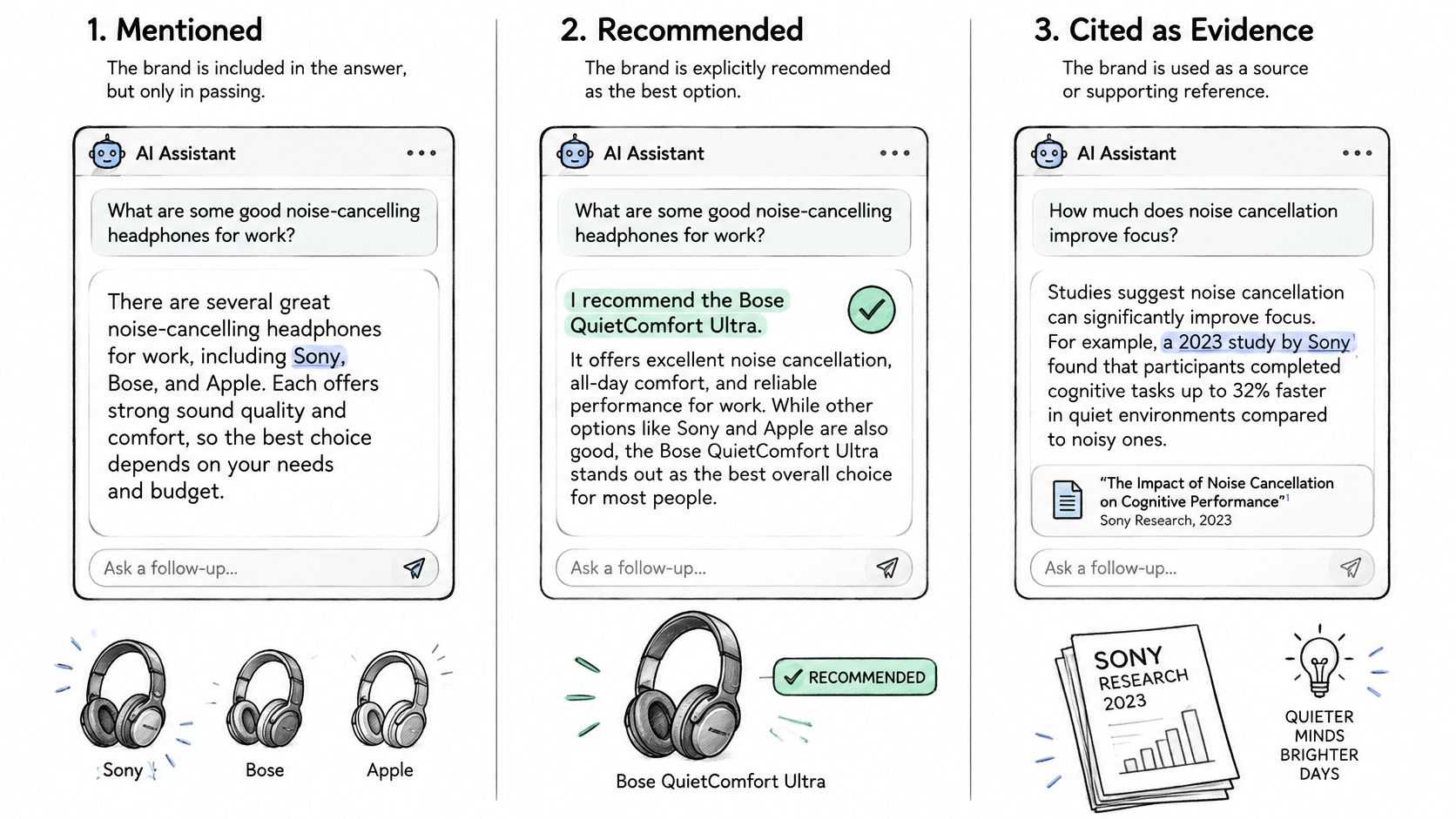
Each outcome needs its own share of voice calculation, with its own numerator.
| Outcome | What it counts | Question it answers |
|---|---|---|
| Mention share | Answers that name the brand anywhere | Is the brand present in the conversation? |
| Recommendation share | Answers that explicitly recommend the brand | Would a buyer shortlist the brand? |
| Citation share | Answers that link to the brand's own domain | Does brand content support the answer? |
| Citation-to-mention ratio | Citations divided by mentions | Is the brand cited without being named? |
| Answer position | Where the brand appears in the answer | Is the brand first, middle or last in the list? |
The last two rows catch a pattern the first three miss. An answer can link to a brand's page without ever naming the brand, so the domain earns credit while the buyer may never notice the company behind it. Analysts call this a ghost citation.
Ghost citations are common at scale. Marketing Dive reporting on 2026 AI visibility found that overlap between the top 100 brands mentioned and the top 100 domains cited across UK categories was only about 36.7% to 45.3%. In practice, AI answers regularly draw on a brand's site as a source while the brand itself stays invisible to the reader.
That evidence supports a contrarian reading. A lower mention share can still outperform a higher one if the brand earns recommendations on high-intent questions. Sentiment and answer position add further context, because a first-place recommendation carries more buyer weight than a neutral name-check at the end.
AI citation tracking that records mentions, recommendations and cited pages separately keeps those signals apart instead of reporting one blended score. Count a result only when it repeats across several runs of the same prompts, since AI answers change between runs.
Reading Share of Voice Without Fooling Yourself#
The most common misreading is treating share of voice as market share. The PPC Land share of voice guide separates the two clearly: market share measures commercial outcomes such as sales or customers, whereas share of voice measures relative communication or visibility.
It isn't brand awareness either. A metric can show that a brand appears often without showing that buyers remember it, trust it or bought because of that exposure. Visibility alone doesn't prove causation.
A falling share with no fall in activity#
Say a SaaS brand keeps 240 qualifying mentions while the category grows from 1,200 to 1,600 mentions. Its share drops from 20% to 15% even though its own count didn't change. Competitors grew faster.
Report that movement correctly in percentage points. Moving from 20% to 15% is a 5-point drop, not a 5% drop. Calling it a 25% relative decline is a different calculation and needs that label.
Before acting on a change, confirm the sample size, confirm the competitor set didn't change, and confirm the movement repeats across periods.
Numbers built on different competitor sets or time windows shouldn't be compared as if they're the same series. Read carefully, and the metric stays useful. Read loosely, and it rewards whoever defined the denominator most favorably.
Turn Share of Voice Into a Competitive Plan#
Start with the gap. Find buyer questions where a competitor is named or recommended and another brand is absent, then study why. A structured competitive gap analysis turns that list into work a team can prioritize.
Five fixes that can start this week#
- Check crawl access. Confirm robots.txt allows AI crawlers to read pages meant to be cited, and test access with the AI crawler checker.
- Find cited pages. Identify best-of lists, reviews, comparisons and community threads that AI cites for those questions.
- Build clear comparison pages. State in one plain sentence where the product fits and who it's for, with crawlable facts nearby.
- Get listed where buyers already look. Pursue accurate entries on third-party lists and review pages that influence shortlists.
- Measure before and after. Rerun the same questions on the same engines so any change stays comparable.
For measurement, Kliqo is one option. It tracks ChatGPT, Google AI Overviews, Google AI Mode, Gemini and Copilot, shows share of voice against competitors, records what AI says about a brand through roles, praise, criticism and quotes, and surfaces brands AI names that aren't tracked. It doesn't track Perplexity, so teams whose buyers use Perplexity should check it separately. Manual spreadsheet checks and other tools can cover the same ground.
The final decision stays small. Pick one gap, one fix and one measurement date.
FAQ#
Is share of voice the same as market share?#
No. Market share measures sales or customers, while share of voice measures a brand's measured presence against competitors. A brand can lead on visibility and trail on revenue, or the reverse.
How often should share of voice be measured?#
The cadence should match the decisions being made. Monthly checks suit many SaaS teams, provided prompts, competitor set, unit and time window stay the same each time so results remain comparable.
Can share of voice predict sales?#
It can show that a brand is being seen or recommended more often, but it doesn't prove that visibility caused a purchase or a market-share change. Teams should read it beside pipeline, trial and revenue data.
How many answers make a result reliable?#
There's no universal minimum for every metric. Enough answers are needed so one changed answer doesn't move the percentage much, and each measurement window needs at least 30 answers for an action to be measured. Repeated runs matter because AI answers vary.
Is share of voice useful for a small SaaS brand?#
Yes, when the competitive set is small and clearly defined. Repeated runs on a focused set of buyer questions give a small brand a clearer signal than one broad, single check.
Kliqo AI tracks how ChatGPT, Google AI Overviews, Google AI Mode, Gemini and Copilot mention and recommend SaaS brands, separating mention share from recommendation share and citations. Teams ready to measure those gaps on real buyer questions can start at Kliqo AI.