Short answer
To track brand mentions in ChatGPT, repeat the same SaaS buyer prompts and code each saved answer for mention, recommendation, position, sentiment, competitors, and citations. Being named isn't the same as being recommended, so a mention-only tracker misses the language that matters to buyers.
On this page
The popular advice to ask a question, check whether the brand appears, and record its position is incomplete. A product can lead a list while the answer steers buyers elsewhere because of price, setup effort, or missing features.
A useful tracker preserves that distinction. It also treats changing answers as normal until repeated, comparable observations show a sustained difference.
What to Log in Every ChatGPT Answer#
Store the full answer before scoring it. A dashboard label without the underlying wording makes disagreements hard to resolve and changes difficult to explain.
HubSpot's brand-mention guide distinguishes references to a brand from linked mentions and discusses sentiment and share of voice. For software buying, the log also needs a separate field for the decision the answer encourages.
Build an evidence row#
Use a spreadsheet with these fields:
- Run identity: Exact prompt, timestamp, country setting, model name, and browsing on or off.
- Session conditions: Logged-in or logged-out state, fresh chat status, and any unavailable settings.
- Answer evidence: Full answer text, without deleting introductions, qualifications, or closing recommendations.
- Competitive context: Brand order among named products and competitors in the order written.
- Source evidence: Cited URLs, source domains, and citation availability.
- Brand assessment: Outcome code, sentiment label, and the exact passage supporting each assessment.
Use a separate brand-assessment row for each product in an answer, connected through a shared run identifier. That keeps competitor comparisons tied to the same observation.
How to code a ChatGPT answer about a brand#
Consider a hypothetical buyer asking which help desk fits a five-person team. The outcome code should describe what that buyer reads, not whether the marketer likes the answer.
| Outcome | What the buyer reads | Counts as recommendation | Sentiment |
|---|---|---|---|
| Explicit recommendation | Named as the best fit or the place to start | Yes | Positive |
| Conditional recommendation | Fits only if a stated constraint is met | Partial | Mixed |
| Neutral inclusion | Listed with no preference | No | Neutral |
| Alternative only | Named after a winner as another option | No | Neutral or weak |
| Warning or criticism | Named with a drawback or a poor-fit caution | No | Negative |
| Omitted | Not named in the answer | No | None |
These sentiment labels are starting rules, not substitutes for reading the answer. Store sentiment separately so a conditional recommendation with entirely favorable wording doesn't automatically become mixed sentiment.
For the help-desk scenario, a product suggested only when advanced reporting is essential receives a conditional code. A product named after the preferred choice without an endorsement receives alternative only.
Count every outcome except omitted toward visibility. Include explicit and conditional outcomes in recommendation reporting, but keep their subtotals visible rather than assigning an arbitrary weight to partial recommendations.
Scoring rule: Position records order. Decision language records preference.
The answer-audit documentation is a useful reference when organizing answer-level evidence. A chat remains an observation, not a permanent ranking.
Controls That Make Runs Comparable#
Three repeats can expose inconsistency, but they don't establish a stable rate. If a product moves between answers, the first question is whether the conditions changed, not whether its market standing improved.
Searchable's tracking guide recommends repeated testing and describes at least 50 responses per prompt for a no-search baseline. That's a different exercise from a lightweight weekly check and shouldn't be treated as a universal sample-size rule.
Settings to hold still between ChatGPT runs#
| Control | Setting to use | What to record |
|---|---|---|
| Prompt text | Exact buyer question, unchanged | Full wording |
| Search mode | Browsing on for live checks | On, off, or unavailable |
| Model | Same named model across the set | Model and date |
| Market | One country, or no country | Setting used |
| Session | Fresh chat, logged out where available | Account state |
| Sample | Four runs as a practical weekly check; use the cited no-search baseline for that separate exercise | Run count |
Four fresh chats on check day are a practical operating routine, not a claim of statistical certainty. Record whether the first-named tool stays put, whether the preferred product changes, and whether the qualifications remain consistent.
If logged-out access doesn't expose the required model or browsing controls, use a consistent account state instead. Record actual conditions rather than labeling an unavailable control as fixed.
Compare like with like#
Maintain separate series for ChatGPT, Gemini, Copilot, Google AI Overviews, and Google AI Mode. Their retrieval and citation behavior differs, so averaging their positions into a single rank obscures what changed.
Use the prompt documentation when organizing a frozen prompt library. Assign each wording a stable identifier, and create a new version when buyer constraints change.
A changed winner deserves investigation. A sustained shift across matched runs deserves action.
Show the sample size beside every rate. When an apparent improvement is similar to the ordinary spread between repeated runs, label it inconclusive rather than a gain.
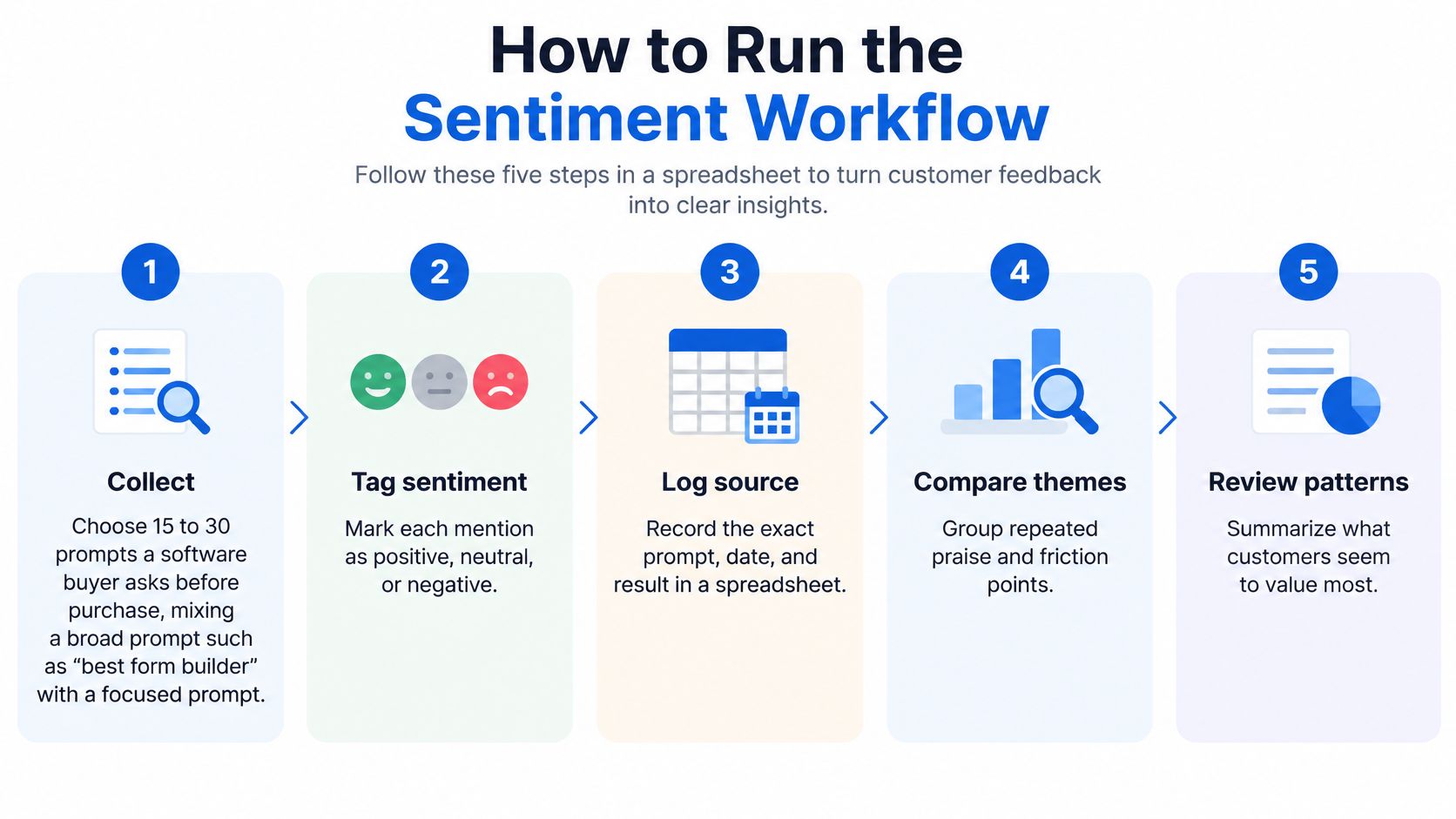
How to Run the Sentiment Workflow#
A spreadsheet is enough to begin, provided the saved answers remain attached to the scores. Separate collection from interpretation so an encouraging response doesn't receive looser treatment than an unfavorable one.
The ChatGPT browsing release notes describe browsing as a way to provide current information with source links. That makes answer wording and displayed sources distinct evidence fields.
Collect and prepare#
-
Collect buyer questions. Choose a manageable set of purchase-oriented prompts, mixing broad discovery with specific constraints. A hypothetical form-builder set could include a broad category question and a narrower question about SSO for a 20-person team. Freeze the wording for the measurement period, prioritize questions where manual checks already show a gap, and exclude general how-to prompts that mostly produce instructions.
Run each question in a fresh chat with browsing enabled and a consistent market setting. Don't add the brand name to an unbranded discovery prompt merely to make it appear.
-
Prepare intact evidence. Paste the complete answer into the sheet and tag the prompt as discovery, comparison, alternative, or constraint-led selection. Preserve caveats about integrations, pricing, and deployment because those details often explain the recommendation.
Mark an undisplayed citation as missing, with the reason when known. Don't turn unavailable source evidence into a claim that the brand received no source visibility.
Code and validate#
-
Code each brand separately. Apply the outcome taxonomy, assign sentiment from the actual praise or criticism, and record competitors in order. For a form builder, favorable comments about usability can coexist with a warning about enterprise access controls.
Store the supporting passage beside the code. Don't infer positive sentiment from a familiar brand name or a high position.
-
Validate the rules with another reviewer. Have a second person independently recode a small batch of saved answers. Compare disagreements about conditional recommendations, alternatives, and mixed sentiment, then revise the coding rules.
Recode affected rows after a rule changes. Otherwise, a cleaner methodology can look like a performance change even though the answers stayed the same.
Apply the findings#
-
Create a source-backed work queue. Flag prompts where the brand is omitted, criticized inaccurately, or included only as an alternative. Record the preferred product, the brand's outcome code, and the leading cited domain.
When repeated runs disagree about the winner, retain the prompt and preserve both observations. Don't choose the more flattering result as its rank.
Collection, preparation, coding, and validation measure the current answers. Application is where a team changes pages or third-party information that later retrieval may encounter.
Review the sheet weekly, but don't edit content after every shuffle. Prioritize sustained recommendation losses, changed source patterns, and factual errors with clear supporting evidence.
What Mention and Citation Counts Show#
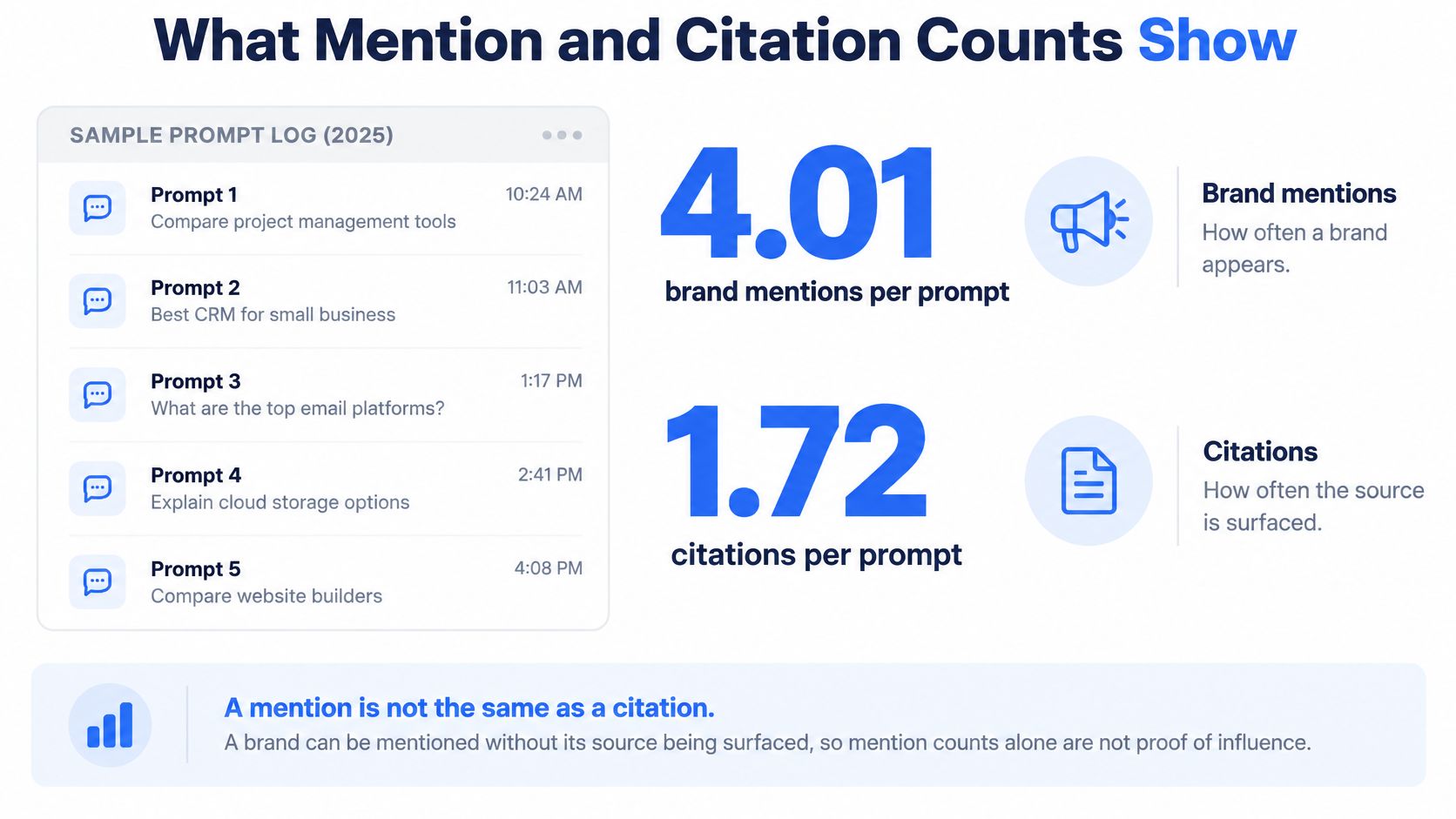
In 2025, Otterly reported that ChatGPT Search averaged 4.01 brand mentions per prompt but only 1.72 link citations per prompt. Those measures aren't interchangeable: the study's aggregate gap doesn't identify which named product received which citation in an individual answer.
In 2025, Yext analyzed 6.8 million AI citations from 1.6 million queries across ChatGPT, Gemini, and Perplexity, finding that 86% came from brand-managed sources, including websites, listings, reviews, and social profiles. That describes the study's combined citation mix, not a ChatGPT-only rate or proof that editing an owned page will secure a recommendation.
Calculate distinct rates#
Use the metrics documentation as a reference for keeping metric definitions explicit. Calculate these measures from the saved rows:
- Mention rate: Answers naming the brand divided by valid completed answers.
- Owned-domain citation rate: Answers citing the brand's domain divided by completed answers with observable citation evidence.
- Recommendation rate: Answers with an explicit or conditional recommendation divided by valid completed answers, with the outcome types also shown separately.
Report the citation denominator and missing-evidence count alongside the result. A batch with fewer observable citations shouldn't appear comparable to a fully observed batch.
Read the gap before choosing the fix#
High mentions with weak recommendations call for investigating buyer fit and decision language. Strong recommendations with few owned-domain citations call for examining whether third-party pages supply the relevant evidence instead.
A citation isn't proof of endorsement, and a recommendation isn't proof of a sale. Neither should be presented as attributed revenue without separate conversion evidence.
Diagnose the mismatch before rewriting the page.
Start with the latest saved batch and calculate the distinct rates before making changes. That gives the team a baseline against which later edits can be assessed.
Fixes You Can Ship This Week#
Fix the issue that matches the logged gap. A crawler restriction, an unclear comparison page, and an outdated review listing require different work.
Resolve access before rewriting copy#
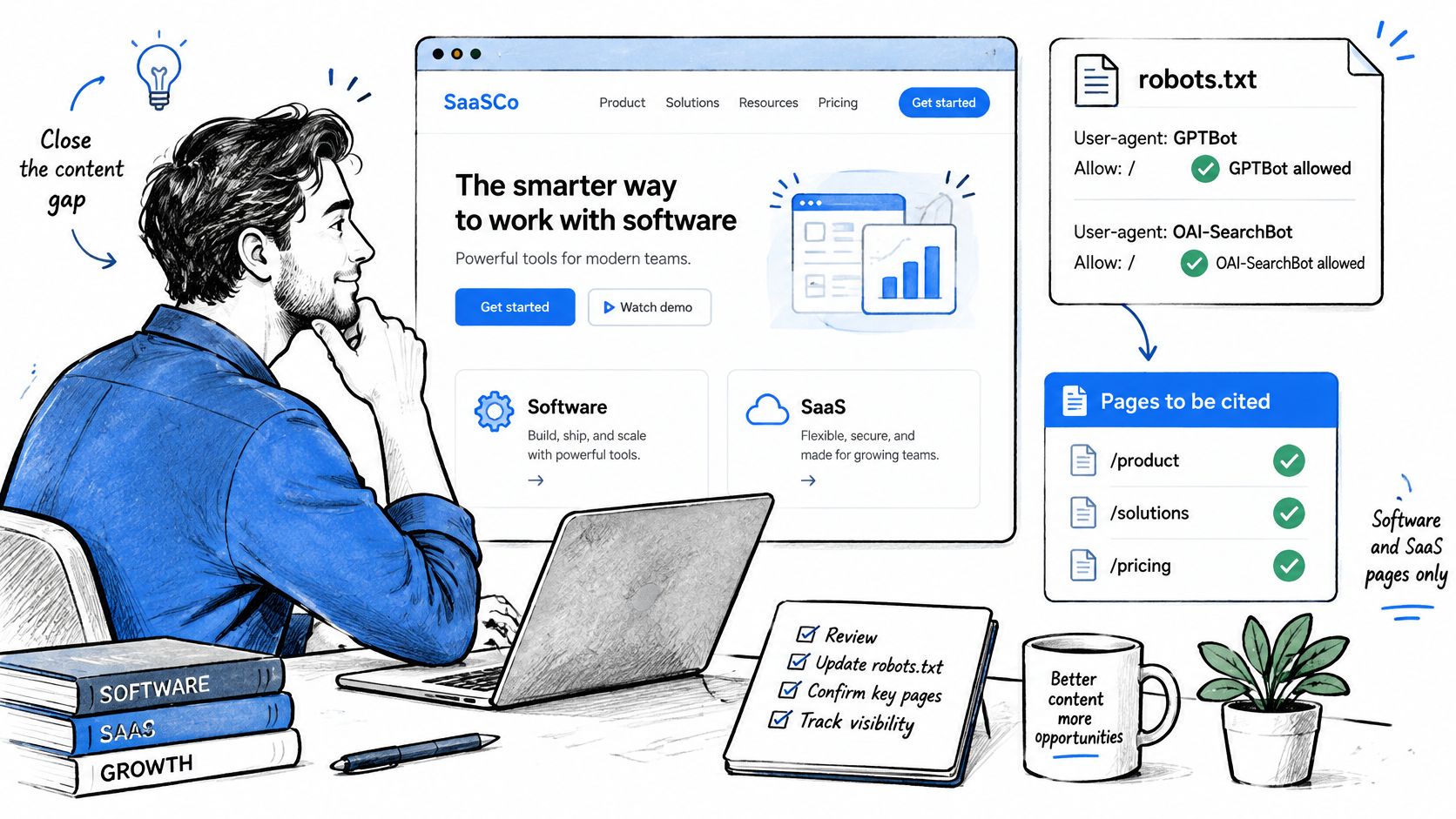
Inspect robots.txt for restrictions affecting the pages intended for search retrieval. Review OAI-SearchBot and GPTBot separately rather than treating search access and training access as the same permission.
Use the AI crawler access checker to inspect robots.txt health, sitemap availability, and whether the homepage can be read without JavaScript. Follow the specific access fix, then verify the affected comparison or product page directly.
An allowed crawler isn't a guarantee of retrieval or citation. It removes an access obstacle.
Make buyer fit easy to verify#
- Clarify comparison copy. Publish a concise statement explaining which teams the product suits and which requirements make another option more appropriate. Include the actual public price band, relevant team size, and plan limitations rather than vague claims about scalability.
- Correct third-party information. Pursue relevant category roundups and software review listings, particularly pages already cited in the losing prompts. Keep the product name, category, current pricing, and feature limits consistent with the authoritative product documentation.
- Retest the unchanged questions. Record deployment dates and compare matched conditions after the change. Assess the outcome codes and supporting wording, not merely whether the brand reappears.
The guide to getting recommended by ChatGPT provides a practical work order: make pages accessible, improve presence on cited pages, write clear comparison language, keep facts consistent, and measure again.
If marketing copy contradicts the docs, correct it before pursuing more mentions. Accurate limitations can support a useful conditional recommendation better than an unsupported best-for-everyone claim.
Kliqo asks these buyer questions every night and separates a mention from a recommendation across ChatGPT, Google AI Overviews, Google AI Mode, Gemini, and Copilot.
FAQ#
How often should the same ChatGPT prompt be repeated?#
A practical starting routine is four fresh runs on check day, followed by weekly checks using unchanged wording. Record the model, market, browsing mode, and session conditions so the observations remain comparable.
Does a higher mention rate mean ChatGPT recommends the brand?#
No. Neutral inclusions, alternatives, and warnings all increase visibility without establishing preference. Report explicit and conditional recommendations separately from those outcomes.
Which prompts are worth tracking for a SaaS product?#
Track questions that ask which product fits a job, team, or purchasing constraint. General how-to questions usually measure instructional coverage rather than competitive buying visibility.
Can this be done without paid software?#
Yes. A spreadsheet containing saved answers, run settings, outcome codes, and supporting passages is enough to start. Manual collection becomes harder to maintain as the prompt library grows.
Why log citations if the brand is already named?#
Citations identify the displayed sources associated with the answer. They help teams investigate outdated claims, understand competitor coverage, and choose relevant pages for content work or outreach.
Kliqo AI offers recurring buyer-prompt monitoring with saved answers, competitor comparisons, and separate visibility and recommendation metrics. Visit the site to assess whether that workflow fits the team's ChatGPT tracking needs.