Short answer
The most common advice about ChatGPT SEO is to get your brand mentioned in AI answers. That's an incomplete goal. A mention doesn't tell a buyer to choose you, and a citation doesn't prove anyone clicked. A useful test starts with a high-intent buyer question, then records whether ChatGPT recommends your brand, where it places you, and whether the cited page supports its claim.
On this page
What to Score Before You Change a Page#
For one buyer question, score the answer as a recommendation, not a name-check. A brand can appear in a shortlist without being endorsed, while a competitor gets the preferred position. That distinction matters when an AI summary is doing more of the comparison work for the buyer. In a European Parliament briefing discussing evidence from Google AI Overviews, users clicked a traditional result 8% of the time when an AI summary appeared, compared with 15% when one didn't. The figures concern Google's AI summaries, not ChatGPT, but they show why the content and placement of an answer matter alongside clicks. The European Parliament briefing on AI summaries and search behaviour also supports treating recommendation quality as distinct from simple presence or citation.
Start with a question that matches a buying decision, such as “Which project management tool suits a small remote team?” Avoid a brand-name query: it tests recognition, not whether the assistant considers your product for the job. Record one answer per run, and leave a field unknown if there's no reliable observation. One answer can omit a brand that appears in another run, so a blank isn't proof of zero visibility.
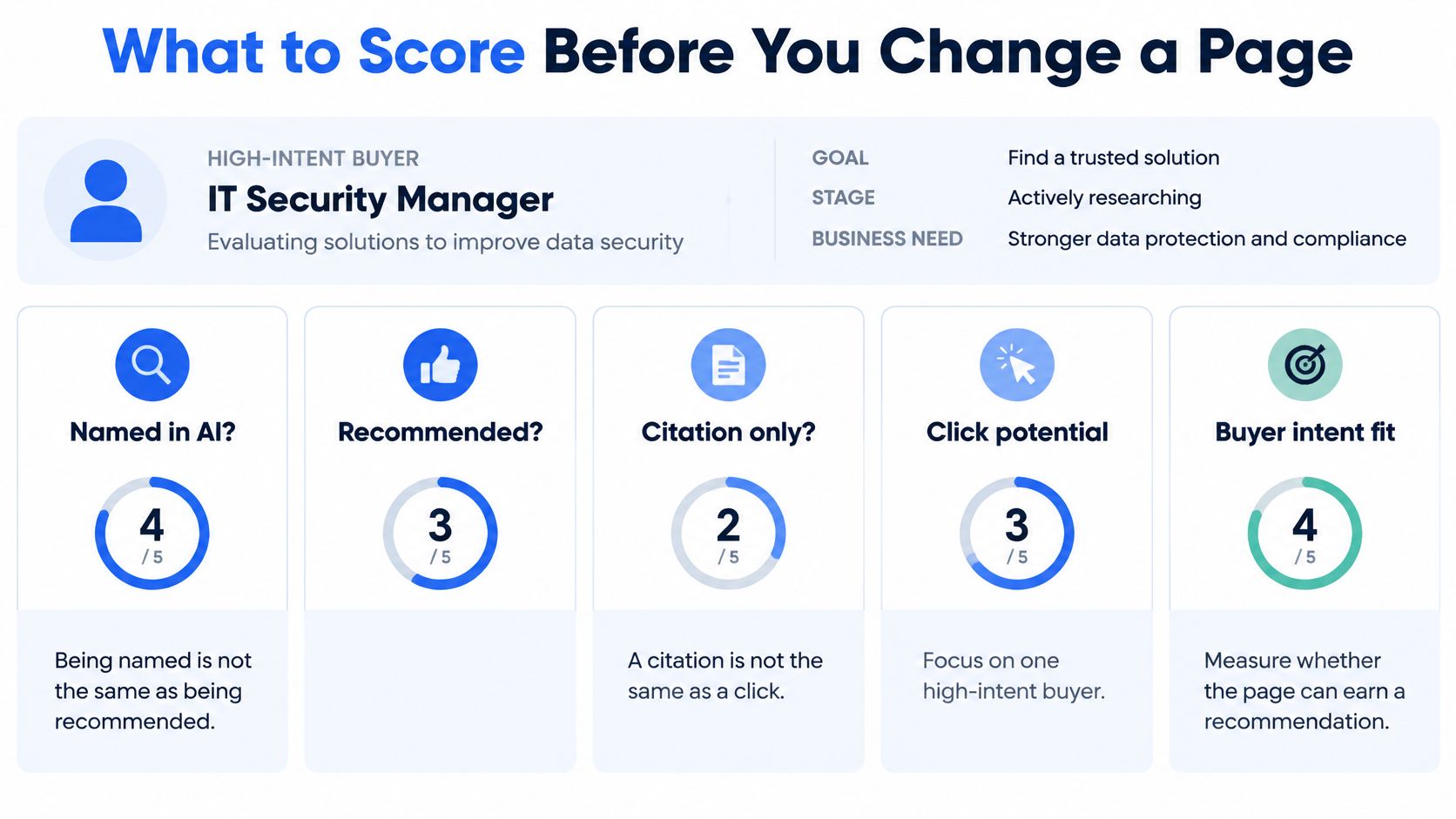
| Field | What to record | Counts as success |
|---|---|---|
| Brand presence | Named anywhere in the answer | No, only a starting observation |
| Explicit recommendation | Told the buyer to choose or prefer the brand | Yes for that question and run |
| Answer position | First, middle, or last among named options | Earlier is stronger, not a rank guarantee |
| Sentiment | Short quote of praise or criticism | Positive only if the claim is accurate |
| Citation | Cited URL and whether the page supports the claim | A supporting citation, not any link |
| Referral | Assistant referral sessions in analytics | Extra evidence, not a substitute for the answer |
Consider a run where a rival is recommended first, while your brand appears third without an endorsement. Log your presence as yes, explicit recommendation as no, and position as third. Record the cited URL and check whether it supports the rival's recommendation. Don't count praise as positive sentiment unless the quoted claim is accurate and relevant to the product.
Practical rule: A citation counts when the linked page supports the answer's specific claim, not merely because it mentions the brand.
If the problem is that a product page leaves key buying details unclear, check the page itself before rewriting the whole site. Kliqo's AI page audit checks how a page appears to AI search, including access, indexing, visible text, title, structured data, and dates.
How to Compare Competitors on Buyer Questions#
A fair comparison uses the same buyer questions across repeated runs. ChatGPT answers can change with prompt wording and retrieval conditions, so one flattering result isn't a trend. OpenAI's bot guidance explains the first eligibility checks: allow OAI-SearchBot if ChatGPT Search visibility is the aim, confirm priority pages can be reached, and test representative buyer questions repeatedly. OpenAI's documentation on its web crawlers distinguishes access from the later question of whether a brand is recommended or cited.
-
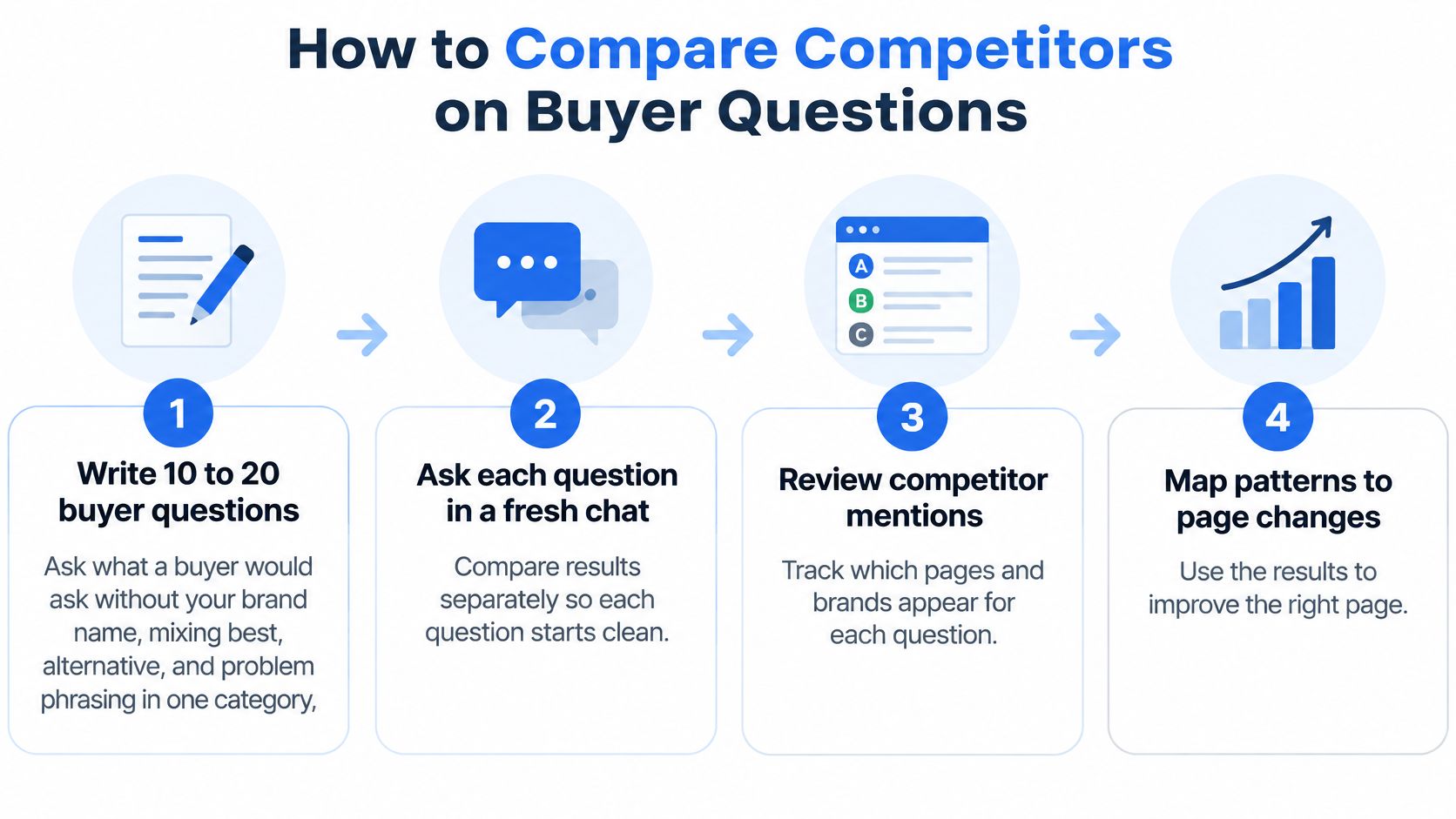
Write the buyer questions. Build a set of 10 to 20 questions for one product category, without using your brand name. Mix “best for” questions, alternatives, and problem-focused wording. Keep each question tied to a real buying need, such as comparing tools for a small team or finding an option with a specific feature. Decision: keep questions that could plausibly lead to a purchase.
-
Run the set consistently. Ask each question in a fresh ChatGPT chat, logged out, in English. Repeat the same set on at least two days. A fresh chat prevents one answer from steering the next, while repeat dates reveal whether a single result holds up. Decision: retain only prompts that can be repeated without changing their meaning.
-
Separate real product rivals from incidental mentions. List every named product, then keep the competitors that beat your brand on a question that matters. Remove generic tools, review sites, and publishers from the competitor list. Don't automatically restore a brand the team has already rejected. Decision: track only products that compete for the same buyer and use case.
-
Record each loss. For every question where a competitor is favored, log brand presence, recommendation, answer position, sentiment, cited URL, citation support, and referral sessions if available. Keep the cited domain too. This makes it possible to see whether the answer favors a rival because its own comparison page is useful, a third-party list includes it, or your page can't be read. Decision: classify the gap by evidence, not by guesswork.
-
Choose the fix by missed recommendations. Prioritize questions where your brand is absent from the recommendation, not prompts that produce the most total mentions. If the answer cites an outside roundup, inspect who it lists and what evidence it gives before changing your product page. Decision: fix the page or source gap tied to a commercially important loss.
-
Rerun a matched test. After a page change, ask the same questions over comparable before-and-after periods. Keep the sample size, engine, country, and dates with the results. A nightly log across ChatGPT, Google AI Overviews, Google AI Mode, Gemini, and Copilot is what Kliqo is built to store, so the record doesn't have to live only in a spreadsheet. Decision: treat the change as a test, not proof of a win.
Check Which Bots Can Read Your Site#
A page can't earn a ChatGPT Search citation if the relevant crawler can't access it. OpenAI uses two separate robots.txt user agents: OAI-SearchBot, which helps surface websites in ChatGPT search, and GPTBot, which crawls content that may contribute to training. A site can allow search access while disallowing training access, or choose the reverse. OpenAI says sites that opt out of OAI-SearchBot won't appear in ChatGPT search answers, though they may still be discoverable as navigational links. OpenAI's explanation of GPTBot and its crawler controls makes clear that training permission and search visibility aren't the same setting.
| User agent | Used for | If you want to be cited | If you want to stay out |
|---|---|---|---|
| OAI-SearchBot | Surfacing sites in ChatGPT search | Allow | Disallow, knowing search answers will omit the site |
| GPTBot | Crawling that may feed model training | Optional and separate from search | Disallow without blocking OAI-SearchBot |
| Googlebot | Crawl for Google Search, including AI feature eligibility | Allow, and don't noindex pages you want cited | Use noindex for true exclusion, not robots.txt alone |
Start by checking the rules that apply to OAI-SearchBot and GPTBot separately. Don't block every AI crawler just to prevent training if the business still wants to appear in search answers. Conversely, allowing OAI-SearchBot doesn't mean a page is guaranteed to be retrieved, cited, or recommended.
Then check Google's access and index controls. robots.txt controls which URLs a crawler may request; it isn't a reliable way to remove a page from Google's index. For a genuine exclusion, Google recommends using indexing controls such as noindex, rather than relying only on robots.txt. Google's robots.txt documentation explains the difference. Keep pages intended for discovery crawlable and eligible for ordinary search snippets.
Fetch each priority URL directly. Confirm it returns a successful response and that its important text appears in the delivered HTML, rather than only after a browser runs JavaScript. Check for CDN, firewall, or hosting rules that challenge crawlers. If an access checker flags a rule, verify it manually before changing the page copy.
Kliqo's AI crawler checker offers a quick robots.txt check, but the live fetch is the practical test: can the relevant crawler reach the page and read the content? Fix any block first. Rewriting copy won't solve an access problem.
Pages That Can Change a Recommendation#
Build or update a page that directly answers the buyer question where a rival wins. A general article about AI search won't replace a clear comparison page when the question asks for alternatives. Google's guidance says there are no additional technical requirements or special schema.org types for AI Overviews or AI Mode; standard SEO fundamentals still apply, and structured data must match visible page content. Google's guidance on AI features in Search also cautions that meeting requirements doesn't guarantee crawling, indexing, or serving.
Match the page to the loss#
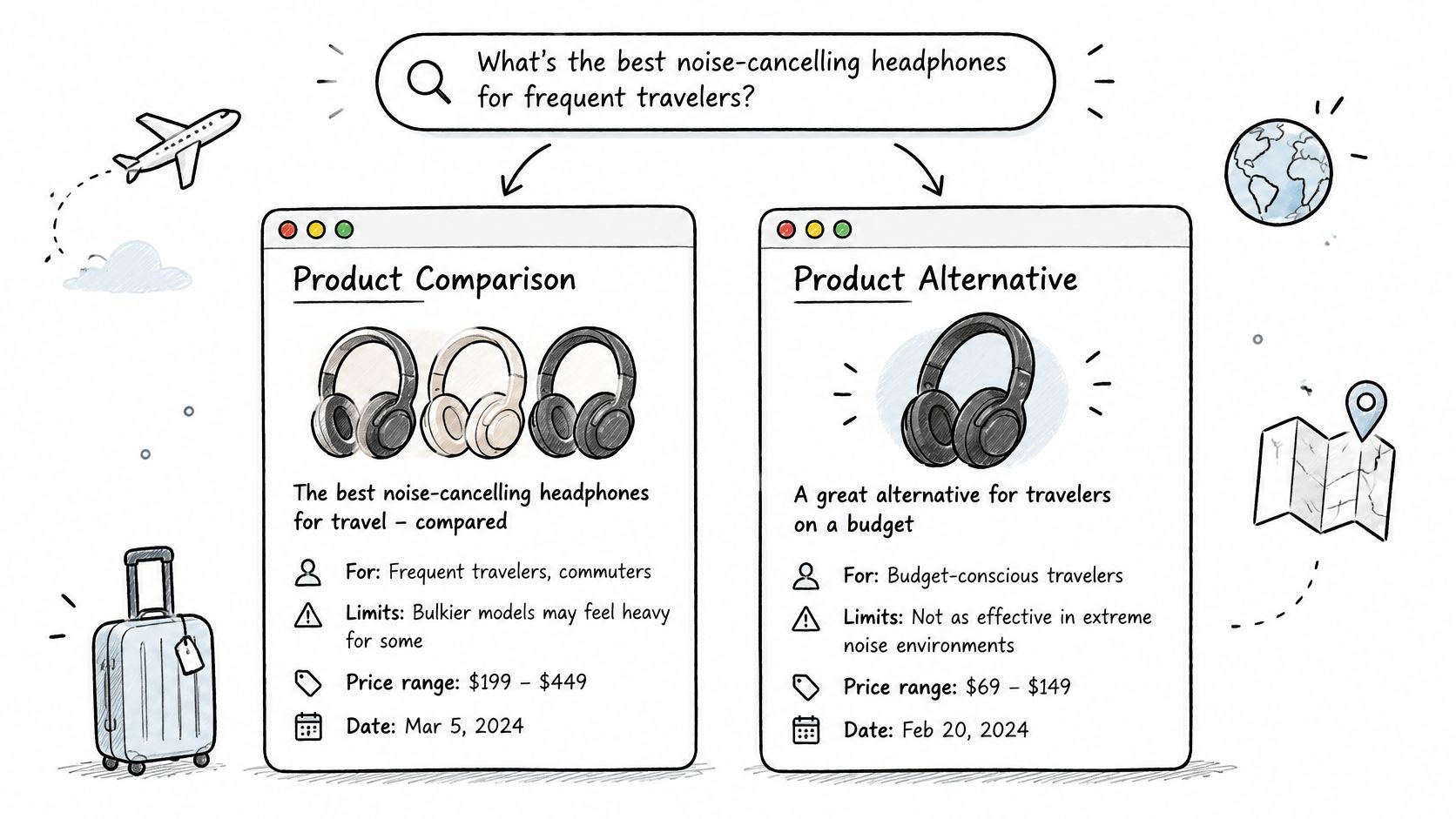
For a comparison or alternative question, make a page that states who each option suits, where it falls short, what public pricing information is available, and when the comparison was updated. Be fair about competitors. A page that acknowledges a rival is stronger for a particular use case is more useful to a buyer than a blanket claim that your product is best.
For a “best for” question, focus on one job. If buyers ask for a tool for a small team, spell out the team size or working context the page addresses, the product's limits, and who shouldn't choose it. For a problem-solving question, put the answer in visible HTML near the top. Don't hide the key steps in an image, a closed tab, or a script-dependent interface.
Put each important claim beside its evidence and any relevant limitation. A clear claim with a primary source and a date is easier to check than a broad assertion followed by a pile of links. Use structured data only when it accurately describes content that people can also see on the page. Skip AI-only text files or special markup presented as a shortcut to inclusion.
Ship, check, then measure#
Once the page is live, make it discoverable through internal links from relevant pages. Check that the text reads without JavaScript and that the URL is accessible to the crawler. If an outside roundup is the source ChatGPT cites for a rival, consider whether the page gives that publisher accurate, useful facts about your product and who it serves. Don't claim control over a list you don't own.
A team can use Kliqo's recommendations documentation as a reference when planning practical fixes. Rerun the original buyer question after the updated page is accessible and indexed, then record the recommendation, position, and cited page. Compare against unchanged prompts or pages where possible. That helps separate an effect of the update from ordinary variation in answers.
A useful way to think about page clarity is to compare two travel headphones. A buyer choosing a premium model needs evidence about comfort, noise cancellation, and travel use; someone on a budget needs a straightforward account of what features they give up. The same principle applies to software comparisons: define the buyer and explain the trade-off, rather than writing copy that tries to suit everyone.
The video below offers another visual example of comparing products by their use case and features.
Tips for Reading the Before and After#
Use a control set before calling a page change a win. Keep prompts and pages you did not touch, then compare their results against the questions tied to the updated page. Report the engine, country, dates, number of runs, and citation rate alongside any observed improvement. Without those details, a before-and-after comparison can hide changes in prompt wording or coverage.
Separate three outcomes: retrieval, citation, and referral. Retrieval means a page may have been available to inform an answer. Citation means the answer links to it. Referral means a session arrived on the site. They are related, but none proves the other. A complete answer can shape later branded search or a purchase without sending a visit, so check branded search and assisted conversions alongside direct assistant referral sessions.
Referral data also needs scope. Semrush's analysis of ChatGPT search and referrals reported that ChatGPT referred traffic to about 71,000 unique domains per month in its October 2024 sample, and that the count of unique domains receiving referrals rose 300 percent from July to December 2024 across more than 80 million clickstream lines.
| Measure | Value | Source |
|---|---|---|
| ChatGPT referral reach, October 2024 sample | About 71,000 unique domains per month | Semrush clickstream report |
| Unique domains receiving ChatGPT referrals, July to December 2024 | Up 300 percent | Semrush, more than 80 million clickstream lines |
Read each number against its sample. These figures show that ChatGPT referrals reach a broad set of websites. They describe the clickstream panel, not a traffic forecast for your domain, so treat them as context for why measurement matters rather than a benchmark to hit.
The sharpest reading mistake is collapsing everything into one visibility score. If mentions rise while recommendation share stays flat, the answer is naming the brand more often without choosing it more often. If citation counts rise but referrals do not, the cited page may still help buyers evaluate the brand, but the citation has not produced a measured session. If the recommendation improves but the cited URL changed, credit the new page and not the one you rewrote.
Keep those outcomes separate, and treat every lift as a claim you still have to tie to a specific change.
A lift is useful only when the team can say what changed, where it changed, and what the answer cited.
Pick Three Questions and Rerun Them#
A mention is only a partial result. Score whether the answer recommends your brand, where it ranks, which page it cites, and whether that changes after a real fix.
Choose three buyer questions where a competitor is recommended and your brand is not, then work the same loop:
- Check access. Confirm OAI-SearchBot can fetch the page that should answer each question. Check robots.txt, the sitemap, and the homepage HTML without JavaScript; a blocked page needs an access fix before a copy rewrite.
- Improve one page for each question. State the intended audience, an honest limitation, and a date in visible HTML. Link to it from relevant content so buyers and crawlers can find it.
- Rerun the same questions. After the pages are accessible and indexed, record the recommendation, answer position, cited URL, date, and engine for each run. Compare runs only when the prompt and engine match.
If manual tracking becomes the bottleneck, Kliqo tracks ChatGPT, Google AI Overviews, Google AI Mode, Gemini, and Copilot, with three engines per project included in each plan. Plans cost $79, $199, and $449 a month with different prompt and project allowances, and the seven-day trial requires a card. A live ChatGPT question takes a few minutes to answer; without an account you can ask one new question a day. A monitoring log can show what changed, but it cannot replace crawlability or a page that answers the buyer's question.
Kliqo AI tracks how AI search services describe, cite, and recommend brands, and helps teams identify competitor gaps and measure changes after page updates. To compare your brand's recommendations with rivals' answers, visit Kliqo AI.