Short answer
Brand sentiment in AI answers is the tone an assistant uses when it describes a software brand, scored apart from whether that answer recommends the product. A warm paragraph can still hand the shortlist to a rival.
On this page
Most dashboards treat a kinder score as proof the brand is winning. That reading fails for software buying. Praise, the pick, the place in the list, and the page cited are four different measurements. A team that only watches the warm score will miss a rival taking the recommendation.
Brand Sentiment in AI Answers in Plain Terms#
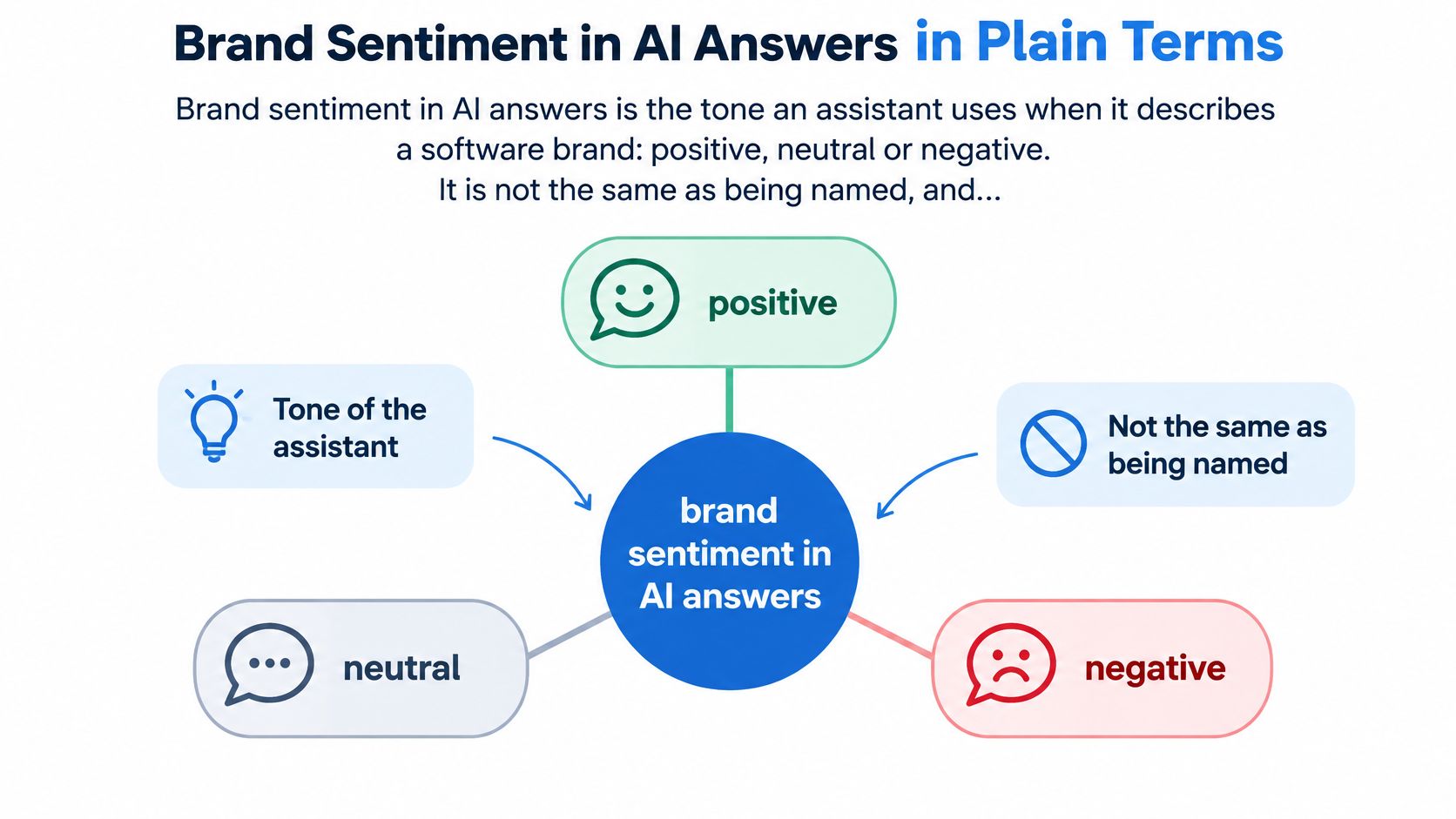
Brand sentiment in AI answers is the tone an assistant uses when it describes a software brand: positive, neutral, or negative. Being named is a separate event, and being recommended is a third one.
The split is easier to see as three tones around one idea, not one blended score.
A founder comparing help desk, form, or email tools may never open a vendor homepage first. Deloitte Digital's Personalizing Growth research reported that 63% of consumers had used AI-powered search tools or assistants during the previous year to find products or services, while 20% now began searches with an AI-powered tool instead of a traditional search engine or a brand website. Among those users, 53% used AI tools to find recommendations and 55% used them to summarize reviews.
One reply can compress reviews, compare three help desk tools, and name a pick before anyone reaches a pricing page.
Keep four readings apart:
- Description: the tone used about the brand.
- Recommendation: whether the answer favors it when a product is picked.
- Position: where the name sits in the list.
- Citations: which pages the answer used.
Sentiment Dashboard Metrics and How to Read Them#
| Metric | What it answers | Read it after | Do not confuse it with |
|---|---|---|---|
| Sentiment | How the answer describes the brand, scored 0 to 100 with 50 neutral | At least 3 mentions | Being recommended |
| Recommendation share | Share of recommending answers that pick the brand | At least 5 recommending answers | Share of mere mentions |
| Position | Average place when the brand is named | At least 3 mentions | A positive adjective |
| Share of voice | How often the brand appears against the rivals chosen for tracking | Repeated runs of the same prompts | Winning the shortlist |
| Citations | Pages and domains the answer used | Any cited URL in the answer | Site traffic analytics |
| Praise, criticism, quotes | Exact wording behind the score | A saved answer | A paraphrased brand claim |
Read a row from left to right, and leave the value blank when the minimum isn't met. These floors are working rules for a small prompt panel, not published benchmarks. One glowing sentence isn't a trend.
Sentiment, share, and place#
Sentiment is how the answer talks about the brand on a 0 to 100 scale, with 50 as neutral. It needs 3 mentions before a value shows. A kind adjective doesn't mean the product was chosen.
Recommendation share is the share of answers that recommend any product which recommend the business. It needs 5 such answers before a value shows. A brand can appear in every reply and still lose the shortlist.
Position is the average place when the brand is named, and it also needs 3 mentions. Third of four isn't a win, even when the wording is kind.
Voice, citations, and the words behind the score#
Share of voice counts how often the brand appears against the rivals on the tracked list. Mentions that never become the pick still count. Read it only after the same prompts have been run again.
Citations are the domains and URLs inside the answer. They aren't sessions or referral reports. Praise, criticism, and quotes are the wording behind the score. A quote stays the exact words of the answer, not a rewritten brand claim.
Practical rule: If the cell is blank, there isn't a trend yet. Don't turn one kind sentence into a score.
The movement view is a 90-day line of recommendation share against the top competitor, not the sentiment gauge alone. List any brand the assistant names that isn't on the tracked set. An untracked tool can be taking the pick.
Reading order: mentions, then recommendation share, then position, then sentiment, then the cited page. The metrics reference shows how a blank cell differs from a zero.
Why Warm Language Still Loses the Recommendation#
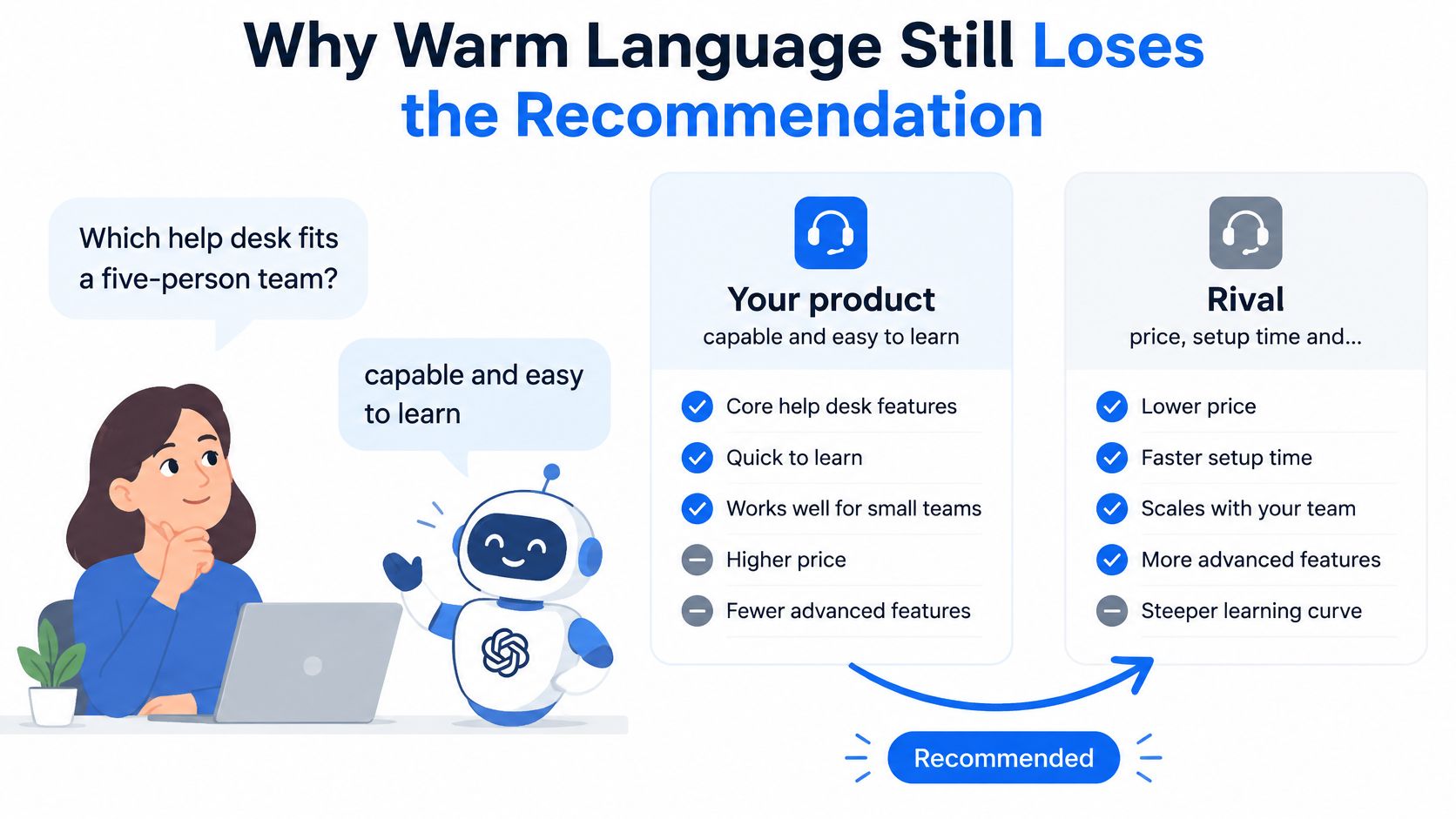
A product can receive a positive description and still lose the buying recommendation. A buyer asks which help desk fits a five-person team. The answer calls one product capable and easy to learn, then recommends a rival because its page states price, setup time, and shared-inbox limits clearly. Sentiment is warm; the rival gets the pick.
An arXiv benchmark of 35,640 grounded responses covered 66 brands, 11 European home markets, and 12 languages. Sentiment varied systematically by language: English and other Germanic-language responses were comparatively more critical, while Uralic and Baltic-language responses were more positive. Switching from English to a brand's home language increased recommendation share by 0.80 on a 0 to 1 scale for local champions, compared with 0.15 for global multinationals.
Keep tone and selection as separate measures. A language change can soften the description and also affect the chance of being chosen. Compare prompts with the same buying intent across languages, then read sentiment alongside recommendation share.
Capgemini's write-up of Adobe's research found that value for price was the leading trust factor, selected by 51% of customers. Praise without a concrete value fact gives an assistant less useful evidence for a recommendation.
Call an answer positive but weakly actionable when it praises the product but omits price, limits, implementation time, or a cited comparison. A comparison page that states product fit in one quotable sentence, with consistent price and limit facts on the pages assistants cite, gives AI clearer evidence to repeat.
For a practical guide to getting recommended by ChatGPT, focus on the buyer's question and the evidence the answer can cite.
When the Same Software Brand Scores Differently#
Don't fold every answer into one sentiment number. A 2024 study of large language models across four brand categories found a consistent bias toward associating global brands with positive attributes while treating local brands less favorably. A high score can reflect fame in the training mix rather than fit for the buyer asking the question.
Split the panel by the question#
Keep these intents in separate rows:
- Small-team fit: the best tool for a five-person team.
- Switching: an alternative to a known suite.
- A feature: SSO or a public API.
- A budget: a stated monthly limit.
The same product can be praised as right for a small team and criticized as too light for a larger one. Those replies don't belong in one average.
Engine, country, and one noisy night#
Run each intent by engine and by country on the same schedule. Store the original answer, the quoted sentence, and the sample size with every score. Treat a one-day swing as noise until the same prompt repeats across several runs.
Channel trust isn't flat either. Coverage of the 2025 Bazaarvoice Shopper Experience Index reported that 55% of surveyed consumers across the US, UK, Germany, France, Australia, and Canada trusted generative-AI shopping tools for at least some tasks, while the figure rose to 75% among consumers aged 18 to 34. 41% of that younger group had used generative AI instead of a search engine to find products.
For each panel, ask whether the negative wording comes from the model, from the sources it retrieves, or from real market variation. That question can't be answered from the score alone. Read the cited page next to the quote.
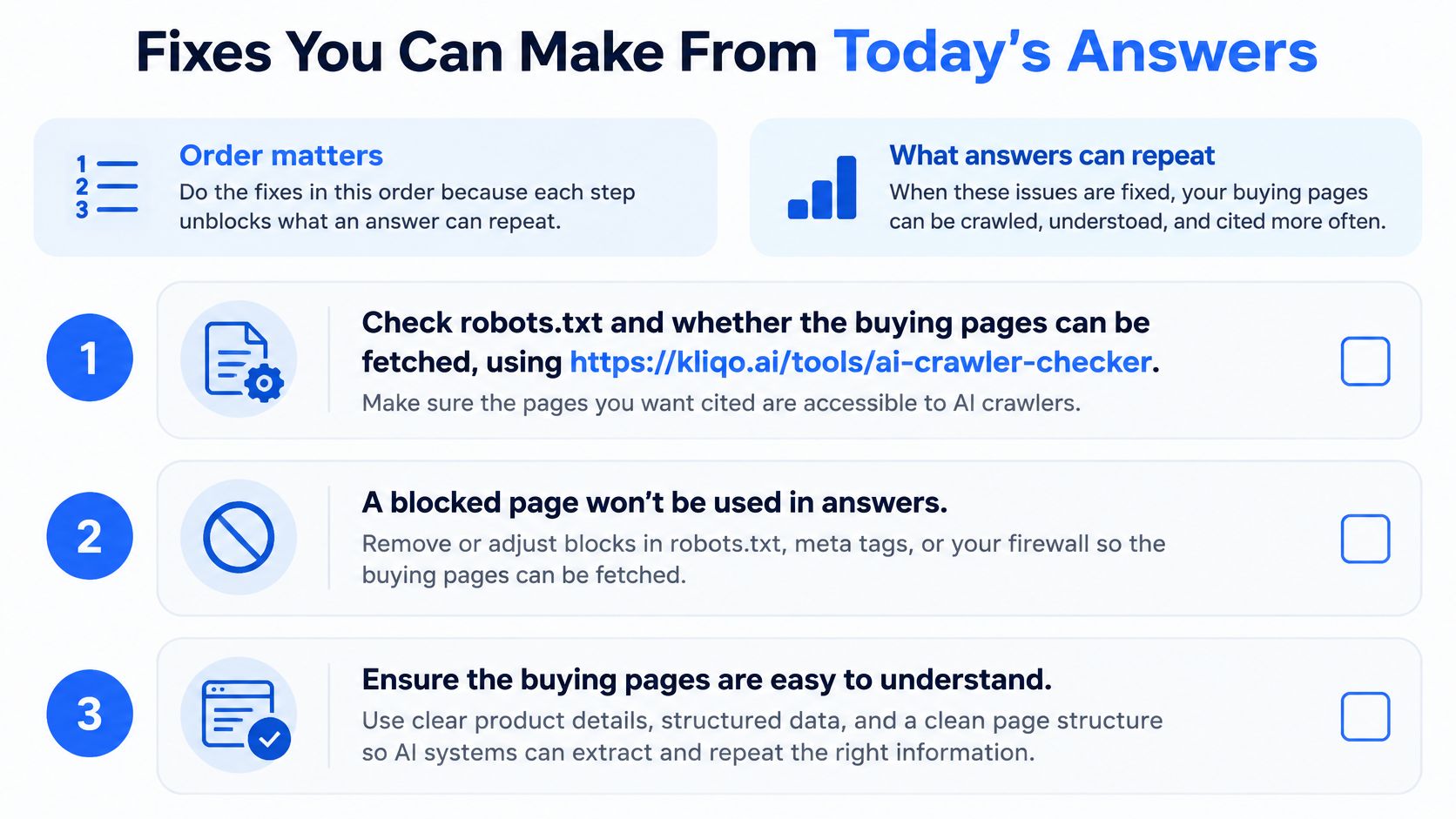
Fixes You Can Make From Today's Answers#
Work in the order that changes what an answer can repeat. A later rewrite won't help if the buying page can't be fetched.
-
Check fetch access. Review robots.txt and test whether pricing and comparison URLs can be fetched with the AI crawler checker. A blocked URL can't correct a stale description. This step should move citations.
-
State the buying facts in plain sentences. Run the important URLs through the AI page audit so each page names the category, who it is for, the price, and the limits. Short factual sentences are easier to quote than a feature grid.
-
Add one fit line. Update a comparison page that says where the product fits against the tools the answers already name. One sentence an assistant can lift is enough. That page is what should change recommendation share and position.
-
Match the lists buyers already meet. Place the product on third-party software lists and review roundups those prompts cite. Keep the name, category, price, and limits identical to the site. A mismatch becomes the criticism quote.
-
Re-measure the same prompts. Track questions that ask which product fits a need. General how-to questions mostly return steps and say little about the brand. Judge a fix on matched before-and-after windows, not on one rerun. Look first for a change in recommendation share and position. A sentiment bump without a citation change is unfinished.
The recommendation workflow ties each fix to the answer that prompted it.
Decide What to Track Before the Next Scan#
Act when recommendation share is visible, position is worse than the rival a buyer would pick, and the cited pages are ones the team can change or earn. Wait when sentiment rests on fewer than three mentions, or recommendation share rests on fewer than five recommending answers.
If the quotes are warm but the cited page lacks price, limits, or a fit sentence, fix that page rather than chasing the sentiment number. If an untracked product keeps taking the pick, add it to the comparison set before judging share of voice.
Compare the same prompts over the next several scans before treating a score as moved. One night is a sample, not a result.
Kliqo tracks ChatGPT, Google AI Overviews, Google AI Mode, Gemini, and Copilot, so the same buyer prompts can be compared from one scan to the next.
FAQ#
Does a high sentiment score mean AI recommends the software?#
No. Sentiment is the description. Recommendation share is the pick, and a warm paragraph can still name a rival first. Read the shortlist before treating the tone as a win.
How many mentions should a team wait for?#
Wait for at least three mentions before reading sentiment or position, and at least five recommending answers before reading recommendation share. Below those counts, leave the cell blank.
Why can ChatGPT and Gemini disagree on the same prompt?#
They retrieve different pages, and they don't repeat the same shortlist on every run. Compare engines on the same question over several nights instead of averaging them into one score.
Should how-to prompts sit in a sentiment panel?#
Only as a side check. Questions that ask which tool fits a team, a budget, or a feature produce the brand names. How-do-I questions mostly give steps and say little about who is recommended.
Which buyer contexts most often create negative wording?#
Small-team versus enterprise fit, missing price or limits, and a competitor set the page never addresses. Read the quote and the citation before treating the dip as a brand problem.
Kliqo AI runs buyer questions across the assistants software customers already use, then separates how a brand is described from whether it is recommended. The scan shows position, cited pages, and the exact quote behind a warm score before a comparison page is rewritten. Compare the next set of buying prompts at Kliqo AI.