Short answer
AI citation tracking records which URLs, domains and brands an AI answer cites or names for a buyer question, by engine and date. It shows where AI answers get their sources, and whether those sources are a vendor's own pages, competitor pages or third-party lists.
On this page
Counting citations and celebrating the total is the popular advice, and it's the wrong place to stop. A cited page can be misread, a brand can be named without a link, and a link can appear in an answer that recommends someone else. Teams get more value when they separate presence, accuracy and demand, then fix one page at a time.
What AI Citation Tracking Records in Each Answer#
Say a buyer asks ChatGPT on a Tuesday for the best help desk for a 5-person team. The answer names four tools, links three pages and recommends one tool first. That single answer already contains several different signals, and treating them as one score hides the useful detail.
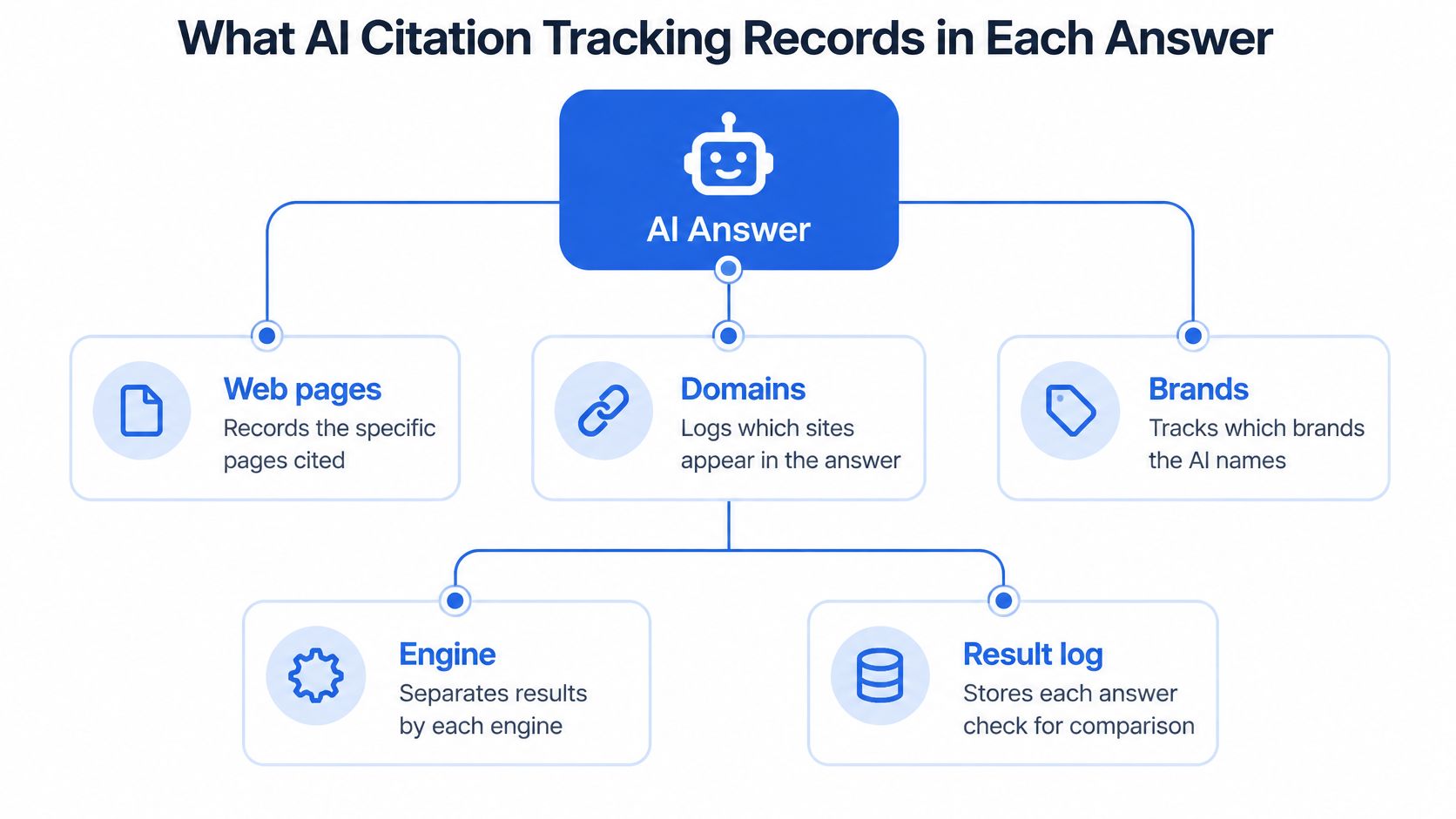
A complete tracking record stores the prompt, engine and date, then saves the full answer text. It also records every brand named, the brand recommended, that brand's position in the list and each cited URL. With those fields, a team can compare the same question next week without relying on a screenshot or memory.
The three layers in one answer#
A brand is mentioned when its name appears in the answer text. That can happen with no link at all, which means the engine knows the name but hasn't used the vendor's page as a source. Mention tracking answers a narrow question about name recognition inside AI answers.
A brand is cited when a link to one of its pages appears as a source. The cited URL matters more than the domain alone, because a comparison page, a pricing page and a help article support very different claims. Recording the exact URL tells a content team which page earned the citation.
A brand is recommended when the answer picks it as the choice, or puts it first with language that directs the buyer toward it. Recommendation is the layer closest to a shortlist decision, so it needs its own label. A tool can be mentioned and cited while another tool gets recommended.
A brand can win one layer and lose the other two, so teams shouldn't merge mentioned, cited and recommended into a single visibility score.
ChatGPT, Google AI Overviews, Google AI Mode, Gemini and Copilot don't read identical sources or present links the same way. A citation on one engine doesn't predict a citation on another, so results stay separated by engine in the log. Blending engines into one average makes a real gap on one surface disappear.
A simple first test takes fifteen minutes. A team picks one buyer question, runs it on each engine buyers use, and writes down the three layers for its own brand and for each competitor named. That one row per engine becomes the starting point for the metrics that follow.
Key Citation Metrics and What Each One Tells You#
The table below is the core lookup for reading a tracking log. Each metric counts something different, answers a different question and fails in a different way. Teams that keep the watch-out column in view avoid the most common misreading, which is treating a link as proof of a recommendation.
| Metric | What it counts | Question it answers | Watch-out |
|---|---|---|---|
| Citation rate | Tracked answers that link to at least one of a brand's URLs | Do AI answers use the brand's pages? | A link isn't a recommendation |
| Mention rate | Tracked answers that name the brand, linked or not | Does the engine name the brand? | Can be high while links stay at zero |
| Recommendation share | Tracked answers that pick the brand as the choice | Do buyers get pointed to the brand? | Needs its own label, separate from mentions |
| Answer position | Where the brand first appears in the list | Is the brand named first or fifth? | Position shifts between runs |
| Citation recall | Answer statements backed by at least one citation | Are the claims supported? | Needs statement-level checks |
| Citation precision | Cited passages that are relevant to the claims | Are the sources on point? | Tangential sources lower it |
| Source share by domain | Cited URLs grouped by domain, for a brand and each competitor | Which sites win the citation? | Domain counts hide the page that earned it |
Citation rate is the number of tracked answers that link to at least one of a brand's URLs, divided by all tracked answers for that engine and prompt set. Mention rate uses the same denominator but counts answers that name the brand, with or without a link. Keeping the denominator identical makes the two rates directly comparable week to week.
The two rates diverge for ordinary reasons. A name can appear with no link when the engine pulls the brand from a third-party list, and a link can appear without the name when the source page doesn't state the brand clearly near the cited text. Neither pattern is an error in the tracking. Each one points to a different fix.
Statement-level measures#
Citation presence alone doesn't show whether sources support what the answer claims. A systematic review of RAG evaluation separates citation recall, the proportion of answer statements supported by at least one citation, from citation precision, the proportion of cited passages that are relevant and necessary for the claims made. The same review treats citation quality, faithfulness and correctness as distinct dimensions rather than one relevance score.
That distinction changes how a long source list should be read. An answer can cite many sources yet show low precision if those sources are tangential, or show high precision while important claims have no support at all. Checking a sample of individual statements against their cited passages catches both problems.
The practical reading order starts simple. A team tracks citation rate and mention rate for the ten buyer questions that matter most, broken out by engine. Once that log is stable, statement-level checks for recall and precision get added on a sample of answers rather than every run.
Set Up Your Citation Baseline This Week#
The goal is a baseline of 20 to 30 buyer questions for one product line, run on the same engines on the same schedule, so later changes are visible. A baseline built on brand-name searches or one-off checks can't show change, because there's nothing consistent to compare against. The steps below produce a sheet a small team can maintain without special tooling.
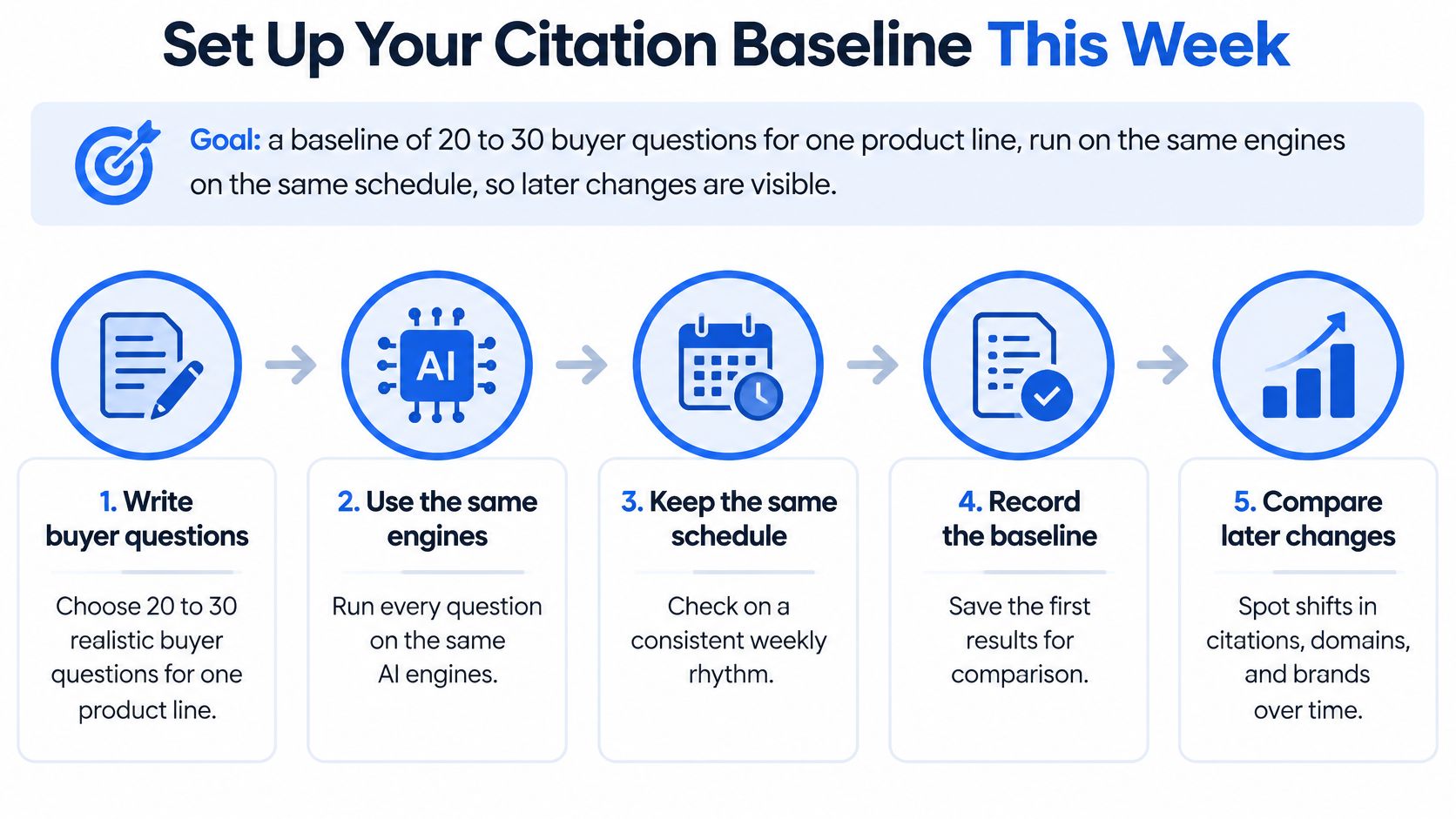
- Write buyer questions from real conversations. Sales calls, support tickets and demo notes supply the wording buyers use, such as best help desk for a small support team. Brand names stay out of most prompts, because a question containing the brand almost guarantees a mention and proves little.
- Choose the engines buyers use. Most software teams start with ChatGPT and Google AI Overviews, then add Google AI Mode, Gemini and Copilot when buyers report using them. Each engine gets its own column or tab so results never blend together.
- Run each question weekly with identical wording. Answers shift between runs, so a fixed schedule turns random variation into a visible pattern. Changing prompt wording mid-baseline starts a new series, and the sheet should say so.
- Record the full answer details. Each run logs the date, the brands named, the recommended brand, its position and every cited URL in a shared sheet. Saving the answer text as well helps, because claims about pricing or integrations often matter more than the ranking.
- Label every cited URL by owner. Each URL gets marked as the team's own domain, a competitor domain, or a third-party list or review site. This label is what turns a log into a work list, since each category needs a different response.
- Check that AI crawlers can read the pages. The check confirms robots.txt doesn't block the pages a team wants cited, the sitemap and key pages load, and key text appears in the HTML without JavaScript. Kliqo AI offers a free AI crawler checker that shows whether ChatGPT, Claude, Perplexity, Google and other AI crawlers can read a site, covering robots.txt health, the sitemap and the homepage without JavaScript, with the exact fix. A blocked comparison page can't earn citations no matter how well it's written.
- Compare after two weeks and pick three gaps. The team lines up the second run against the first and selects three questions where a competitor is cited and its own pages aren't. Those three questions become the first page fixes, which keeps the work list short enough to finish.
For teams working specifically on Google surfaces, a guide to getting cited in Google AI Overviews covers the page-level habits that support citation there. Setting up a tracking project in a tool follows the same logic as the sheet. It means adding the site, checking the brand profile, picking topics and prompts, and choosing the three AI models to track.
End state for week one: one baseline sheet, one row per question and engine, one dated first run and three named gaps to fix.
Where Citation Tracking Falls Short#
Being cited and being right are different events. A citation shows that an answer used a source, not that the answer read the source correctly, quoted it fairly or even linked to a working page. Say a buyer asks an engine for the best expense tools for a 50-person company and the answer cites your pricing page. If that page carries last year's seat limits, the citation still counts as visibility while the buyer reads the wrong number. Teams that skip that check report citation gains and never see the problem.
The gap shows up at scale. A March 2025 Tow Center evaluation ran queries built from publisher content through a set of AI search and chatbot tools and found that most of the answers it checked contained errors. The strongest tool in the group still produced incorrect answers in a large share of cases, the weakest was wrong nearly every time, and in one tool the citations frequently sent readers to error pages.
That pattern sets the floor for what a log has to record. Beyond whether a brand is cited, each logged answer should note:
- Whether the cited URL resolves to a live page.
- Whether the page supports the claim attached to it.
- Whether the answer credits the source to the correct company.
- Whether the claim itself is current, since a cited page can carry outdated pricing or features.
Citation validity and claim-level support belong in the same log as the counts, reviewed on the same schedule. Kliqo, for example, records for each answer which brands it names and recommends, in which position, and which pages it cites, so presence and accuracy can be checked in one view instead of reconciled later.
Run-to-run variation#
The same prompt can name different tools on different days, so one check isn't evidence of anything. Exact prompt wording, the timing of the run and the location or account the engine uses all move the result. A screenshot from a single Tuesday check can send a team rewriting a page that was never the problem.
The reading rule is simple. Compare trends across four to six weeks and several runs per prompt, and never act on a single check.
Tracking also has edges it can't cross. It doesn't reveal the full retrieval path an engine followed or what a model absorbed during training, and no log can explain exactly why one page beat another on a given run. Access problems are at least checkable, and a plain guide to robots.txt for SEO helps a team confirm that blocking rules aren't the hidden cause behind missing citations.
When comparing tracking tools, fairness questions matter more than feature lists. A buyer can ask each vendor how it handles missing answers, whether missing observations appear as missing rather than being converted to zero, and how many runs sit behind each reported rate. Vendors that answer those questions plainly make their numbers easier to trust, and easier to challenge when the numbers move.
Turning Cited Sources into Page Fixes#
A citation and a brand mention solve different problems. A citation works like a footnote: the engine points to the page it used. A mention works like a salesperson naming a product in the aisle. A source can be cited while the brand is absent, and a brand can be named while the answer links somewhere else, so citation rate and mention rate often diverge and need different fixes. The useful review asks which claim each cited page supports, whether the answer names the right product, and whether the wording helps a buyer choose.
Use the log as a lookup table. Find the pattern that appears in your own answers, check the likely cause, then apply the matching fix before moving to the next row.
| Citation problem | Likely cause | Fix |
|---|---|---|
| Competitor page cited for a buyer question | Competitor has a page that answers the question directly | Write a comparison page with the criteria buyers use |
| Brand named but never linked | Answer relies on third-party lists and review sites | Get listed on the lists the answer already cites |
| Brand's pages never cited | AI crawlers blocked, or key text needs JavaScript | Check robots.txt, then confirm the text loads without JavaScript |
| Wrong product claim in the answer | Product page is outdated or unclear | Update the page with the current fact and a visible date |
| Competitor wins a use case the brand serves | No page covers that use case | Publish a use-case page with specific details |
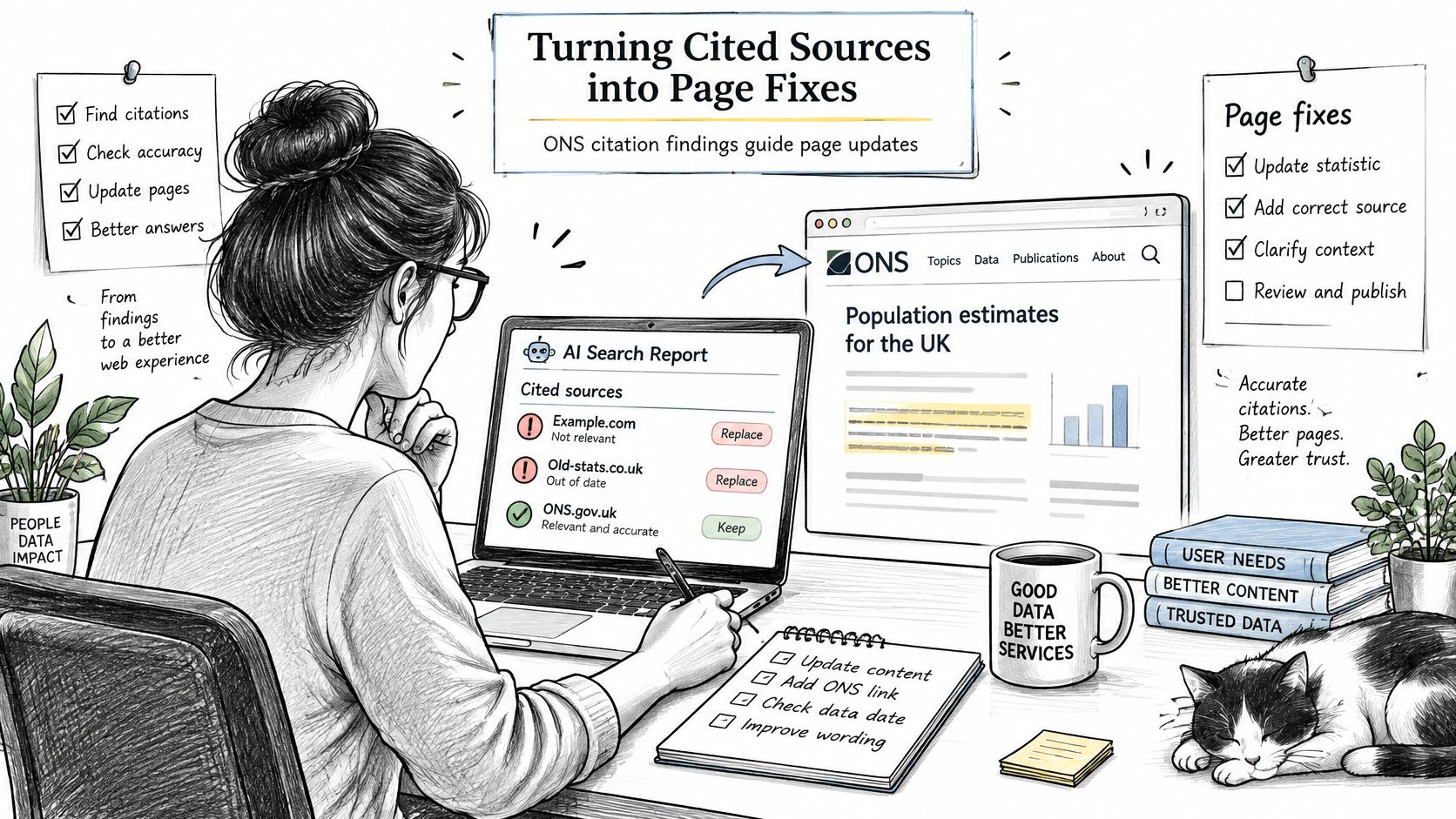
The order follows the gap shown in answers. When a competitor page is cited for a buyer question, write a comparison page that answers that exact question with criteria buyers use, such as team size, integrations and price bands. A structured competitive gap analysis shows which questions competitors win before anyone drafts copy.
When a brand is named but never linked, the answer is leaning on third-party lists and review sites. Getting listed on the specific lists the answer already cites does more than chasing coverage elsewhere, because those domains have already earned the engine's trust for that question. When a brand's pages never appear at all, access comes first. The team confirms robots.txt allows the crawlers it wants and checks that key text is present in the HTML without JavaScript.
Wrong claims need a different response. When an answer states an outdated price or a retired integration, the product page gets updated with the current fact and a visible date, so the next retrieval has something accurate to pull. When a competitor wins a use case the brand genuinely serves, such as help desk software for a team that works across time zones, a dedicated use-case page with specific details gives the engine a citable answer. Kliqo AI records which pages each engine cites in every answer and keeps each suggested fix tied to the answers behind it, so the source list for this review stays ready without manual copying.
Change one page per fix so cause and effect stay readable. After the page goes live, the same prompts run again on the normal schedule, and the team watches that question's citation rate alongside whether the answer names the brand and repeats the corrected claim. If mentions rise while the wrong claim stays, accuracy is the next job.
Judging Whether Citations Drive Demand#
Visibility and traffic can move in opposite directions. Pew's analysis of approximately 900 U.S. adults, covered in Search Engine Land's report on AI Overviews and clicks, found that users clicked a traditional result in only 8% of Google searches containing an AI Overview, compared with 15% without one, and clicks on links inside the summaries occurred in just 1% of visits. A rising citation count can sit next to falling clicks, so the count alone doesn't prove demand.
The counter-finding keeps the picture honest. The same report describes an analysis of more than 3,100 queries from June 2024 through September 2025 in which cited sites had 35% higher organic CTR and 91% higher paid CTR, even while AI Overviews were associated with large overall CTR declines. Both results point the same way. Attribution is the open question, not whether citations appear.
Connecting citations to demand signals#
- AI referral sessions. Analytics gets a report that shows sessions arriving from AI assistants, broken out by landing page, so cited URLs can be matched against actual visits.
- Branded search movement. After a cited page is updated, the team watches branded searches for the product name across the next 14 to 28 days.
- Demo form answers. A "where did the buyer first hear about the product" field with an AI assistant option gives direct, if imperfect, evidence.
Say a help desk vendor's comparison page is cited for best help desk for a small team. After the page is updated with current pricing and a clearer criteria table, the team checks whether visits landing on that page and branded searches rise over the following month. If neither moves, the citation is validating an answer buyers read without clicking, which is worth knowing rather than celebrating.
A less-cited page on the buying path can matter more than a widely cited glossary page. Fewer, highly relevant citations on comparison and use-case questions often sit closer to a demo request than broad citation volume on definitional prompts. If running and logging these checks by hand is too much, Kliqo AI tracks ChatGPT, Google AI Overviews, Google AI Mode, Gemini and Copilot.
FAQ#
Is AI citation tracking the same as AI rank tracking#
No. Rank tracking records a page's position in traditional search results, while AI citation tracking records which sources and brands an AI answer uses. A page can rank well and never be cited, or be cited often while ranking modestly, so the two logs answer different questions.
How many prompts should a team track#
20 to 30 buyer questions is enough to start for one product line. The set should grow only after the first baseline is stable across several weekly runs. Adding prompts before the baseline settles makes week-to-week comparisons hard to read.
Do I need to change robots.txt to get cited#
Only when the file blocks AI crawlers that a team wants reading its pages. Many sites need no change at all, which is why checking comes before editing. A quick access check shows whether blocking is the problem or whether the gap sits in the content itself.
How often should I check AI citations#
At least weekly for a baseline that a team plans to act on. One run can differ sharply from the next, so weekly checks on the same prompts and engines turn noise into a trend. Daily checking adds effort without adding much signal at small prompt volumes.
Can citation tracking prove revenue#
Not on its own. Citation data shows where answers get their sources, and revenue proof needs those cited URLs paired with referral visits, branded search movement and demo form answers. Teams that connect all four can say which citations sit near real buying activity, and which ones only decorate an answer.
Teams that want the weekly runs, cited-source lists and before-and-after checks handled in one place can see how Kliqo AI tracks buyer questions across ChatGPT, Google AI Overviews, Google AI Mode, Gemini and Copilot. A short trial on a single product line is enough to build the first baseline and spot the first three citation gaps worth fixing.