Short answer
Competitive gap analysis compares a product with named rivals on the same buyer questions and measures, then ranks the shortfalls a team can address. For SaaS visibility, it separates whether AI answers mention, recommend, position, or cite a brand from whether crawlers can access its pages, without treating a higher position as revenue.
On this page
Score the Gaps Buyers Actually See#
In 2024, 65% of sales opportunities were competitive for the average B2B software company, according to publisher Crayon's State of Competitive Intelligence report. A SaaS team needs more than a count of brand mentions to understand how its product compares when buyers ask for recommendations.
Competitive gap scorecard for AI buying answers
| Gap | What to count | Buyer effect | Check today |
|---|---|---|---|
| Visibility | Share of answers that name the brand | Buyer may never encounter the product | Count named versus not named |
| Recommendation | Share of tool-suggesting answers that explicitly pick the brand | Buyer receives a shortlist favorite | Separate mentioned from recommended |
| Position | Place in the list when the brand is named | Later placement may receive less attention | Record first, second, third, or later |
| Sentiment | Praise, criticism, and repeated claims | A mention can discourage a purchase | Log praise, criticism, and wrong claims |
| Citations | Domains and URLs the answer used | Cited evidence may support the pick | List brand URLs versus competitor URLs |
| Crawl access | Whether relevant crawlers can fetch key pages | An inaccessible page may be unavailable as evidence | Check robots.txt and the live URL |
Visibility means being named, even in a passing reference. Recommendation share means being explicitly chosen or endorsed within answers that suggest tools. An answer can name a product while recommending a rival, so those events need different columns.
Position records list order, not buyer preference by itself. Sentiment records praise, criticism, and recurring claims, including negative statements attached to otherwise prominent mentions. A separate review of brand sentiment in AI answers helps prevent positive exposure and harmful exposure from being combined.
Citations identify the domains and URLs shown as supporting evidence. Crawl access checks whether relevant bots can retrieve the pages that explain the product. Neither a citation nor successful access guarantees a recommendation.
Keep the comparison fair#
The team should use a shared prompt list during the same week across ChatGPT, Google AI Overviews, Google AI Mode, Gemini, and Copilot. Results should remain separated by engine before any aggregate is calculated.
Measurement rule: A failed request is missing evidence, not evidence that a brand lost.
A missing answer should leave its scoring fields blank, with a separate failed status. A completed answer that doesn't name the brand can count as an observed absence. That distinction protects the scorecard from technical failures disguised as competitive losses.
The practical output is a set of specific questions: which prompts produce losses, which evidence accompanies those losses, and which change deserves attention first.
What a Competitive Gap Analysis Measures#
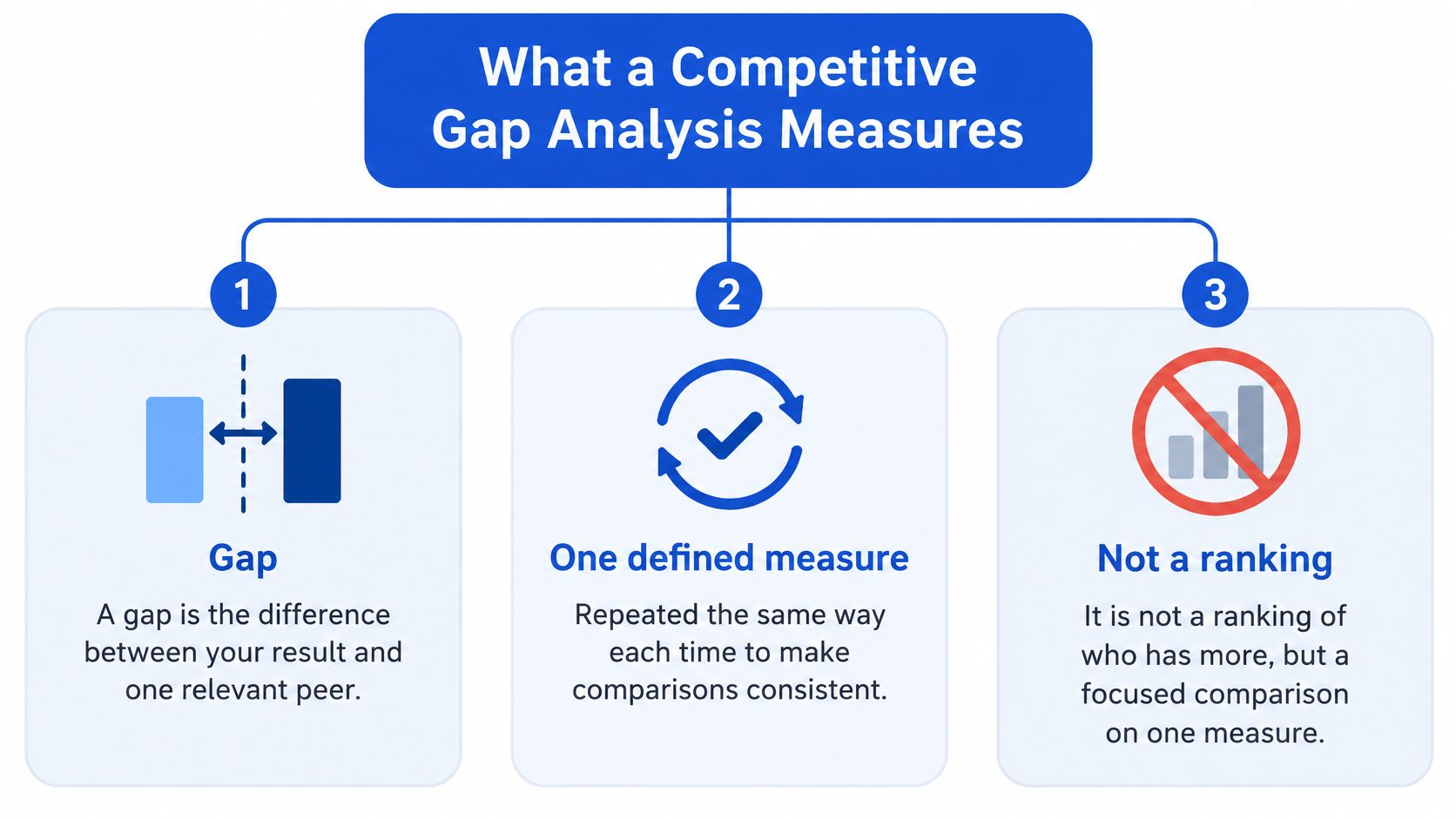
A competitive gap is the difference between a brand's result and a relevant peer's result on a defined measure. Repeating the comparison under consistent conditions makes the difference useful. A feature inventory or an isolated chat screenshot doesn't establish that pattern.
Say a founder asks an assistant for a help desk suited to a five-person SaaS team. The answer names several products, recommends a particular option, and omits another relevant product. That absence is a clue, but repeated observations are needed to establish whether it persists.
Define the comparison before collecting answers#
A useful analysis follows these rules:
- Choose realistic peers. Compare products a buyer could shortlist for the same use case, budget constraints, and implementation needs.
- Control the conditions. Keep the prompt, country setting, engine, and collection period consistent across brands.
- Preserve the evidence. Retain answer text and cited URLs rather than replacing them with an unexplained blended score.
The help desk example could reveal different problems. The assistant might misunderstand the product's target customer, cite an outdated comparison, or recommend a rival with a better fit. Those explanations require different actions.
The benchmarking principle has a long history: in 1979, Xerox's Fuji-Xerox division compared products and manufacturing economics with Japanese competitors, an episode described in a historical review of benchmarking. The useful logic remains measure, compare, quantify, and act.
For SaaS teams, AI search analytics should preserve that connection between a measured difference and its supporting observation. A high-level score can help summarize performance, but the underlying answer determines whether the team needs better evidence, a technical correction, or a product change.
How to Compare Brands on the Same Questions#
A repeatable collection routine matters more than an elaborate dashboard. A spreadsheet can support an initial analysis if each row represents a recorded answer and the team keeps its scoring rules consistent.
Build a repeatable collection routine#
-
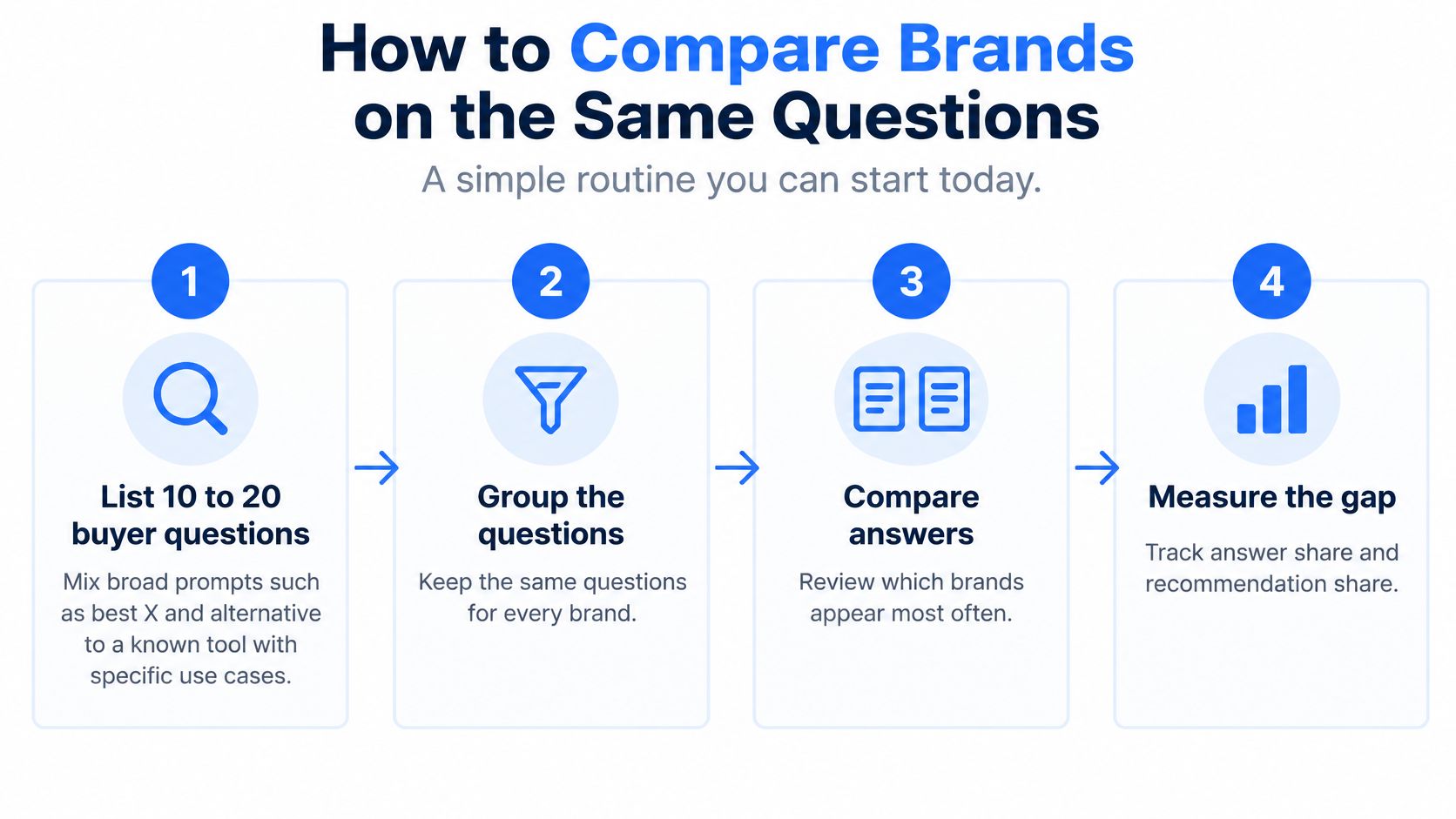
Collect buyer questions. Start with language from sales calls, support conversations, and lost-deal notes. Include broad category searches, alternatives to known products, and specific requirements such as a help desk for a small SaaS team or a CRM with a particular integration. Keep discovery questions separate from detailed product-verification questions.
-
Define the competitor set. Include rivals already appearing in buyer shortlists. Record additional brands that assistants repeatedly name, but review whether they compete before adding them. A review site, general-purpose assistant, or adjacent product shouldn't automatically become a competitor.
-
Standardize the testing conditions. Use the same question text across the selected engines, in English, with fresh conversations and logged-out sessions where available. Keep country settings aligned with the target market and record any setting that can't be controlled. A search experience that produces no AI answer should be logged as such, not converted into a brand loss.
-
Read and code each completed answer. Record the engine, timestamp, prompt, named brands, explicit recommendations, position, sentiment, and cited URLs. Preserve the full response. A recommendation should require clear endorsement, not merely inclusion in a list of options.
-
Repeat before interpreting. Run the same set again rather than assuming the initial favorite is stable. Kliqo's published software-recommendation study provides a relevant reference for examining recommendation consistency. The team's own repeated answers should determine whether a suspected gap persists across its category and testing conditions.
-
Calculate rates from completed observations. Divide brand appearances by completed answers for visibility. For recommendation share, use completed answers that suggest tools. Report completed and failed observations separately so a partial collection doesn't look like a complete result.
Keep denominators visible#
An answer can complete successfully without suggesting software. It belongs in the visibility denominator, but it shouldn't automatically enter a metric specifically defined around tool-suggesting answers.
Similarly, a completed answer without visible citations isn't necessarily a failed answer. Its citation field should distinguish no citation shown from citation capture failed.
A rate is only interpretable when the reader knows which answers qualified for its denominator.
The analyst should write those eligibility rules into the spreadsheet before calculating results. Otherwise, a change in scoring can look like a change in brand performance.
Comparison windows also need a stable tracked brand list. If competitors are added or removed, the team should establish a new baseline rather than presenting the windows as directly comparable.
Find Citation and Content Gaps#
A chatbot answer can discourage a purchase as readily as it can support one. A 2026 consumer survey reported by HubSpot found that 57.5% of U.S. AI users had decided not to buy something because of chatbot information, while 57.51% had bought something based on a chatbot recommendation. These are separate reported behaviors, not opposing shares of a single purchase decision.
For a SaaS marketer, that distinction broadens the investigation. A lost recommendation may reflect missing evidence, but a harmful claim may require correction before more visibility would help.
Why an AI answer favored a competitor
| What appears | Likely evidence to investigate | What to record | First fix to test |
|---|---|---|---|
| Rival recommended, tracked brand absent | A cited best-of list or comparison omits the brand | Winning URL and list | Seek an eligible listing or publish the missing comparison |
| Brand named, rival recommended | Rival page states a clearer use-case fit | Both URLs and the repeated wording | Clarify the product-fit sentence |
| Wrong limit or price | Facts differ across pages and listings | Incorrect claim and authoritative fact | Align name, price, limits, and dates |
| Brand page never cited | Crawler restrictions or retrieval problems | Bot rule and fetch result | Correct unintended access barriers and retest |
| Criticism repeats | Reviews or old documentation contradict current capabilities | Exact claim and supporting source | Correct the source or explain the current product accurately |
| Only one engine prefers the rival | Engines cite different domains | Engine, country, and prompt | Keep the finding engine-specific |
These are diagnostic hypotheses, not proof of how a model reached its answer. A cited page establishes visible evidence; it doesn't reveal every influence on the recommendation.
Test access before rewriting content#
The technical and editorial checks should follow a practical order:
- Inspect robots.txt. Confirm that intended crawler access isn't blocked. An AI crawler checker can support that review without replacing a review of the actual rules.
- Fetch the exact page. Check the URL an assistant would need, including redirects, authentication barriers, response errors, and readable content. An AI page audit can help identify page-level issues.
- State the fit clearly. Publish or tighten a comparison page with a factual sentence describing the customer, task, and relevant limitation.
- Pursue relevant third-party coverage. Seek inclusion on cited lists where the product meets the publisher's criteria, without asking for unsupported rankings.
- Align product facts. Keep the name, category, price, limits, and update dates consistent across authoritative pages and maintained listings.
A focused review of getting cited in Google AI Overviews can support engine-specific diagnosis. Engines, countries, and prompt types can disagree, so an average shouldn't be presented as a global winner.
A Worked Software Recommendation Gap#
Use a practice table to see why two percentages can move in opposite directions. Suppose a team tracks its own product against five familiar writing tools and records two rates on the same buyer prompts: visibility, the share of completed answers that name the brand, and recommended, the share of tool-suggesting answers that explicitly prefer it.
Illustrative visibility versus recommendation worksheet
| Brand | Visibility | Recommended | What the split means |
|---|---|---|---|
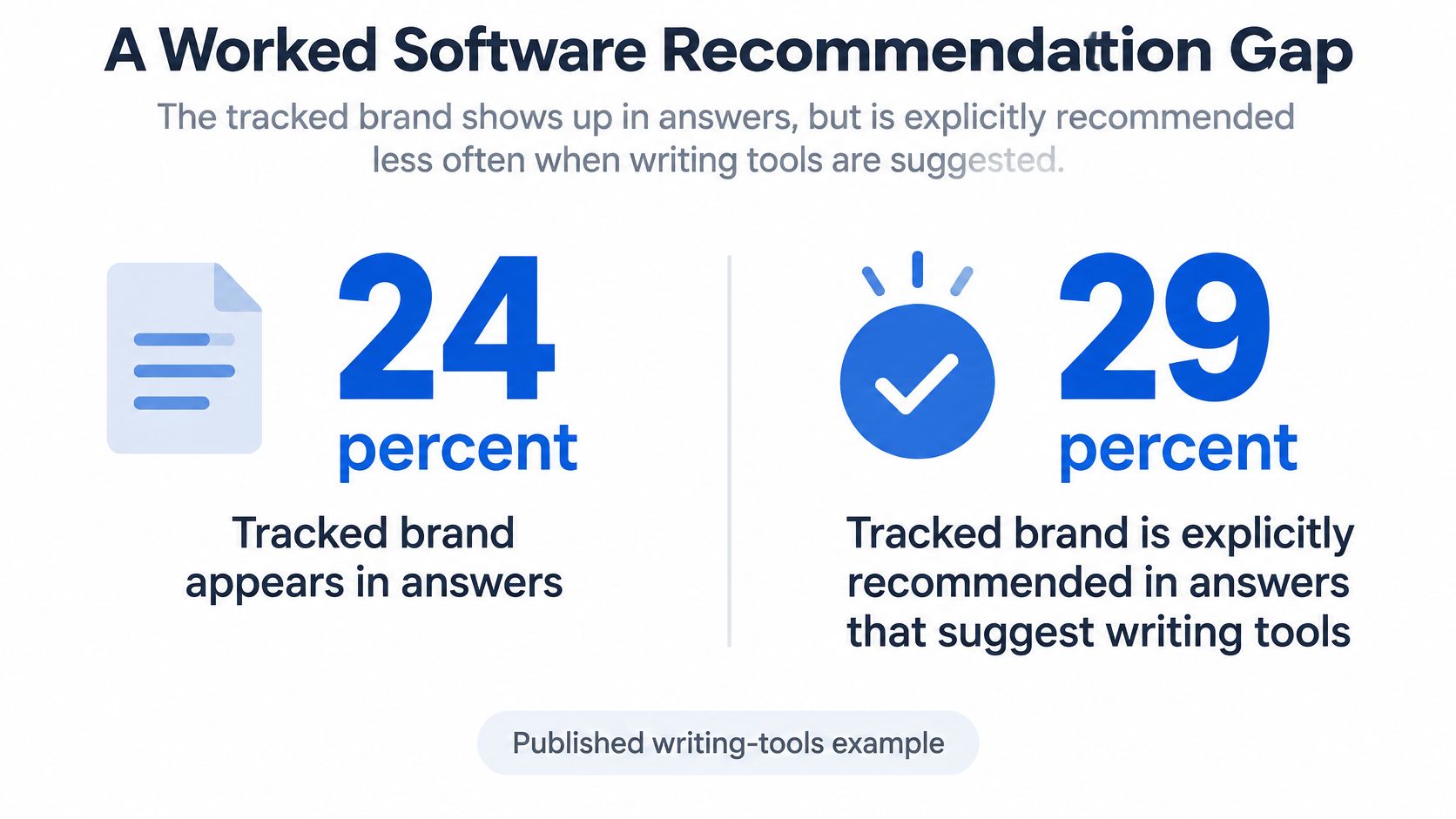
| Tracked brand | 24% | 29% | Higher recommendation rate within tool-suggesting answers |
| QuillBot | 31% | 34% | Leads both measures in this worksheet |
| Grammarly | 22% | 18% | Mention rate exceeds recommendation rate |
| Wordtune | 12% | 9% | Smaller shares on both measures |
| Jasper | 9% | 6% | Naming and explicit selection remain distinct |
| Copy.ai | 7% | 4% | Naming and explicit selection remain distinct |
Interpret the split without overstating it#
A lead on both measures points to a share gap rather than disappearance. In this worksheet, QuillBot sits above the tracked brand on visibility and recommendation, so the next useful question is which buyer intents account for that difference.
A brand can be named often and preferred less often. The Grammarly row shows why counting every appearance as an endorsement would overstate buyer preference. The team needs the answer text to separate a neutral option, a comparison reference, and a favored choice.
The tracked brand's 29% uses a narrower denominator than its 24%. Only answers that suggest tools are eligible for the recommendation rate, while all completed answers are eligible for visibility. The narrower set can produce a larger percentage even when fewer total answers name the brand.
Interpretation check: Percentages with different denominators shouldn't be subtracted to estimate conversion from mention to recommendation.
A category-level table also can't establish whether any product is objectively better. A tool may fit one workflow and fit another poorly, so prompt-level evidence matters more than an unqualified league table. Treat a higher rank as a lead to test; pipeline needs its own proof.
Adapt the example to another SaaS category#
A marketing team can create a row for each tracked brand and keep visibility and recommendation rates separate. Alongside the table, the analyst should maintain a loss log containing the prompt intent, winning rival, answer text, and completed-answer counts. Count completed answers only, and record failed prompts separately so both denominators stay clean.
For a project-management product, that log might distinguish general category questions from questions about agency workflows or developer issue tracking. Those groups suggest different editorial or product decisions.
The table identifies where attention is needed. The loss log determines what the team can reasonably change.
Turn Evidence into a Fix Order#
A long list of gaps isn't an action plan. The team should rank each candidate against buyer relevance, the kind of loss, the strength of the supporting evidence, and the effort required to test a correction.
Choose a defensible next action#
The strongest candidates satisfy these tests:
- Buyer relevance. Sales conversations, search information, or customer interviews show that the prompt reflects a real evaluation need.
- Recommendation loss. The rival receives an explicit preference, not merely an incidental mention.
- Traceable evidence. A particular URL or repeated factual claim gives the team a concrete hypothesis.
- Practical delivery. An accountable owner can ship a focused correction this week.
Work should proceed from access problems to relevant cited coverage, clear comparison content, and factual consistency. The team should apply the matching diagnostic check rather than rewrite every page at once.
For each completed action, a useful operating method compares the 14 days before with the 14 days after, using the same prompts and engines. The result is after rate minus before rate, expressed in percentage points. Windows with changed tracked brand lists shouldn't be treated as matched comparisons.
Separate answer movement from business impact#
McKinsey's shopping research, as reported by The Economic Times, covered approximately 21,000 consumers in 11 markets and found that 81% said AI helped narrow choices. That supports measuring shortlist influence, but it doesn't establish that an improved answer causes SaaS revenue.
A buyer may verify an AI suggestion through search, visit a comparison page, consult colleagues, or abandon the evaluation. The analyst should therefore pair answer changes with referral traffic, branded-search patterns, assisted conversions, and pipeline notes.
A before-and-after improvement also isn't a controlled causal result. Model changes, competitor updates, and unrelated marketing activity can affect the same period. The report should state what changed, what evidence supports the interpretation, and what remains uncertain.
A higher AI position is not revenue. The business question is whether qualified buyers progress further, not whether a dashboard becomes more favorable.
FAQ#
What is competitive gap analysis in one sentence?#
Competitive gap analysis is a repeated comparison of a brand and relevant rivals on consistent measures, used to choose an evidence-backed improvement. For AI visibility, its value comes from connecting an observed loss to a testable action.
How is it different from a feature comparison?#
A feature comparison describes product capabilities. An AI-focused gap analysis records what assistants say, recommend, and cite when buyers ask questions. A missing capability may explain a loss, but unclear documentation or outdated third-party evidence may also explain it.
How many runs are needed before a gap is real?#
A single answer is a clue, so the collection routine should be repeated under matched conditions until the team can distinguish recurring losses from isolated changes.
Should a mention count as a recommendation?#
No. A mention establishes presence, while a recommendation requires explicit preference or endorsement. The scoring rules should also distinguish neutral references from criticism so that additional exposure isn't automatically reported as improvement.
How often should teams rerun the questions?#
Teams should use a consistent schedule that fits their decision cycle and preserve the original prompt set while evaluating changes. Failed observations should remain visible, and matched reporting windows should retain the same tracked competitors.
Kliqo AI tracks buyer prompts across ChatGPT, Google AI Overviews, Google AI Mode, Gemini, and Copilot, keeping competitive gaps connected to the answers and sources behind them. Teams ready to monitor these comparisons can visit Kliqo AI and start with the buyer questions already appearing in their sales conversations.