Short answer
AI brand monitoring tools track whether assistants mention, cite, or recommend a brand, a meaningful distinction when 89% of unbranded prompts were fulfilled by third-party sources in the citation analysis described by Bain. The strongest choice combines recurring buyer-question monitoring with cited-source research, competitor comparisons, and reporting that helps teams decide what to fix.
On this page
A single answer isn't a dependable baseline. Repeated measurements help distinguish persistent recommendation gaps from changes between runs, the issue examined on this ChatGPT software recommendations research page.
Teams comparing platforms should evaluate engine coverage, recommendations versus mentions, cited URLs, before-and-after reporting, and collaboration. The AI visibility tools comparison offers another starting point, but a practical evaluation should use the company's own software-buying questions rather than a vendor's sample dashboard.
1. Kliqo AI#
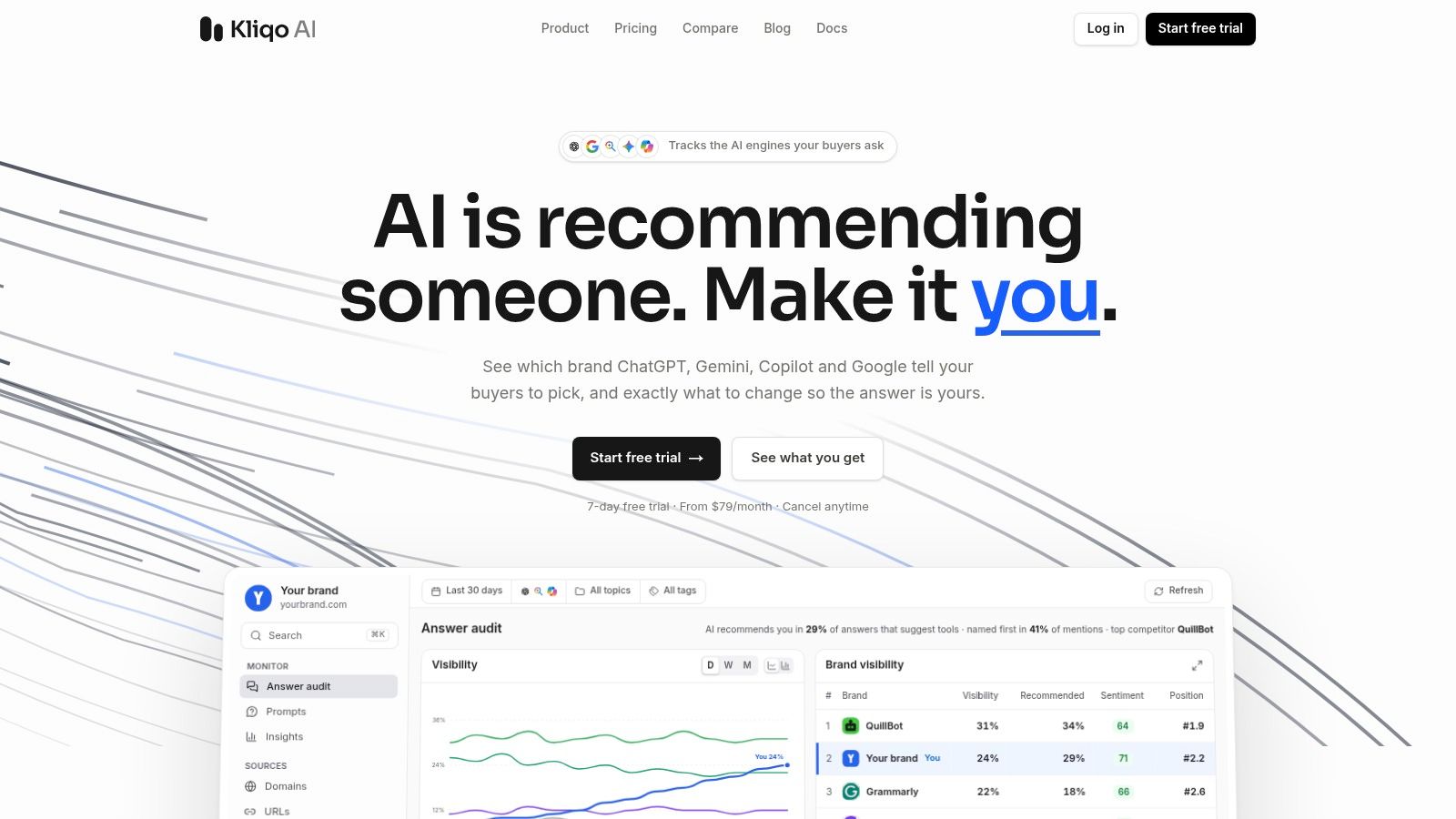
Best fit for teams connecting monitoring to corrective work. A category prompt that names a competitor instead of your brand becomes a concrete task here: Kliqo AI records which brands each answer names and recommends, in which position, and which pages it cites. It runs selected buying questions nightly across ChatGPT, Google AI Overviews, Google AI Mode, Gemini, and Copilot.
That answer-level record is what separates investigation from a visibility score. Teams can trace which domains and URLs support competing recommendations, check flagged claims against the brand profile, and move fixes through an action board with statuses. A 90-day trend chart tracks the share of AI answers recommending the brand against the top competitor.
- Monitoring and research: Recommendation share, position, sentiment, and cited pages per answer support competitor gap analysis and source opportunities.
- Reporting and collaboration: Every plan includes CSV exports and unlimited members, with owner, administrator, editor, and viewer roles.
- Impact assessment: A 14-day before-and-after view compares matched windows around completed work, useful evidence without claiming a visibility change proves causation.
Published pricing runs $79, $199 and $449 per month for Starter, Growth and Pro, with a seven-day trial requiring a payment card. Plans differ in prompt and project allowances. Each project includes three AI engines, and additional engines are available for a monthly fee.
Trade-off: Entry plans force prioritization of which prompts to track. Treat the published workflow as evaluation material, then confirm fit against your own buying questions rather than a sample dashboard.
2. Profound#
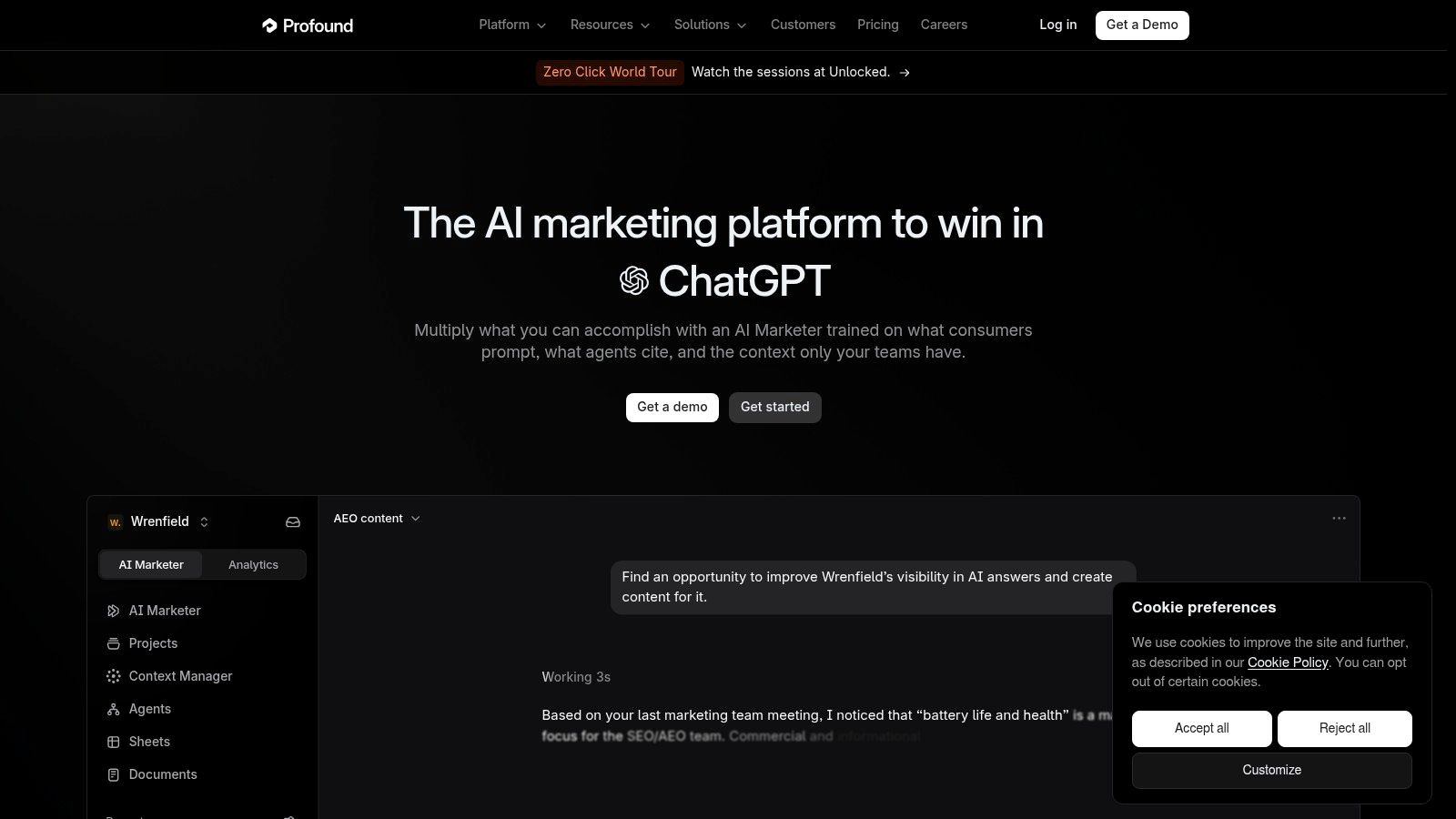
Profound suits teams that want AI visibility monitoring alongside content optimization, with enterprise options for broader brand programs. Engine coverage depends on the plan, so the product name alone doesn't establish whether a subscription covers the company's buying journey.
For a SaaS marketing team, the useful evaluation is whether a losing category prompt can become an actionable content assignment. Monitoring identifies the gap; the content workflow determines whether the team can address it without moving evidence between disconnected systems.
Evaluation rule: A citation report should expose the underlying page, not merely count the publisher's domain.
The distinction matters when evaluating AI citation tracking: a documentation citation and a recommendation-list citation support different actions.
Strength: Monitoring and content capabilities can fit a shared marketing workflow. Trade-off: Entry-level coverage is narrower than broader plans, and annual-billing terms and plan-dependent capabilities deserve attention before purchase.
3. Peec AI#
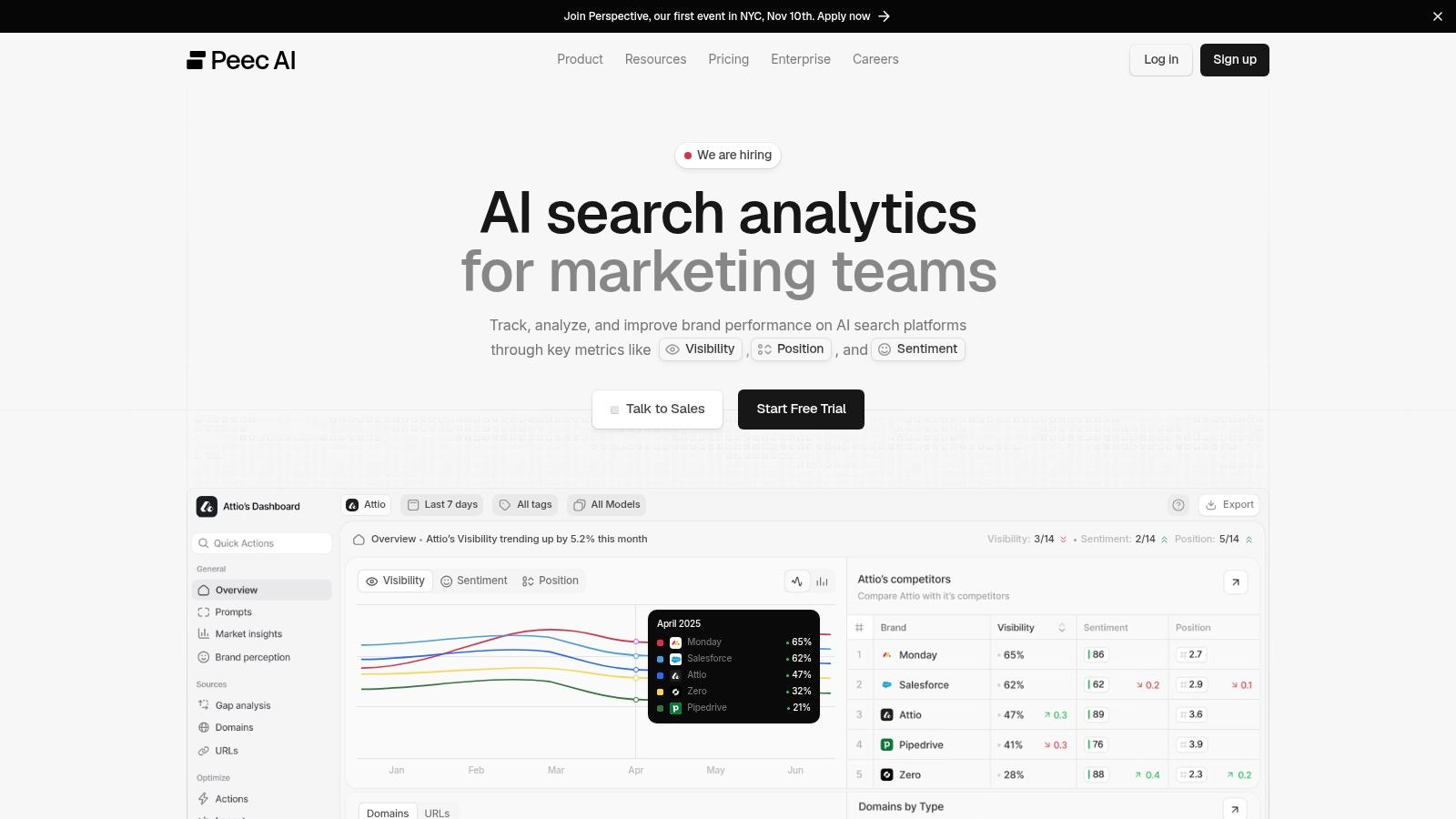
A marketing analyst who already has writers and developers may need better evidence, not another content generator. Peec AI fits that monitoring-first workflow, emphasizing recurring prompts, brand visibility, position, competitors, and cited sources.
Its project and location options matter for SaaS companies selling into different markets. A software recommendation for a domestic buyer shouldn't automatically be treated as evidence of visibility in another country.
- Research fit: Investigate which sources appear alongside competing brands.
- Reporting fit: CSV exports support further analysis, while eligible tiers offer additional reporting and integration options.
- Collaboration fit: Published brand plans include unlimited users.
Trade-off: Prompt, project, and model allowances constrain the entry plans. Additional models and integrations can require an upgrade or add-on, so the evaluation should use the intended configuration.
Peec is a sensible shortlist candidate when the team wants focused analytics and already has a separate process for publishing, outreach, and technical fixes.
4. Otterly.AI#
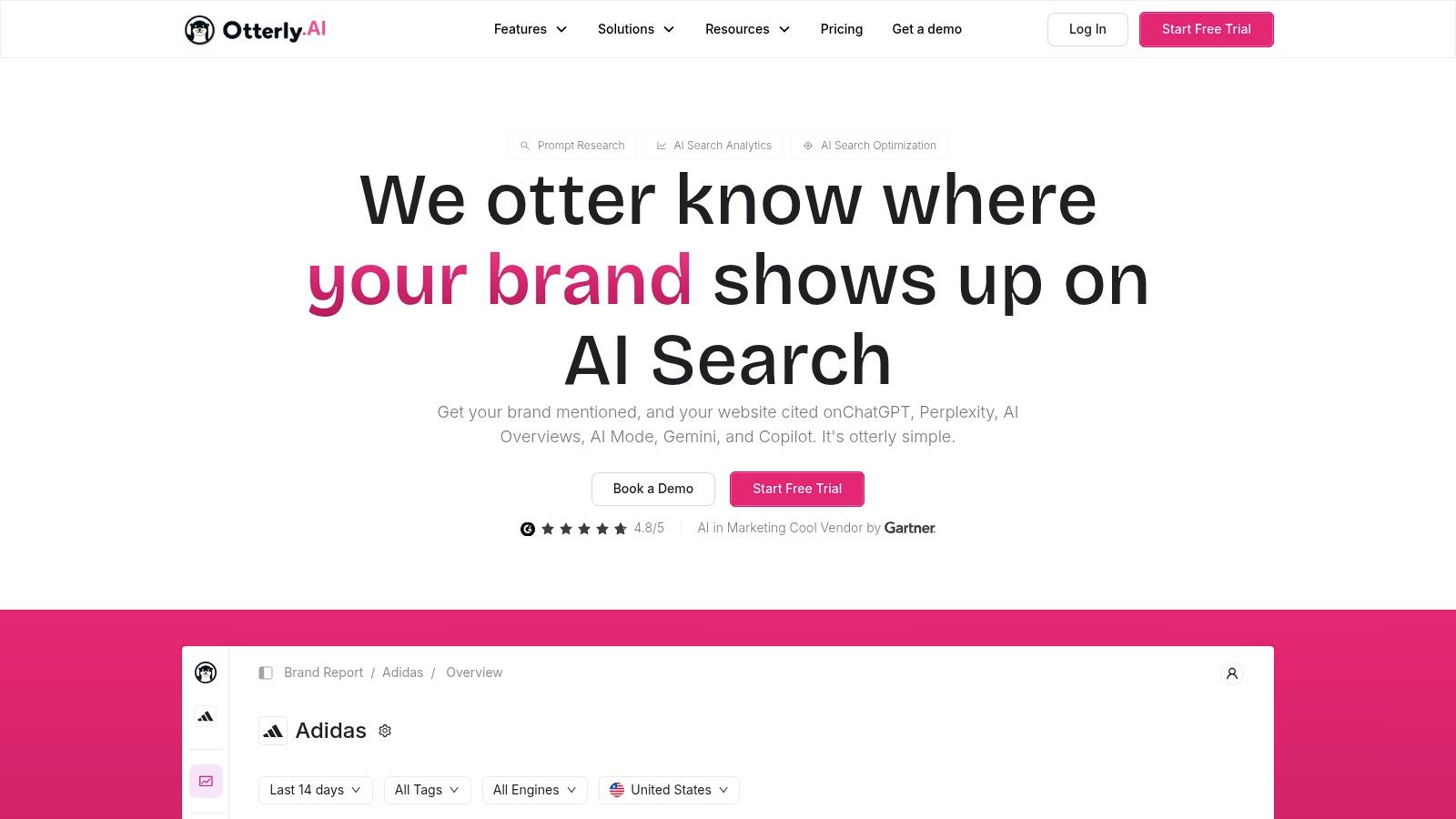
A narrow monitoring program can be useful. Otterly.AI is a self-serve option for marketers, small teams, and agencies tracking selected prompts, brand visibility, sentiment, and citation sources.
The practical starting point is a tightly defined SaaS buying journey: category discovery, alternatives, and a direct product comparison. That gives daily checks a coherent purpose instead of filling the account with loosely related questions.
Its optimization recommendations and brand profiling add context to the monitoring. Teams establishing their process can also use this guide to tracking brand mentions in ChatGPT, while keeping mentions separate from favorable recommendations.
- Works well for: A manageable prompt set with regular citation review.
- Watch closely: Entry-plan prompt allowances and engine add-ons.
- Reporting consideration: Advanced access and agent analytics depend on the subscription.
The trade-off is scope. A compact plan can support a focused pilot, but it shouldn't be mistaken for broad coverage across products, regions, and buyer personas.
5. AthenaHQ#
AthenaHQ is worth evaluating when the immediate question is what should the team change? Its workflow combines visibility monitoring with prompt, answer, source, competitor, and sentiment analysis, plus content recommendations and optimization capabilities.
For a SaaS company missing from security-focused buying questions, the useful output is not just a low visibility score. The team needs to distinguish incomplete product evidence, weak third-party coverage, and technical access problems before commissioning more content.
A recommended action is useful only when an analyst can inspect the answer and source behind it.
Strength: Source and competitor analysis can support a more actionable investigation than mention counting alone. Trade-off: Credit-based usage requires a workload estimate, while advanced regional support and enterprise controls depend on the plan.
The free option offers a way to explore the interface. A serious evaluation should still test the intended prompt volume, engine coverage, and handoff from analysis to content or technical owners.
6. Semrush AI Visibility Toolkit#
Semrush AI Visibility Toolkit fits companies that want AI-answer monitoring close to existing SEO research and site-audit work. It combines custom prompt tracking, brand and competitor analysis, prompt research, and AI-readiness checks.
That connection is practical when the same SEO team owns both discovery and implementation. A cited-source gap may require a comparison page, while an access problem belongs in the technical backlog.
- Monitoring: Tracks prompts and mentions across supported services, including ChatGPT, Google AI, Gemini, and Perplexity.
- Investigation: Connects visibility questions with competitor research and site auditing.
- Reporting workflow: Offers a broader platform context for teams already working in Semrush.
Trade-off: Domain and tracked-prompt allowances matter, and expanding coverage costs extra. The relevant comparison isn't the subscription price; it's whether the combined workflow reduces duplicate analysis.
A team seeking only high-volume buyer-prompt monitoring should compare dedicated trackers before choosing a broader SEO environment.
7. Ahrefs Brand Radar#
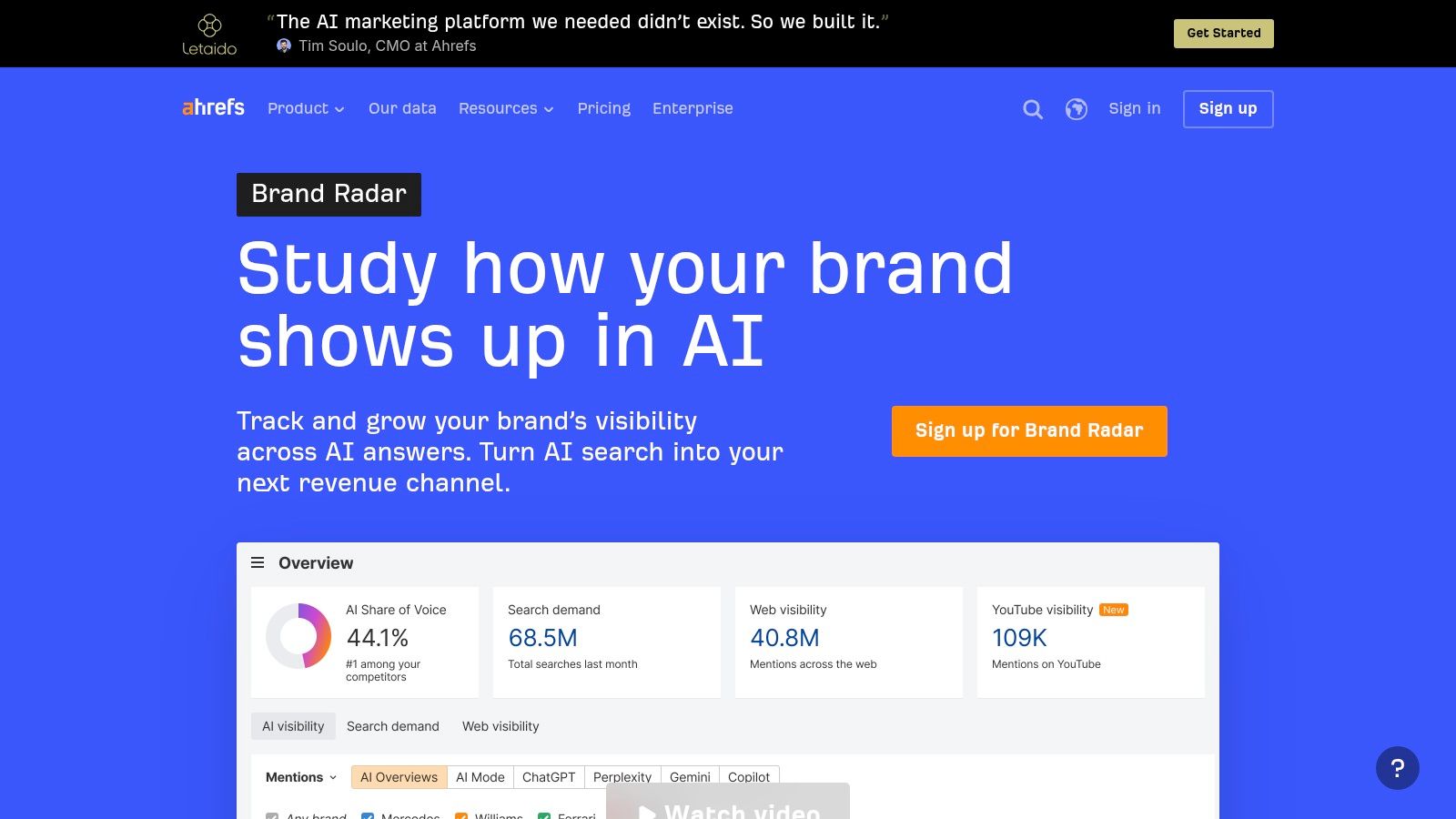
Discovery and recurring monitoring answer different questions. Ahrefs Brand Radar combines broad AI visibility research with custom prompt checks, making it relevant to teams investigating category-level brand mentions and citations.
Broad discovery can reveal software-buying topics that the marketing team hasn't considered. Custom tracking then provides a more deliberate view of the questions the company chooses to monitor repeatedly.
Where it fits#
The strongest fit is an SEO team already using Ahrefs for search and content research. Analysts can investigate cited pages and domains alongside other search opportunities rather than treating AI visibility as an isolated channel.
Trade-off: Index access, custom checks, and base-plan requirements can make budgeting less straightforward. A large discovery dataset also shouldn't be presented internally as though it were a controlled panel of the company's selected buyer questions.
During evaluation, reporting should clearly distinguish exploratory findings from repeated measurements.
8. Scrunch#
When the problem includes how AI systems access the website, Scrunch deserves consideration. It combines answer-level visibility monitoring with AI bot traffic, referral analysis, technical checks, and agent-facing optimization workflows.
This suits a software company whose content and engineering teams share responsibility for discovery. Analysts can investigate mentions, position, sentiment, share of voice, and citations while technical owners examine access and content-consumption issues.
- Strength: Connects answer monitoring with technical diagnosis.
- Agency fit: Offers arrangements for multi-client programs.
- Limitation: It isn't a general-purpose content-generation product.
The important distinction is between a crawler visit and a recommendation. Bot activity can help diagnose access, but it doesn't establish that an assistant recommended the product.
Scrunch's broader diagnosis workflow may justify evaluation for technically complex sites. Teams needing only a small recurring prompt panel should weigh that breadth against implementation effort and packaging.
9. Rankscale#
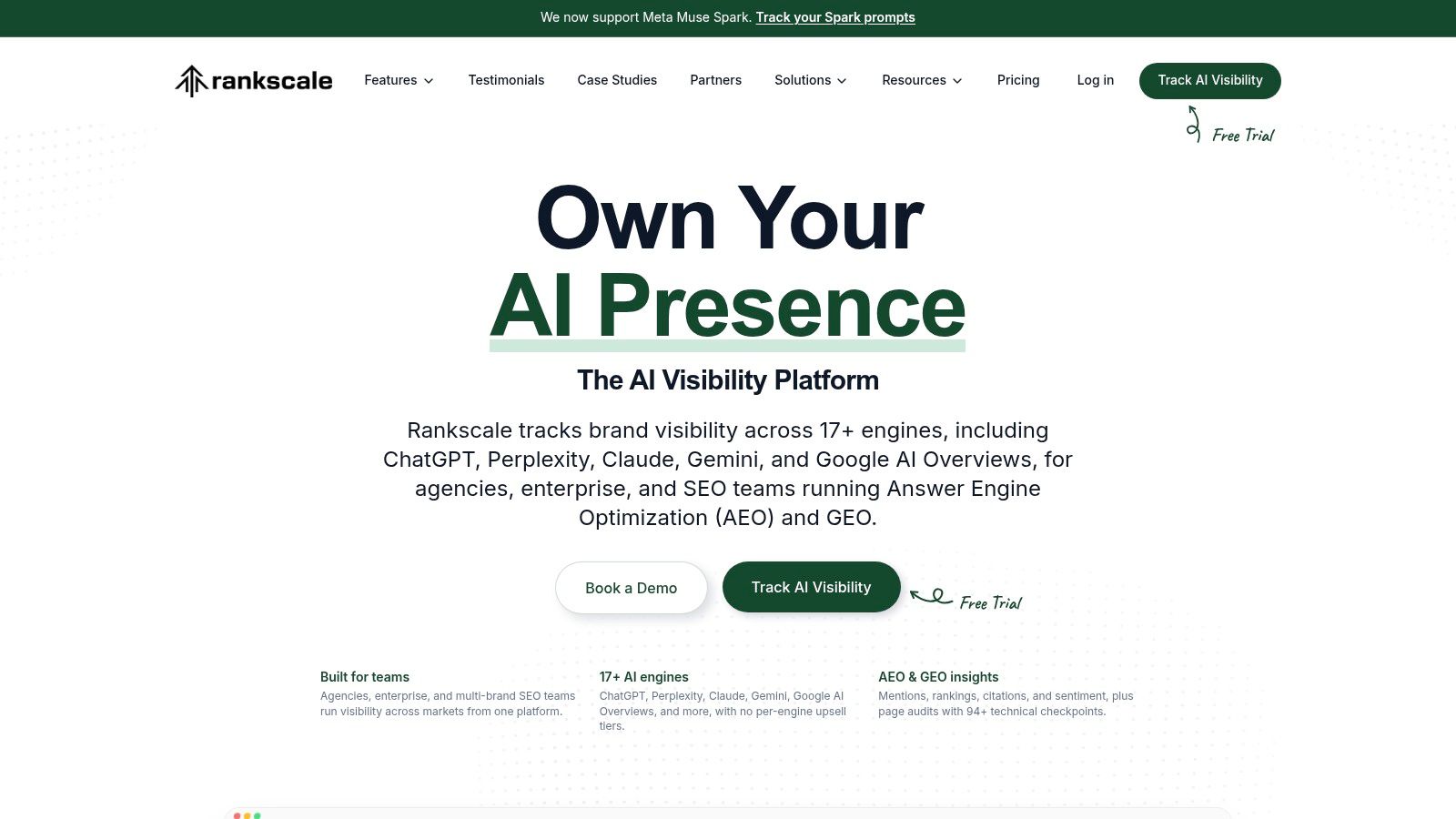
Rankscale organizes work around readiness, prompt planning, diagnosis, and improvement. Its usage-based credit model can suit teams that want to adjust monitoring intensity rather than commit immediately to a fixed workload.
That flexibility requires planning. Prompt count alone doesn't describe consumption when engine selection and tracking frequency also affect usage.
Budgeting advice: Compare the cost of the intended monitoring schedule, not the smallest advertised configuration.
A practical pilot might separate core software-category questions from exploratory prompts. The core set stays stable for trend analysis; exploratory questions help investigate new use cases without continually changing the baseline.
Strength: A structured workflow connects diagnosis with follow-up. Trade-off: Intensive monitoring can consume credits quickly, and estimated usage deserves attention before subscribing.
The distinction between discovery and ongoing measurement is also central to AI search analytics. Flexible usage works best when the team documents which questions belong to each activity.
10. Conductor AI Search Performance#
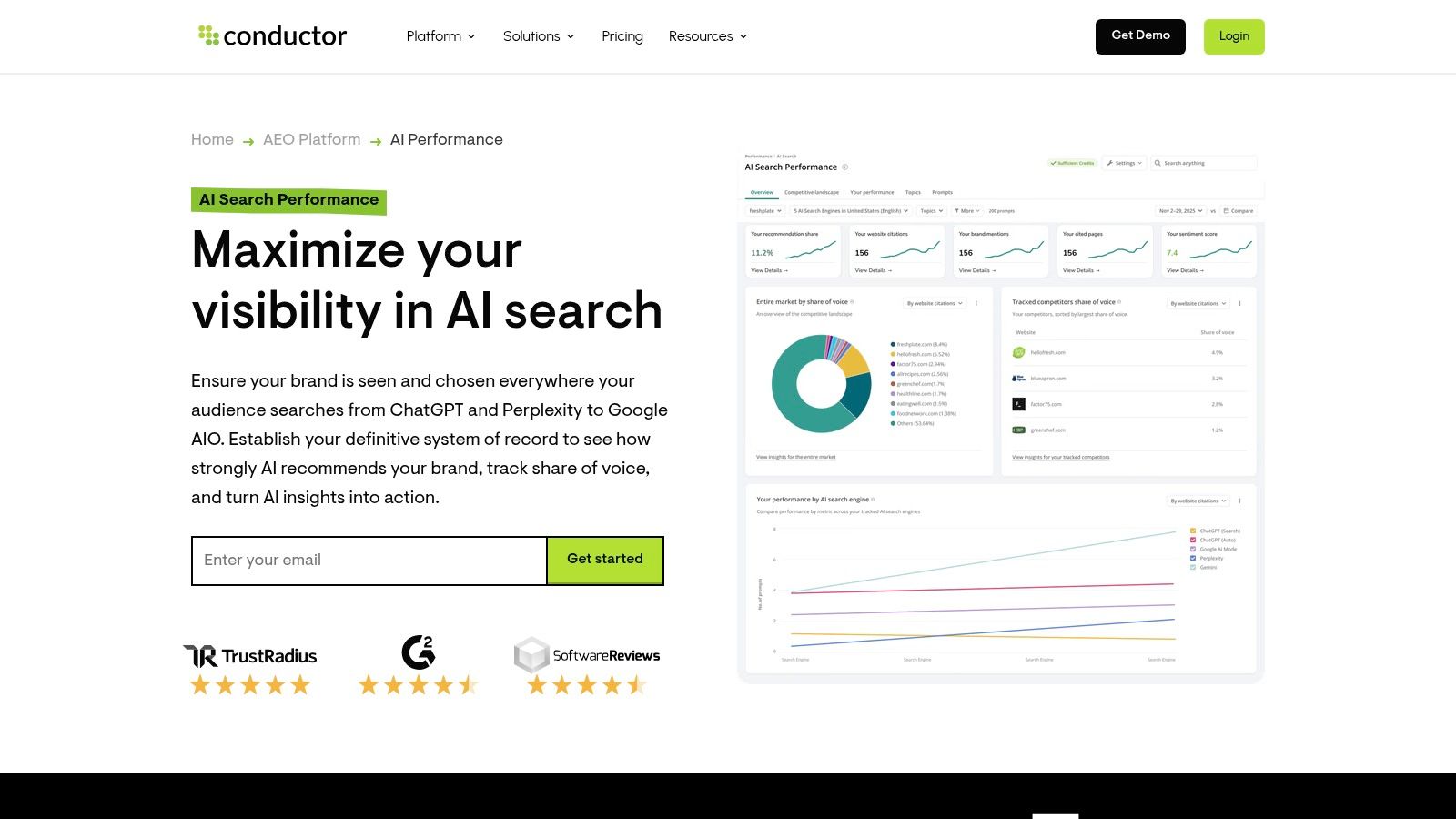
Conductor AI Search Performance fits enterprise teams that need AI monitoring inside SEO, content, and site-management workflows. It connects brand mentions, citations, sentiment, and competitive share with topic, prompt, persona, and intent analysis.
For a SaaS organization with separate product marketers, regional teams, and technical owners, that context can improve assignment quality. A visibility gap becomes more useful when the responsible team can identify the audience, buying intent, and relevant content.
- Research: Audience and intent analysis extends beyond basic mention totals.
- Operations: Content workflows, crawler reporting, and API or business-intelligence options support broader programs.
- Governance: Enterprise controls are relevant where access and reporting requirements are formalized.
Trade-off: Usage-based AI Response Credits require contract-level workload planning. The platform's breadth may be unnecessary for a small company that only needs recurring monitoring and a shared export.
Evaluation should cover the complete path from recorded answer to assigned work and executive reporting.
10 AI brand monitoring tools compared by entry price, tracking scope and best fit#
Entry price alone tells you little here. Two tools at similar cost can differ sharply in engine coverage, evidence depth, and whether exports come standard or sit behind higher tiers. Of the ten, Kliqo AI is the only one publishing a fixed starting price: Starter at $79 per month.
| Tool | Entry price | AI engines tracked | Reporting and exports | Best for |
|---|---|---|---|---|
| Kliqo AI | $79/month | Three engines per project, chosen from ChatGPT, Google AI Overviews, Google AI Mode, Gemini and Copilot; extra engines for a monthly fee and engine switching allowed at any time | Visibility, recommendation share, citations, competitor gaps, wrong-claim checks, action board, CSV exports on every plan, before-and-after impact measurement; unlimited members | Evidence-based visibility tracking with actionable audits |
| Profound | Entry plan billed annually | ChatGPT on the entry tier; broader coverage on higher plans | Brand visibility and competitor analysis | Teams seeking monitoring with content optimization |
| Peec AI | Tiered subscription | Major AI search platforms | Visibility, position, citations, CSV exports; API and integrations on eligible tiers | Marketing and SEO teams focused on AI search analytics |
| Otterly.AI | Lite plan plus paid add-ons | Four engines on Lite; additional engines as add-ons | Daily visibility, sentiment, citations, and optimization recommendations | Marketers, small teams, and agencies seeking self-serve monitoring |
| AthenaHQ | Free tier, then a paid Starter plan | Multiple AI models; coverage varies by plan | Prompt, source, sentiment, and competitor analysis with content recommendations | Teams combining visibility monitoring with optimization |
| Semrush AI Visibility Toolkit | Toolkit subscription | ChatGPT, Google AI, Gemini, Perplexity | Visibility and competitor analysis, prompt research, AI-readiness checks | Semrush users adding AI monitoring to SEO workflows |
| Ahrefs Brand Radar | Add-on to Ahrefs plans | Selected AI platforms | Share of voice, cited pages and domains, custom prompt checks | Ahrefs users researching AI visibility alongside SEO data |
| Scrunch | Tiered subscription | AI search engines | Visibility, citations, sentiment, bot activity, and referrals | Mid-market teams and agencies needing technical diagnosis |
| Rankscale | Credit-based pricing | Supported answer engines | Credit-based tracking and progress monitoring | Individuals, teams, and agencies scaling usage gradually |
| Conductor AI Search Performance | Contract pricing with usage credits | Engine coverage and allowances set per contract | Mentions, citations, sentiment, intent analysis, crawler reports, API/BI options | Enterprise teams integrating AI monitoring with SEO and content workflows |
Engine counts and export access shift by tier, so confirm coverage on the exact plan you intend to buy.
How to Choose and What to Do First#
Choose coverage around actual buying behavior, not the longest engine list. Sales calls, customer interviews, referral records, and purchase-research questions can help identify which assistants and Google surfaces deserve monitoring.
Then build a stable prompt set covering category discovery, use cases, alternatives, and comparisons. Estimate usage across engines, locations, and frequency before comparing plan-based and credit-based subscriptions.
Turn monitoring into assigned work#
- Verify crawler access: Review robots.txt with the AI crawler checker, allowing intended crawlers without opening private areas.
- Inspect buying pages: Use the AI page audit to investigate access and readability on product, pricing, integration, and comparison pages.
- Publish useful comparisons: Explain supported use cases, limitations, migration requirements, and verifiable product differences.
- Improve independent coverage: Seek accurate inclusion in relevant software directories and editorial lists without manufacturing reviews.
- Measure completed changes: Preserve prompts and reporting settings, record implementation dates, and compare equivalent periods.
Reporting must fit the people doing the work. Analysts need answer-level evidence and CSV exports; contributors need clear ownership; agencies need client separation; leadership needs an understandable summary.
Visibility isn't revenue attribution. Recommendation changes can be compared with branded searches, direct visits, qualified inquiries, and assisted conversions, but correlation alone doesn't prove that an AI answer caused demand.
FAQ#
What do AI brand monitoring tools measure?#
They measure how brands appear in generated answers, including mentions, recommendations, position, sentiment, competitors, and cited sources. Coverage and metric definitions vary by platform.
Is a brand mention the same as a recommendation?#
No. An assistant can name a product while criticizing it or recommending an alternative, so teams should inspect recommendation language separately from mention counts.
Can traditional SEO software replace AI monitoring?#
Traditional ranking reports don't establish what an assistant says about a brand. SEO suites with dedicated AI products can support both workflows, but engine coverage and recurring prompt tracking still need evaluation.
How should teams measure improvement?#
Teams should preserve a stable prompt set, compare equivalent periods, and inspect recorded answers alongside summary metrics. Business outcomes should be tracked separately rather than inferred from citation growth.
Kliqo AI offers nightly buyer-question monitoring, competitor comparisons, cited-source analysis, and matched before-and-after reporting. Teams evaluating AI brand monitoring tools can visit Kliqo AI to assess the workflow against their own software-buying prompts.