Short answer
AI search analytics is the repeat measurement of whether AI answers mention, recommend, cite, or describe a software brand versus its competitors. Teams should read those signals separately from clicks, because an answer can shape a buyer's short list before anyone visits a website.
On this page
What AI Search Analytics Measures and Why Clicks Miss It#
A founder asking which help desk to shortlist for a five person support team doesn't always get a list of links to work through. The assistant may name three products, favor one, quote a price, and cite a comparison page. That answer is the event worth recording.
The scale is already hard to ignore. The Pew Research Center analysis of browsing behavior from March 2025 found that 58% of participating Google users encountered at least one search page containing an AI generated summary. Across that study, approximately 18% of all Google searches produced an AI summary.
Click behavior changed when a summary appeared. Users clicked a traditional search result link in only 8% of visits when an AI summary appeared, compared with 15% of visits without one. A link inside the summary was clicked in just 1% of visits.
Sessions also ended earlier. The same Pew analysis found 26% of pages with an AI summary ended the browsing session without a click, compared with 16% of pages containing only traditional results. Those figures come from observed U.S. browsing behavior, not stated preferences.
That creates a plain measurement gap. A rank shows where a page sat. A visit shows that someone arrived. Neither shows whether the generated answer named the product, placed it first, recommended it for the stated job, or credited a rival's page instead.
For software buying, the omission matters early. If an answer builds the short list and a product isn't on it, later retargeting and comparison pages may never get a chance to work. AI search analytics therefore starts at the answer, not at the session. The next task is defining exactly which signals inside that answer deserve a field in the log.
Metrics Worth Tracking for SaaS Buying#
| Metric | What it counts | What to do with it |
|---|---|---|
| Mention | Product is named, recommended or not | See if buyers encounter the brand at all |
| Recommendation | Answer explicitly favors or shortlists the product | Separate a real pick from a passing name |
| Answer position | Place in the short list, first through last | Treat the first name as more influential than a late mention |
| Citation | Domain or URL the answer credits | Find the page to earn, fix, or match |
| Sentiment | Praise, criticism, and quoted claims | Catch a wrong price, limit, or category |
| Competitive share | Mentions or recommendations versus rivals on the same prompts | See who the answer set favors |
Reading One Answer#
Take one buyer prompt. A useful test prompt names the job, the team, and a constraint, such as asking for the best help desk for a five person SaaS support team that needs shared inboxes and simple reporting. A vague prompt produces a vague answer, and the log won't tell the team what changed.
Work through the answer in table order. First, record whether the product is named at all. Absence is a result, not a blank. It means a buyer using that wording didn't encounter the brand in that run.
Next, decide whether the answer recommends it. A product can appear in a list of tools that exist without being picked for the job. Language such as a good fit, best for small teams, or worth trialing signals a recommendation. A neutral directory style listing doesn't.
Then note position. The first name sets the frame for the rest of the answer, and later entries often read as alternatives to it. A move from fourth to second across repeated runs means more than a steady stream of fourth place mentions.
Citation is a separate field. The answer may name the product in prose while crediting a rival's comparison page, a review site, or the product's own pricing page. Record the exact domain and URL, because that URL is the page to earn, fix, or match. A deeper method for this step sits in this guide to tracking brand mentions in ChatGPT, which fits the same field by field approach.
Claims and Competitors#
Sentiment covers more than tone. It includes the specific claims the answer repeats about price, seat limits, integrations, category, and who the product serves. A favorable answer with a wrong price still needs action, because a buyer may drop the product for a cost it does not charge.
Record the claim in the answer's own wording. A paraphrase hides whether the engine said per user, per month, or something else entirely.
Competitive share closes the pass. Count mentions and recommendations for every product named on the same prompts, including brands the team didn't plan to track. An untracked rival taking the first slot on several runs is a finding, not noise.
Keep the prompt, engine, country, and date with every row. Without those four fields, two runs can't be compared, and a change in wording looks like a change in performance. Keep missing answers missing rather than converting them to zeroes. A failed run says nothing about visibility, and a zero would drag the average down for the wrong reason.
Visibility Without Clicks Still Moves Buyers#
A mention or recommendation can change the short list even when analytics shows almost no AI referral sessions. That's the split teams keep missing. They check referral traffic, see little, and conclude the answers don't matter.
The traffic side is clearly small. Search Engine Land's summary of AI search evidence describes a study of 100 websites that found ChatGPT generated only 0.62% as much traffic as Google organic. The same summary describes an analysis of 632 tests across 12 sites that could not establish a reliable relationship between AI visibility and later branded search or direct traffic.
The influence side points the other way. In a study of 185 high stakes purchase tasks covered in that summary, users accepted the AI shortlist in 88% of cases, selected the first ranked item in 74%, and clicked nothing in 64%. The answer did the narrowing. The click never happened.
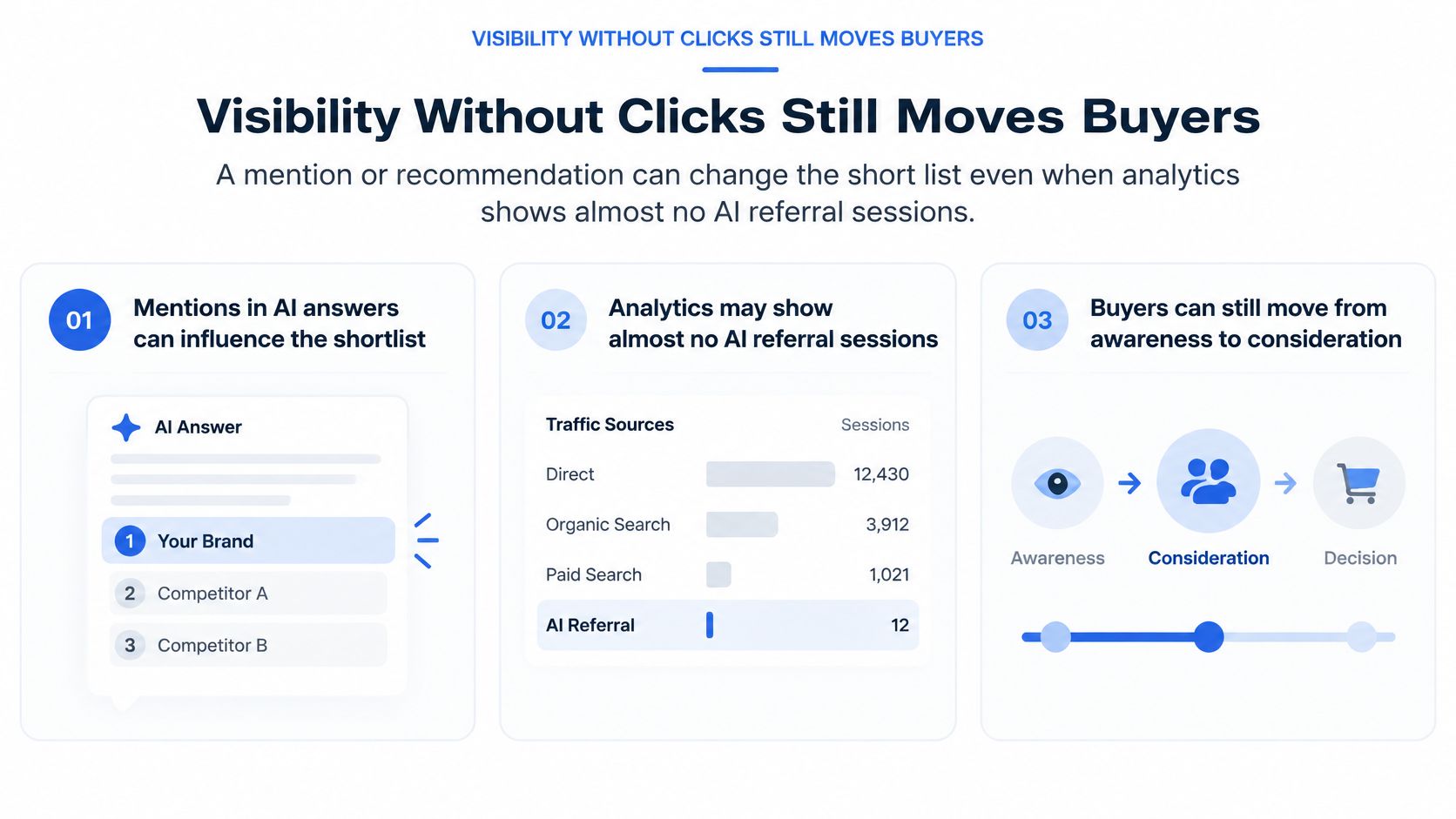
Traffic share tells the same limited story. Digiday's report on Conductor data put AI platforms at an average of 1% of web traffic across 10 major industries in 2025. That figure measures traffic share. It doesn't measure how many buyers formed a short list inside an answer and then arrived later through search, a bookmark, or a direct visit.
Apply that to a software decision. A help desk or email tool can be named first, described as the fit for a small team, and win a place in the evaluation. The buyer may still type the brand name into a browser days later. Analytics credits the later visit, not the answer that created the intent.
So log recommendation and position on each prompt, then track downstream signals as separate outcomes. Branded demand, demo requests, trial starts, and notes from sales calls each answer a different question. None of them should be collapsed into referral sessions, and a thin referral line shouldn't be read as proof that AI answers carry no weight.
Retrieved Sources Versus Cited Sources#
An answer engine can fetch or display more pages than it finally cites. The citation set in the finished answer is a filtered output, not a full inventory of what the engine looked at. Treating the two as one step hides where a page lost.
| Stage | Mean count | How to read it |
|---|---|---|
| Retrieved or displayed, engines in the study | 4.31 | A page can be fetched and still never be cited |
| Cited in the final answer, same study | 3.0 | The citation set is smaller than retrieval |
| Displayed by one engine in the study | 5.00 | Display volume is not the same on every engine |
| Cited by that same engine | 2.58 | That engine dropped much of what it displayed |
Those means come from a 2025 qualitative study of answer engines that reported a mean of 4.31 retrieved or displayed sources versus only 3.0 sources cited in final answers. The gap widened on one engine, which displayed a mean of 5.00 sources but cited only 2.58. The finding doesn't name that engine, so the log shouldn't either.
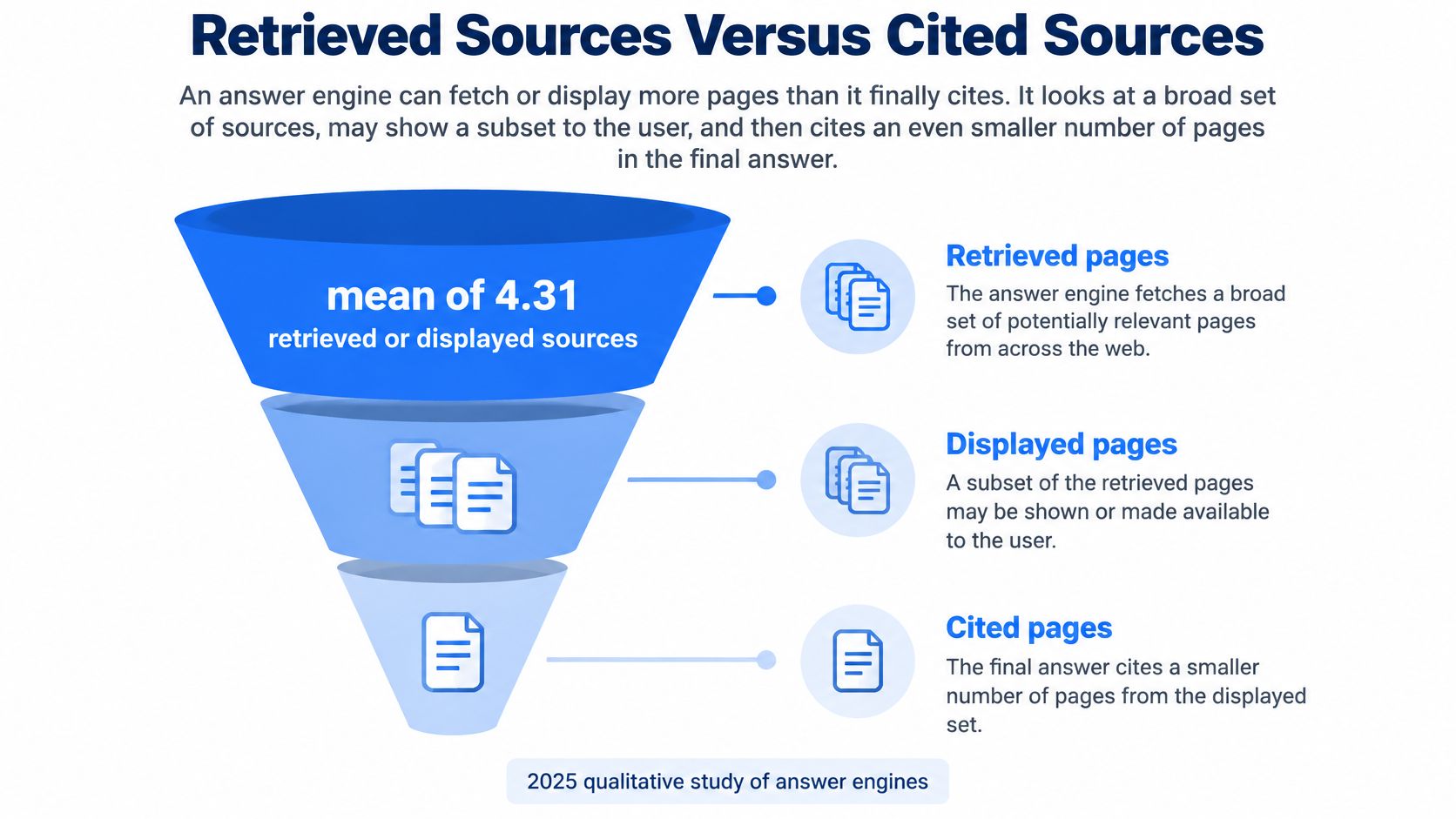
Two rates make the funnel usable. Citation conversion is cited sources divided by retrieved sources for a given page or domain. Recommendation given a citation asks whether a cited domain's brand is picked in the prose. The first rate finds extraction problems. The second separates being used as evidence from being chosen as the product.
Say a competitor's API docs URL is retrieved often for screenshot API prompts but rarely cited. That pattern points at the passage. The page may bury the relevant endpoint, spread the answer across tabs, or state limits without the comparison detail the prompt asked for. Retrieval isn't the failure. Selection is.
The reverse pattern matters too. A review page cited on most runs holds answer stage influence even when it isn't the top organic result, and its structure is worth studying before the next content edit. Guidance on earning that final step appears in this breakdown of getting cited in Google AI Overviews.
Crawl blocks affect whether a page is retrieved at all. Vague comparison copy affects whether a retrieved page gets quoted. Those are different fixes owned by different people, which is why the funnel stages stay separate. Save the URL and the full answer text for every run. Share of voice alone can't show why a rival won.
Organic Rank Is a Weak Citation Proxy#
Only 17% of AI Overview citations came from pages ranking in Google's organic top 10, according to Markets Insider's coverage of AI search versus traditional SEO research. The rest of the cited pages sat outside the positions a rank tracker treats as winning.
The research behind that figure covered roughly 150,000 indexed pages across 10 websites, and content type split the results. Trends and analysis content earned citations 78% of the time, compared with 12% for standard how to guides. Referral traffic showed the same pattern in a milder form: the strongest organic pages drew most of the organic sessions but a smaller share of AI-referred visits, and many high-ranking pages received no AI referral traffic at all.
Four events get blurred into one here. A mention names a brand. A recommendation picks it. A citation links the evidence. A referral delivers a visit. Google rank measures none of the four, so a position report cannot stand in for who AI search names or which page it quotes.
What This Means for Software Pages#
A how to guide on setting up a form builder can rank well, earn steady clicks, and still be absent when AI answers which form builder a small SaaS team should buy. A comparison page with clear category framing can take the citation instead. The buyer prompt asks for a judgment, and the cited page tends to be the one that makes one.
The practical response is an export. Pull every URL cited for each tracked prompt and mark each one clearly.
- Own domain: The page already reaches the answer, so the task is keeping its claims current.
- Rival domain: The competing product's own page is doing the persuading.
- Third party: A review, list, or publication carries the influence, and it may not be a tracked competitor.
Record organic position only as context beside that label. A cited page at position 30 tells you more than an uncited page at position 3, because the cited page shows what the engine chose to quote.
When a lower ranked brand or an untracked third party keeps taking citations for buyer prompts, the answer sits in the cited URL itself: its wording, its structure, and the claim it supports. Rank can stay in the report. It just can't lead it.
What 568 ChatGPT Software Answers Showed#
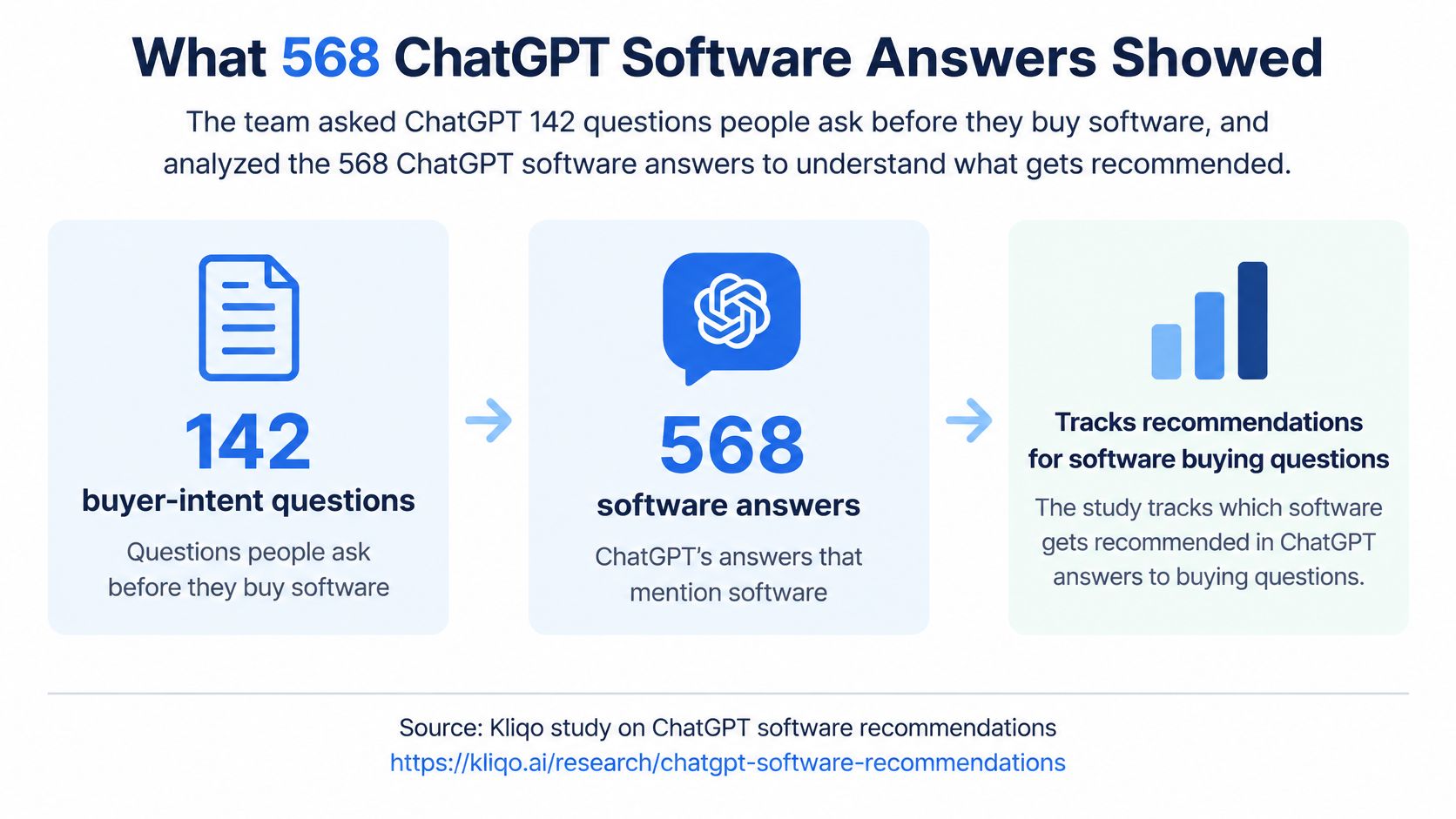
Run one buyer question four times and you get four answers. Run 142 buyer questions four times each and the log holds 568 answers. A log that size is where the single screenshot stops working as evidence, because the spread across runs becomes visible.
The First Name Moves#
Read any tracked question across repeated runs and the first tool named tends to shift. Some questions crown the same product every time. Others rotate the top slot between two or three tools, and a share of questions never settles on a leader at all.
That pattern kills the single screenshot as evidence. One manual check can crown a different help desk or email tool than the next run on the same question. A team that reacts to one answer is reacting to a draw, not a position.
Short Lists Stay Short#
Each answer names a handful of tools. Across repeated runs, the pool of tools a question touches grows wider than any single answer shows, and only a small core appears every time. The stable core is small. The rotating edge is wide.
A short list of a few names means absence is common, even for known products. Missing one run isn't a verdict. Missing most runs is.
Where the Links Point#
Citation links in software answers lean toward pages that state a position: vendor pages, comparison pages, and review or list pages that name a pick. Community threads can appear, but the pages doing the persuading are the ones a buyer could act on, which keeps comparison and product pages worth fixing.
That mix is engine-specific, not universal. Other engines can cite a different blend of vendor pages, reviews, and publications, and the log should record the mix per engine rather than assume one carries over.
The measurement rule follows directly. Score each tracked prompt as the share of runs in which the brand is named, recommended, and cited. Three separate shares, each across repeated asks, because mention, recommendation, and citation move independently: a brand can be named without being recommended, and recommended without its domain being cited. A single run is never the basis for a decision.
A reasonable starting point is 10 real buying prompts in one category, each run more than once before judging any change. That volume is enough to separate a stable first-place product from one that rotates in and out of the answer, and to show which domains the engine keeps reaching for.
Fixes You Can Ship This Week#
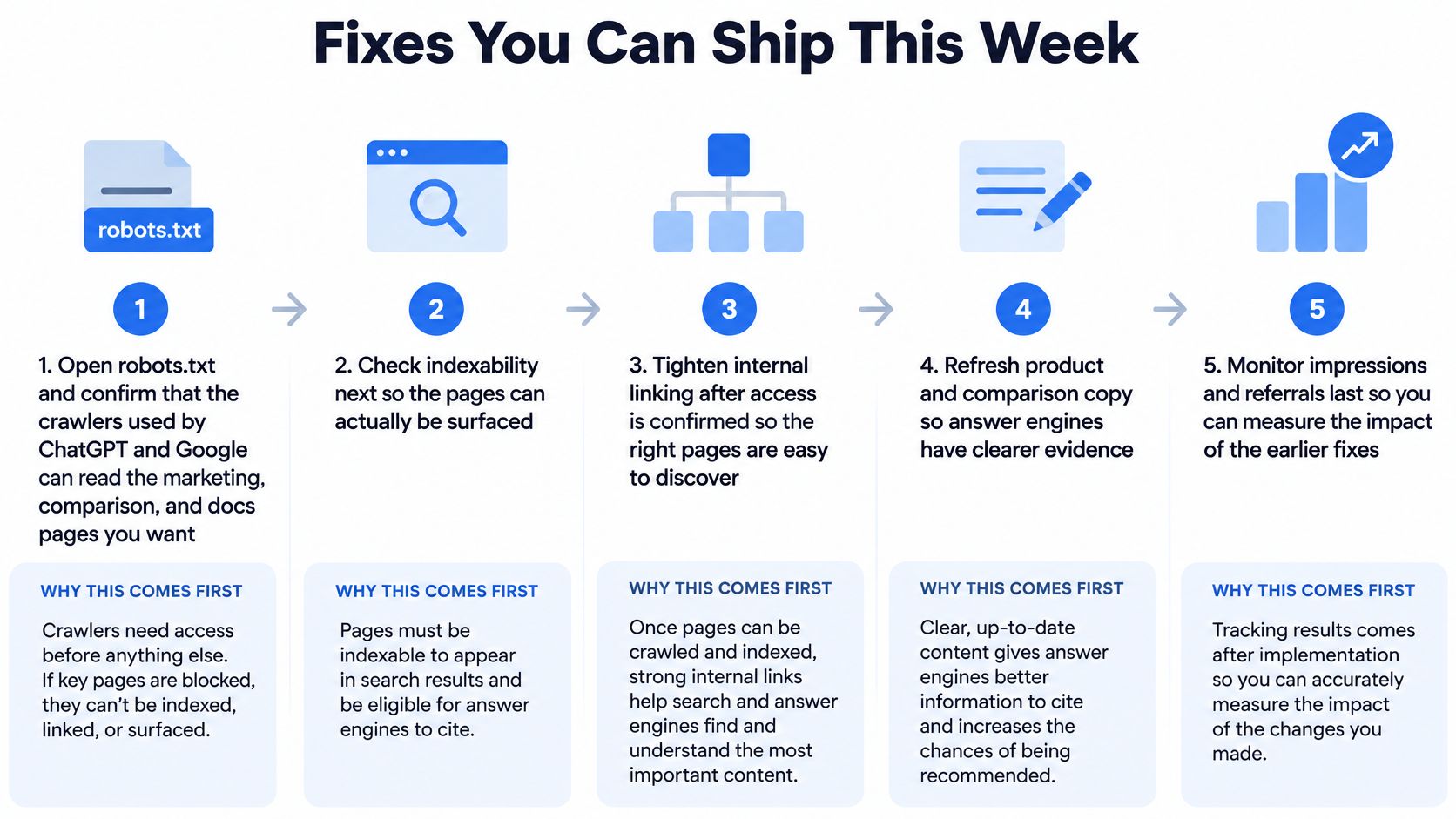
Five steps, in order. Access comes first because a page that can't be read can't be cited, and measurement comes last because a change without a before and after score is just an opinion.
- Open robots.txt first. Confirm that the crawlers used by ChatGPT and Google can read the marketing, comparison, and docs pages worth quoting. A blocked page can't be retrieved, so no copy edit downstream matters. Background on the file itself sits in this robots.txt overview.
- Check the page without JavaScript. Open the same URLs with JavaScript disabled and confirm the product name, price, limits, and intended buyer appear in the HTML. If those facts only appear after a client render, a crawler may record a blank.
- Add one fit sentence to a comparison page. State the team size or job the product serves in a single clear line. An answer needs a sentence it can repeat, and vague positioning gives it nothing to repeat.
- Work the pages already cited. List the third party URLs credited for buyer prompts, then request a factual listing or correction on those best of and review pages. That beats publishing another uncited blog post and hoping.
- Re ask the same prompts. Use the same engines, score mention, recommendation, position, citation, and sentiment before and after the change, and run each prompt more than once.
Two free checks cover the first steps without a project setup. The free crawler check reports on robots.txt, sitemap, and homepage access. The free page audit shows one page the way AI search sees it, covering access, indexing, text without JavaScript, title, structured data, and dates.
Check the Claim, Not Just the Citation#
A citation doesn't prove a claim is right. An answer can cite a pricing page and still state the wrong seat limit or an old price in the sentence beside the link. Compare the price and limit sentences in the answer against the live page, word for word, before treating a citation as a win.
That check also protects against quiet damage. A wrong claim repeated across runs can push a product out of a price band it fits. Fixing the source page, then re asking the prompt, shows whether the engine picked up the correction or kept the old figure.
None of these steps guarantees a recommendation. Engines choose their own sources, and a clean crawl only earns a page the chance to be considered. What the steps do guarantee is a cleaner test. The team changes one thing, keeps the prompt set stable, and can see whether mention, citation, or recommendation rates moved.
FAQ#
How Often Should the Same Prompt Be Checked#
Nightly, or on another fixed schedule that never drifts. A one off check can mislead, since the software study saw the first named tool change on 61 of 142 questions across repeated runs. A fixed cadence turns that movement into a rate a team can act on.
Which AI Services Should a SaaS Team Include#
A practical starting set is ChatGPT, Google AI Overviews, Google AI Mode, Gemini, and Copilot. Keep the engine list stable so runs compare cleanly over time. Don't assume every tracking tool covers the same set, and check coverage before comparing scores between tools.
Does a Citation Mean the Claim Is Correct#
No. A cited page can fail to support the price, limit, or comparison sentence placed next to it. Save the sentence and the URL together, then check both against the live product page. Citation presence and citation accuracy are separate findings.
What If AI Referral Traffic Is Only About 1 Percent#
Keep scoring recommendations anyway. A small referral share measures sessions, while purchase task evidence shows buyers accepting AI short lists without clicking. The answer can set the consideration set long before a visit shows up in analytics.
Teams that want the same buyer prompts run every night across ChatGPT, Google AI Overviews, Google AI Mode, Gemini, and Copilot can do that with Kliqo.
Stop guessing from referral sessions and start reading the answers buyers see. Kliqo AI runs buyer prompts nightly across major AI engines and reports mentions, recommendations, position, sentiment, and cited sources against competitors. Visit the site, pick the prompts that match real software buying questions, and score the first week of answers before changing a single page.