On this page
To get cited in Google AI Overviews, make the page accessible to Google Search, publish clear, verifiable answers to buyer questions, and earn accurate coverage on third-party pages, but treat citations separately from traffic: Campaign's 2025 reporting on Pew Research Center's March 2025 analysis found that users clicked links inside an AI summary in only 1% of visits. The practical work is to fix eligibility first, improve the passages Google could use, and measure whether the answer recommends the product.
What a Citation Is Worth#
A citation is evidence of inclusion, not evidence of preference. An overview can use a software company's documentation to explain a category while recommending a competitor for the buyer's needs.
Say a buyer searches for the best help desk for a five-person SaaS team. An overview might cite one vendor's explanation of shared inboxes, then name a different product as the better fit because of its setup requirements or support features.
That distinction matters before anyone rewrites a landing page.
Four citation outcomes and what the data says#
The citation and click figures below come from Pew Research Center's analysis of browsing by 900 U.S. adults during March 2025, discussed in Search Engine Land's coverage of the Pew study.
| Outcome | What it means | Checkable figure |
|---|---|---|
| Retrieved | The page can enter the evidence set but may not be shown as a link | Crawlable, indexed page that can show a normal snippet |
| Cited | The overview links the page as one of several sources | Pew found that 88% of summaries cited three or more sources; 1% cited one |
| Clicked | A searcher opens a link | Pew found traditional-result clicks in 8% of visits with a summary, versus 15% without |
| Recommended | The answer names the product as the pick for that buyer | Record the named pick separately from background citations |
Eligibility isn't proof of retrieval. Unless a monitoring system exposes supporting evidence that a page was retrieved, its retrieval status should remain unknown, not inferred from its ranking or crawlability.
Likewise, a product mention isn't automatically a recommendation. An answer can name software in a warning, an alternatives list, or a comparison without favoring it.
Measurement rule: Keep the cited URL, the named product, and the recommended product in separate fields.
This is the commercially useful part of generative engine optimization: understanding what role the brand plays in the answer, rather than counting every appearance as a win. Demo requests and qualified opportunities still need their own reporting.
Before editing copy, establish a baseline for each buyer question. Otherwise, a team can celebrate additional background citations while losing the recommendations that matter to pipeline.
Make the Page Eligible for AI Overviews#
Google's documentation for AI features states that a supporting page must be indexed and eligible to appear in Search with a snippet. There's no special AI schema or machine-readable file that turns citations on.
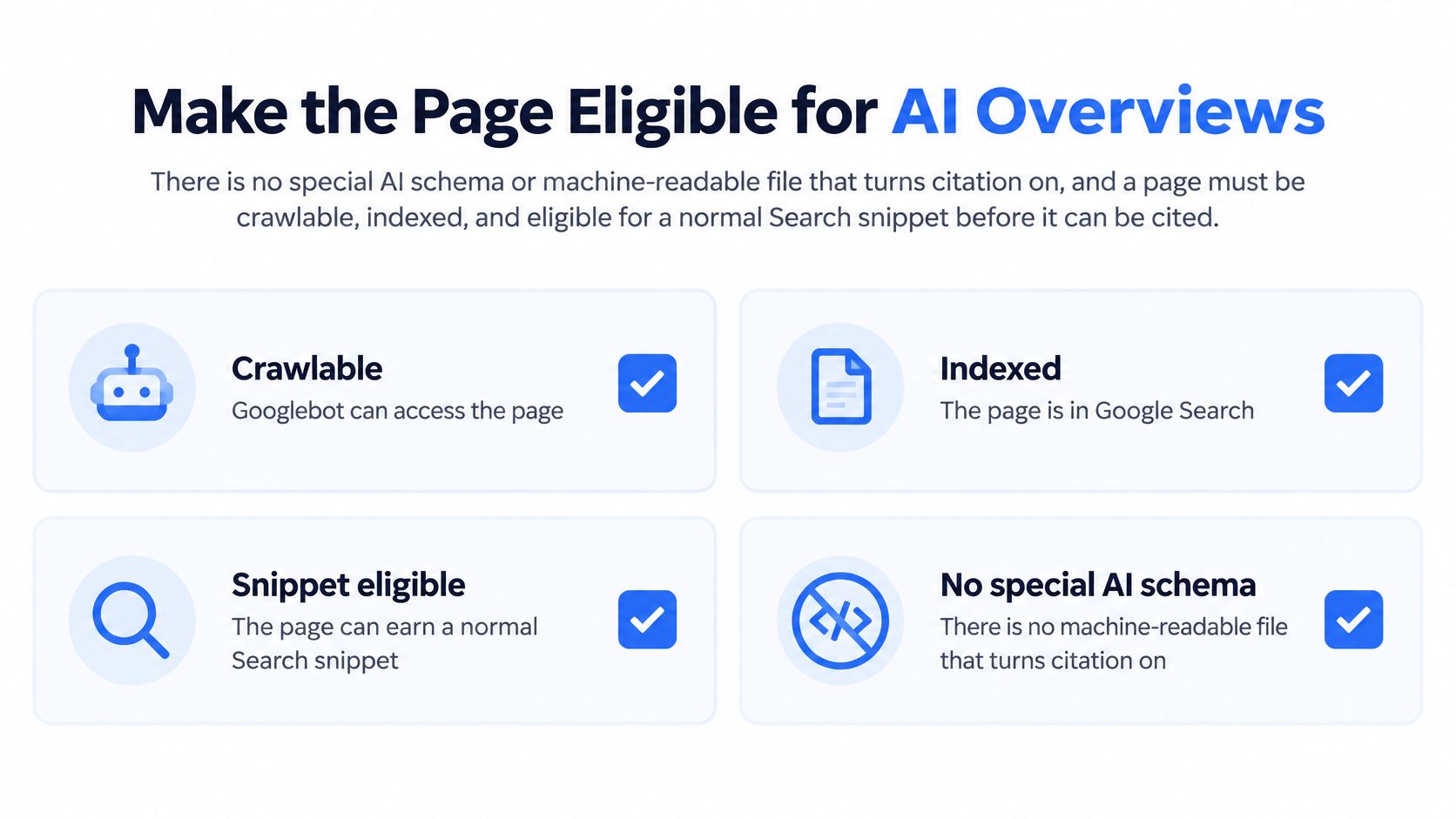
Run the access checks in order#
-
Check crawler access first. Review robots.txt for rules affecting Googlebot, then inspect the CDN or hosting firewall for challenges and blocked requests. Google's technical guidance explicitly includes allowing crawling through both robots.txt and hosting infrastructure. Use the AI crawler access checker for an initial robots.txt and homepage check, then confirm CDN behavior in request logs. The robots.txt SEO guide provides additional context for reviewing those rules.
-
Request the actual URL. Confirm that the intended page returns HTTP 200, as required by Google's technical guidance, rather than an error, login screen, or soft error page. Test the public version, not a logged-in preview. A pricing page that works only for authenticated staff isn't useful public evidence.
-
Inspect the important text. Check both the returned HTML and Google's rendered version in Search Console URL Inspection. Product limits, comparison criteria, and eligibility statements shouldn't require a visitor to submit a form or click through an interactive calculator. Server-render critical facts where practical.
-
Resolve indexing conflicts. Check the canonical URL, noindex directives, internal links, and duplicate versions. A comparison page shouldn't point its canonical at a broad category page merely because both discuss the same product. Confirm which URL Google actually indexes.
-
Review snippet controls. Google's robots meta documentation says nosnippet prevents a page from being used as a direct input for AI Overviews and AI Mode. Inspect page-level robots tags and any data-nosnippet attributes. The latter excludes marked portions, so a restriction around a pricing table can hide precisely the material the team wants available.
-
Match markup to visible copy. Structured data should describe what's on the page. Check names, offers, titles, and dates for inconsistencies rather than adding markup as a speculative citation tactic. A single-page audit can help inspect access, indexing signals, text without JavaScript, title, structured data, and dates.
Separate selection problems from access problems#
A software documentation URL can be absent because Google selected another source. It can also be absent because Google couldn't index the intended page.
Those failures require different work. Fix access before commissioning another article, but don't mistake a clean technical audit for a promise that Google will cite the page.
Why a Top 10 Rank Still Misses Citations#
| Study and date | What was measured | Result |
|---|---|---|
| Ahrefs analysis, publication date not specified in the cited summary, approximately 1.9 million citations from 1 million AI Overviews | Cited pages in Google's organic top 10 | 76.10% |
| Ahrefs, same citation set | Cited pages in positions 11 to 100 | 9.50% |
| Ahrefs, same citation set | Cited pages not in the top 100 | 14.40% |
| Ahrefs findings reported by Slate, March 2026, 863,000 keywords | Citations from the organic top 10 | 38% |
| ACM study, 2026, 55,393 searches | Cited domains absent from the matching first page | Nearly 30% |
These are observations from different samples, not a controlled before-and-after experiment. The later result doesn't establish that a ranking improvement has become less valuable for every SaaS category, and none of these percentages predicts an individual page's citation probability.
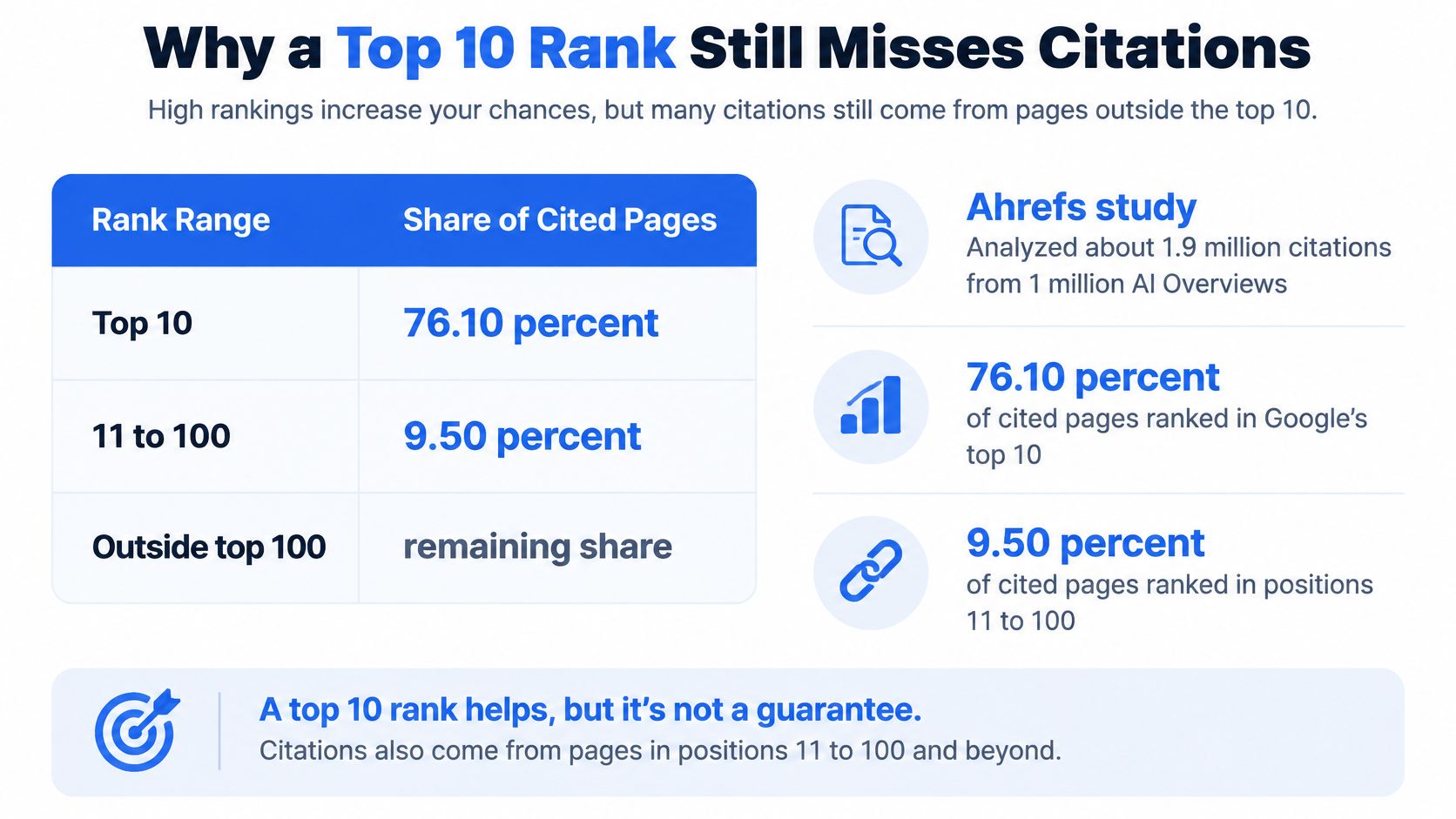
The chart reflects the earlier Ahrefs citation set, not the later March 2026 sample. The useful conclusion is narrower than either percentage alone suggests: organic position doesn't fully describe source selection.
Map the buying question beyond its main keyword#
For a search about a form-builder alternative, the main comparison is only part of the buying decision. Related questions might concern response limits, conditional logic, data export, or whether billing requires an annual commitment.
Build a question map around those decisions:
- Primary question: Which form builder fits the buyer's workflow?
- Constraint questions: Which capabilities are included, restricted, or unavailable?
- Alternative questions: What changes when switching from the incumbent tool?
- Verification questions: Which documentation supports the comparison?
Match each question to a specific URL and passage. Don't create separate pages for every wording variation when one substantive comparison can answer them clearly.
Citation monitoring should include relevant URLs beyond page one. A page might support a narrow subquestion even when it doesn't rank prominently for the broad category query.
Use SEO to improve discovery. Judge citation success by the URL selected and the claim it supports, not by keyword position alone.
A highly ranked page that doesn't state the needed limitation is still a weak source for that limitation. Conversely, a focused documentation page can provide the exact evidence a broad landing page lacks.
Write Claims an Overview Can Repeat#
A citation-ready passage should make sense without the surrounding sales narrative. It needs a clear subject, a specific claim, and enough qualification to avoid misleading the buyer.
For SaaS pages, break the buying question into atomic claims: the product's definition, the comparison criterion, its limitation, any relevant specification, the use case, and when the fact was verified.
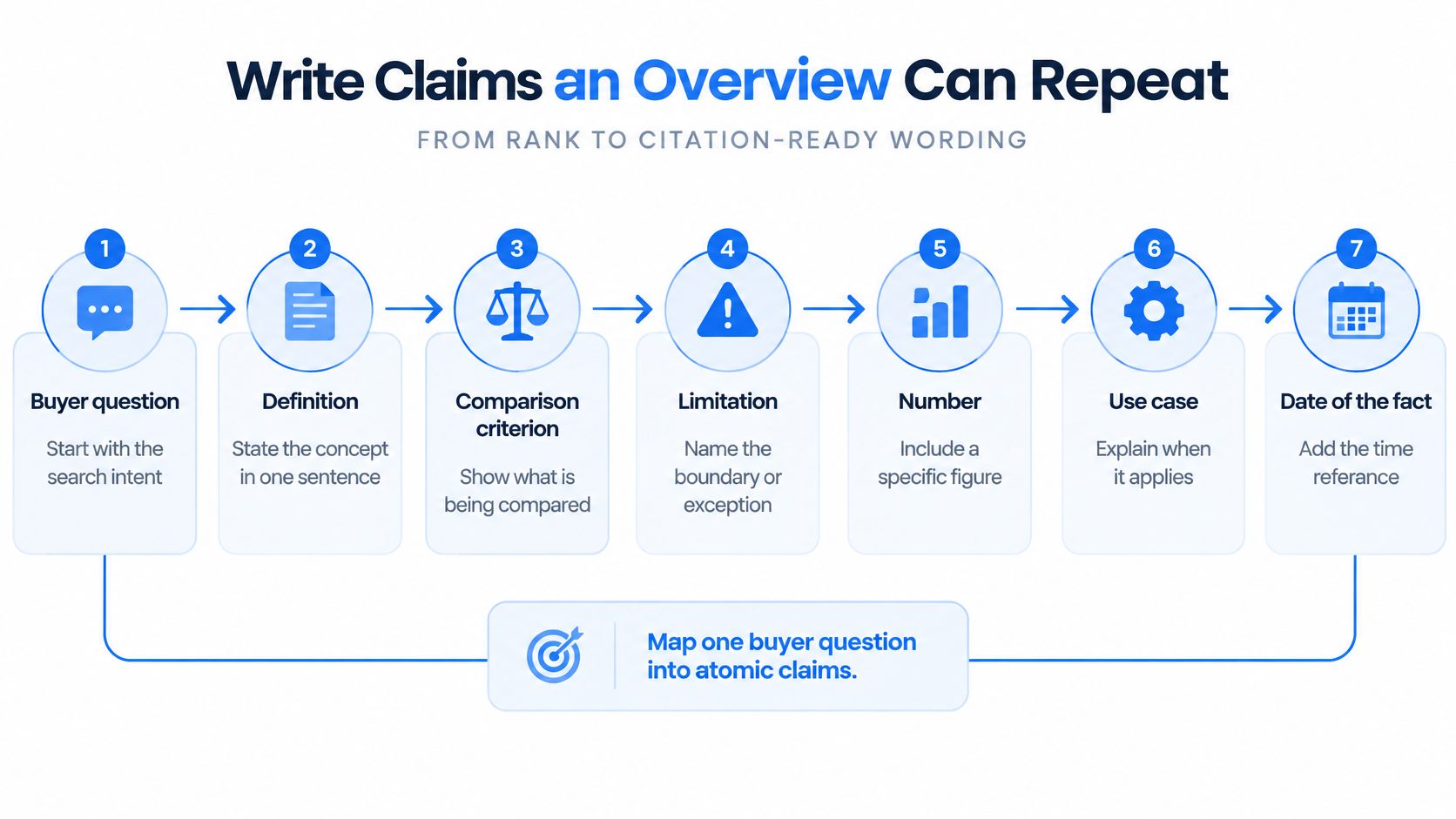
Make the answer independently understandable#
-
Answer immediately under the relevant heading. A heading about export support should lead to the supported formats and restrictions, not a paragraph about helping teams. The reader shouldn't have to infer the answer from feature slogans.
-
State fit and exclusions together. A hypothetical form-builder alternative page could explain that the product suits SaaS teams collecting onboarding information but isn't designed for complex internal approval workflows. That gives a comparison something useful to evaluate.
-
Use tables for genuine differences. Compare billing terms, seat requirements, export options, or workflow capabilities when those criteria affect the purchase. Don't fill a table with vague checkmarks for ease of use or innovation.
-
Keep factual details consistent. Product names, plan labels, limits, and prices should agree across pricing, documentation, and comparison pages. When the product changes, update the connected pages rather than leaving competing versions of the same fact online.
-
Remove unsupported claims and unnecessary barriers. Replace best-in-class with a documented capability or a clearly labeled judgment. Put decision-critical information on the public page instead of behind a demo form.
Compare a usable passage with a buried claim#
A form-builder alternative page that states supported workflows and exclusions gives both buyers and search systems a checkable answer. A feature page that hides the relevant usage restriction beneath a demo form leaves the central comparison unresolved.
The aim isn't to flatten every page into short definitions. Buyers still need implementation details, screenshots, migration constraints, and supporting documentation. Put the answer first, then preserve the depth needed to verify it.
Editorial test: A passage should remain accurate when copied into a comparison without its surrounding promotional copy.
The guide to getting recommended by ChatGPT offers a related workflow for recommendation-focused work. Its engine-specific advice shouldn't be treated as proof of how Google selects sources, and ChatGPT findings shouldn't be presented as AI Overviews findings.
Earn a Place on Pages Overviews Already Cite#
A company's own blog is only part of the source pool. In Pew Research Center's analysis of March 2025 browsing by 900 U.S. adults, government websites represented 6% of links in AI summaries versus 2% in standard results, while news websites represented 5% in both.
The source mix isn't a prescription to pursue government links for SaaS products. It shows why a team shouldn't assume that its category blog represents the entire evidence environment.
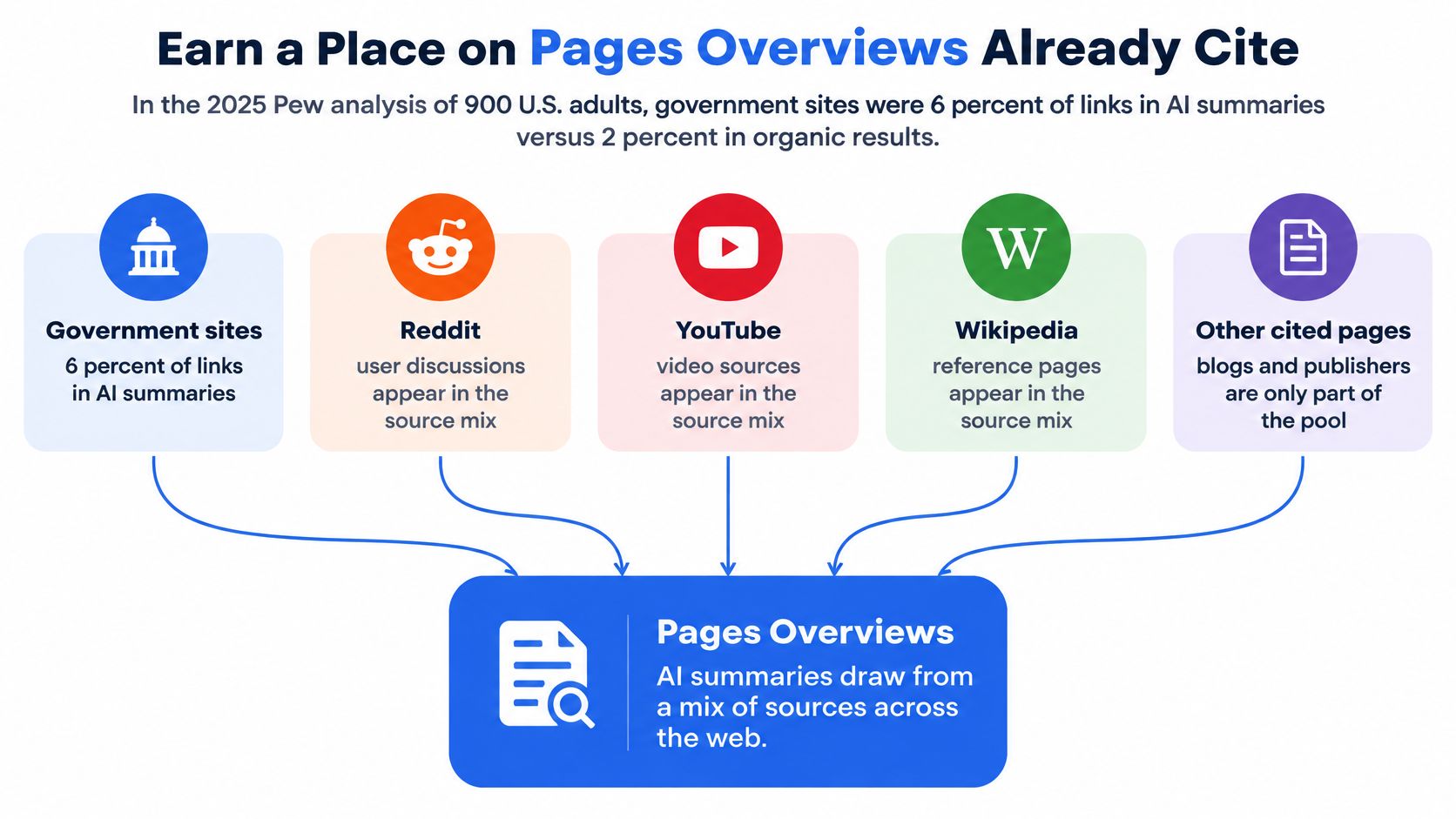
Start with the sources in actual buying answers#
For software buying, inspect independent best-of articles, comparison write-ups, review roundups, technical documentation, and relevant community discussions. Prioritize pages that appear in answers to the intended buyer questions, rather than chasing mentions on any recognizable domain.
A practical outreach sequence looks like this:
-
Record the cited domains and URLs. Search the target buying question and save the overview's sources, not just the visible product names.
-
Classify ownership. Separate company-owned pages, competitor pages, and independent third-party coverage. The action available for each is different.
-
Request factual inclusion where it fits. For a relevant third-party list, provide the product category, current public pricing reference, supported workflow, and meaningful limitations. Let the publisher make its editorial judgment.
-
Publish comparisons for unresolved decisions. A company-owned comparison earns its editorial purpose when existing lists omit an important migration issue, integration constraint, or buyer requirement. Another generic alternatives page may add little.
-
Check what the mention accomplishes. A listing can make the product available as a candidate without causing the overview to favor it. Inspect the generated answer after inclusion rather than declaring an outreach win a recommendation win.
Keep community participation factual and transparent. Product employees shouldn't pose as independent customers or manufacture agreement.
Competitors with clearer third-party coverage may receive citations even when the company's own page ranks well. The response should be better documentation and relevant editorial inclusion, not an assumption that every competing result was bought.
Track Citations Then Decide the Next Fix#
Use a fixed set of buyer questions and a repeatable observation routine. Otherwise, changes in wording can make a content edit appear more effective than it was.
Ahrefs' April 2025 study of more than 300,000 keywords associated AI Overviews with a 34.5% reduction in click-through rates for top-ranking pages. That association is a reason to report clicks alongside answer-level outcomes, not to abandon traffic measurement.
Keep a question-level evidence log#
- Save the context. Record the exact question, date, engine, and target market. Start with Google AI Overviews rather than mixing all engines into one aggregate.
- Capture the outcome. Store cited URLs, named brands, explicit recommendations, and answer position. Mark retrieval as unknown when it isn't observable.
- Record the wording. Note praise, criticism, and incorrect claims about pricing, capabilities, or limitations. A brand sentiment review helps distinguish favorable visibility from damaging mentions.
- Repeat consistently. Recheck unchanged questions on a set schedule and preserve the underlying answers. Don't judge a change from a single screenshot.
Kliqo AI tracks answers across ChatGPT, Google AI Overviews, Google AI Mode, Gemini, and Copilot, recording which brands answers name and recommend, their positions, and the pages cited.
Which fix follows each recorded failure#
| Recorded failure | Next fix |
|---|---|
| Blocked crawler or nosnippet tag | Fix access and robots meta settings before editing copy |
| Missing claim in the cited passage | Rewrite the passage so the claim is stated directly and sourced |
| Competitor's list page is cited | Seek a factual listing on that third-party list when editorially relevant |
| Cited as background but not recommended | Strengthen comparison criteria and fit statements on company-owned pages |
After each change, preserve the implementation date and compare repeated observations using the same questions. A changed answer is an observation, not proof that the edit caused it.
Pipeline reporting should remain separate: attributable visits, demo submissions, qualified opportunities, and buyer-reported discovery. More citations won't compensate for weak buyer fit or an unclear conversion path.
FAQ#
Does Google require special schema to get cited in AI Overviews?#
No. Ordinary Search eligibility is the prerequisite, not special AI markup. Structured data should accurately describe visible content, but adding schema doesn't guarantee that Google will select the page as a supporting source.
Can a page outside the organic top 10 be cited?#
Yes. Citation studies include pages outside the top organic results. Teams should monitor relevant documentation and comparison URLs even when those pages don't rank prominently for the main buying keyword.
Will a nosnippet tag keep a page out of AI Overviews?#
Yes, it prevents Google from using that page as a direct input for AI Overviews and AI Mode. A data-nosnippet attribute is narrower: it restricts the marked content rather than automatically excluding every part of the page.
If citations increase, why might demo requests stay flat?#
The page may support a background explanation without influencing the product recommendation. Buyers may also get enough information from the answer without visiting, so citation growth should be evaluated alongside recommendations, visits, qualified demos, and pipeline.
How often should a team recheck the same questions?#
A weekly review is a practical starting cadence, with more frequent observation during an active test. Keep the wording and market consistent, retain the answers, and avoid reacting to every isolated change in the recommended product.
Kliqo AI offers scheduled monitoring of buyer questions, cited pages, and brand recommendations across supported AI engines. Visit Kliqo AI to keep a before-and-after record while testing access fixes, clearer product claims, and relevant third-party coverage.