Short answer
Generative engine optimization is the work of improving the chance a brand is named, accurately described, and cited when an AI assistant or generative search engine answers a question. Success means being selected inside that answer, not ranking as another blue link below it.
On this page
What Generative Engine Optimization Is#
For a software company, the question is concrete. A buyer asks for the best help desk, form builder, or screenshot API for a specific team. The answer may name the product, summarize it in one line, recommend a rival, or leave it out entirely. What is generative engine optimization if not the practical work of improving which of those outcomes happens, and checking whether the description is right?
The term has a clear origin. The Princeton University publication record for "GEO: Generative Engine Optimization" notes the paper appeared in the proceedings of the 30th ACM SIGKDD Conference in 2024. The researchers framed GEO as a "black-box" problem, because a content creator can test changes without knowing a system's internal retrieval or ranking rules. They introduced GEO-bench for systematic evaluation and reported that GEO methods could increase visibility in generative-engine responses by as much as 40%, with performance varying by domain and strategy.
How GEO Differs From SEO#
SEO tries to rank a URL among links a buyer can choose from. GEO tries to get a brand selected, summarized, attributed, or recommended inside an answer the system has already assembled. The two overlap on crawlable, clear, useful pages, but they don't end at the same place.
That distinction matters in software buying because the answer often does the first round of shortlisting. A founder needs to know four separate things. Does the product appear at all? Is it recommended, or only mentioned? Which URL gets cited? And does anyone visit afterward? Treating those as one score hides the gap that needs fixing.
How an AI Answer Chooses Sources#
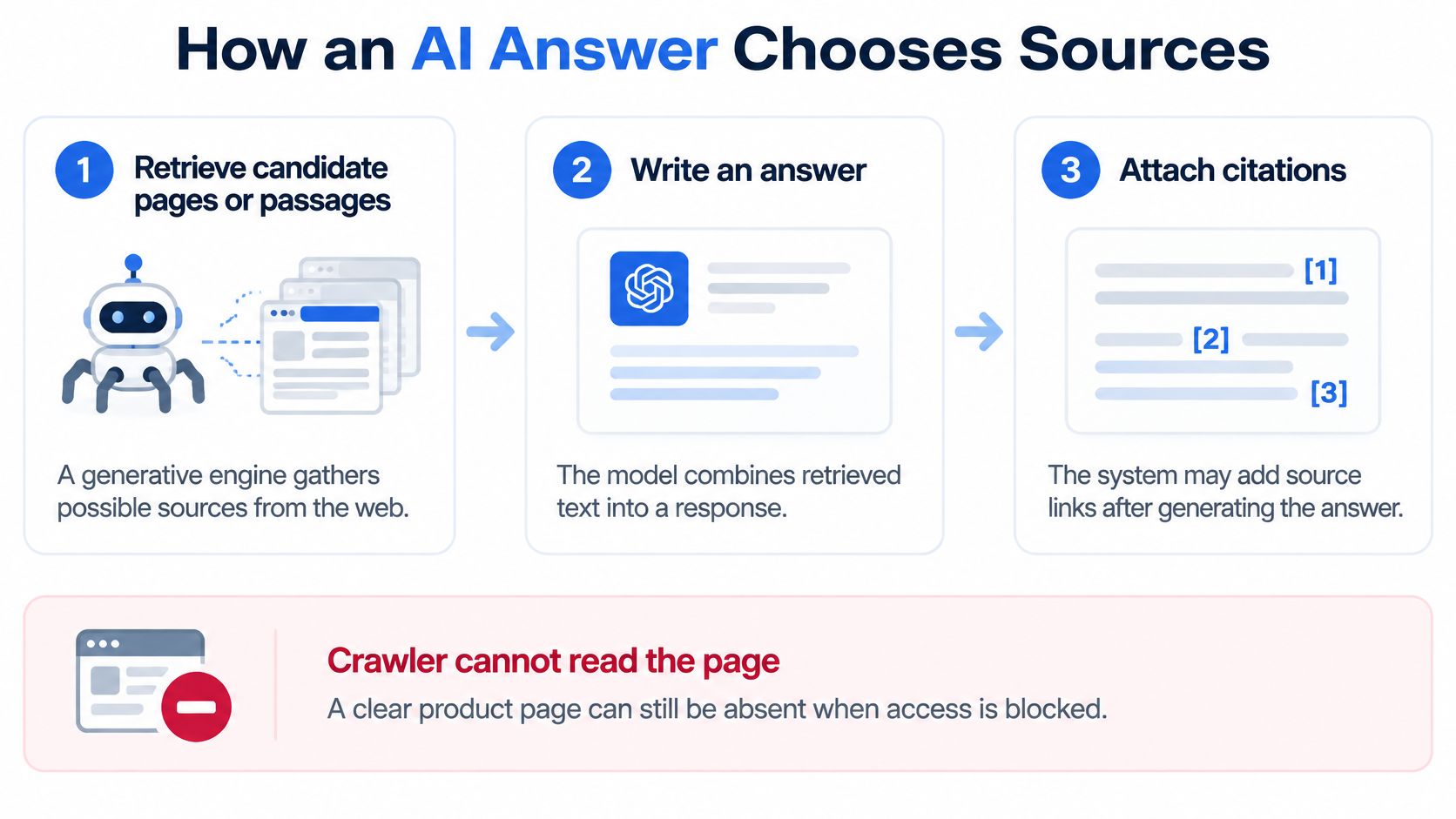
A generative engine works in stages. It retrieves candidate pages or passages, writes an answer from what it found, and may attach citations. Good prose helps only after a page gets retrieved, so a clear product page can still be absent if a crawler can't read it or the page isn't indexed.
One Question Becomes Several Searches#
Google's AI features and your website guidance describes a query fan-out process for AI Overviews and AI Mode. The system issues multiple related searches across subtopics and data sources, then can identify additional supporting pages while generating the response. The result can show a broader, more diverse set of links than a classic search result.
Say a buyer asks for the best help desk for a five-person team. One sentence in the answer may rest on a product page, another on a comparison page, another on documentation, and another on a pricing explanation. Optimizing one target page for one query misses the other three. A founder should list every page that could answer part of that buying question, then check which of those URLs are crawlable and indexed before judging the copy. A useful starting point is a plain review of how robots.txt rules affect crawl access across the pages that matter.
Baseline rule: A page must be indexed and eligible to appear in ordinary Google Search with a snippet before it can qualify as a supporting link in AI Overviews or AI Mode.
Citation also isn't a mirror of classic rank. Because sources are gathered per subtopic, the page that wins a blue-link position isn't automatically the page attached to a claim. The practical implication is simple. Match each page to the specific sub-question it answers, put the directly answerable claim where a reader finds it fast, and support it with evidence that can be checked. Then record which URLs get cited, rather than assuming the ranking page did the work.
Four Gaps Between You and the Tools AI Names#
A citation is not a visit. The Pew Research Center findings reported in Mashable's coverage of the Pew AI Overviews study show that when an AI Overview appeared, U.S. users clicked a traditional result 8% of the time, versus 15% without one. Just 1% clicked a source link inside the summary, and 26% ended the browsing session, compared with 16% without an Overview. More citations can therefore coincide with fewer clicks, which is why the outcomes below need separate tracking.
Four GEO outcomes and the gap each one shows
| Outcome | What to record | Gap signal | Fix to test |
|---|---|---|---|
| Named | Brand appears in the answer | Rivals listed, you absent | Crawl access and third-party lists |
| Recommended | Answer tells the buyer to choose it | Named but not suggested | A comparison sentence that states who it fits |
| Cited | URL attached to a claim | Rival domains cited instead | The page that matches the sub-question |
| Visit | Referral or trial after the answer | Often cited, few clicks | Track AI referrals separately, since citations are not traffic |
Reading Each Gap#
Named is the weakest outcome. The brand appears in a list, perhaps with no reason to pick it. Recommended is stronger, because the answer tells the buyer to choose it, usually for a stated fit such as team size or budget. A help desk tool can be named in every answer and recommended in none, which points to positioning, not access.
Cited means a specific URL backs a claim. If a rival's comparison page is cited while your brand is only named from memory or another source, the rival controls the evidence. Visit is the business layer, a measurable referral or trial after the answer. A brand cited often with almost no clicks may still influence the shortlist, but the team shouldn't report that as traffic growth.
Position cuts across all four. Answers often name only a few tools, so third in a short list reads differently from first, and a brand below the fold of the answer may never be seen.
Before measuring, set the comparison group. Name three to five rivals a buyer would realistically shortlist, then pick five to ten buyer questions for the category. For each question, record who is named, who is recommended, which URLs are cited, and whether analytics show an AI referral. Don't collapse those into one visibility score, because each gap calls for a different fix.
What Software Answers Actually Repeat#
Two evidence sets matter here, and they answer different questions. The first is about content changes. The second is about how stable software recommendations are when the same question is asked again.
The 2024 GEO Method Lifts#
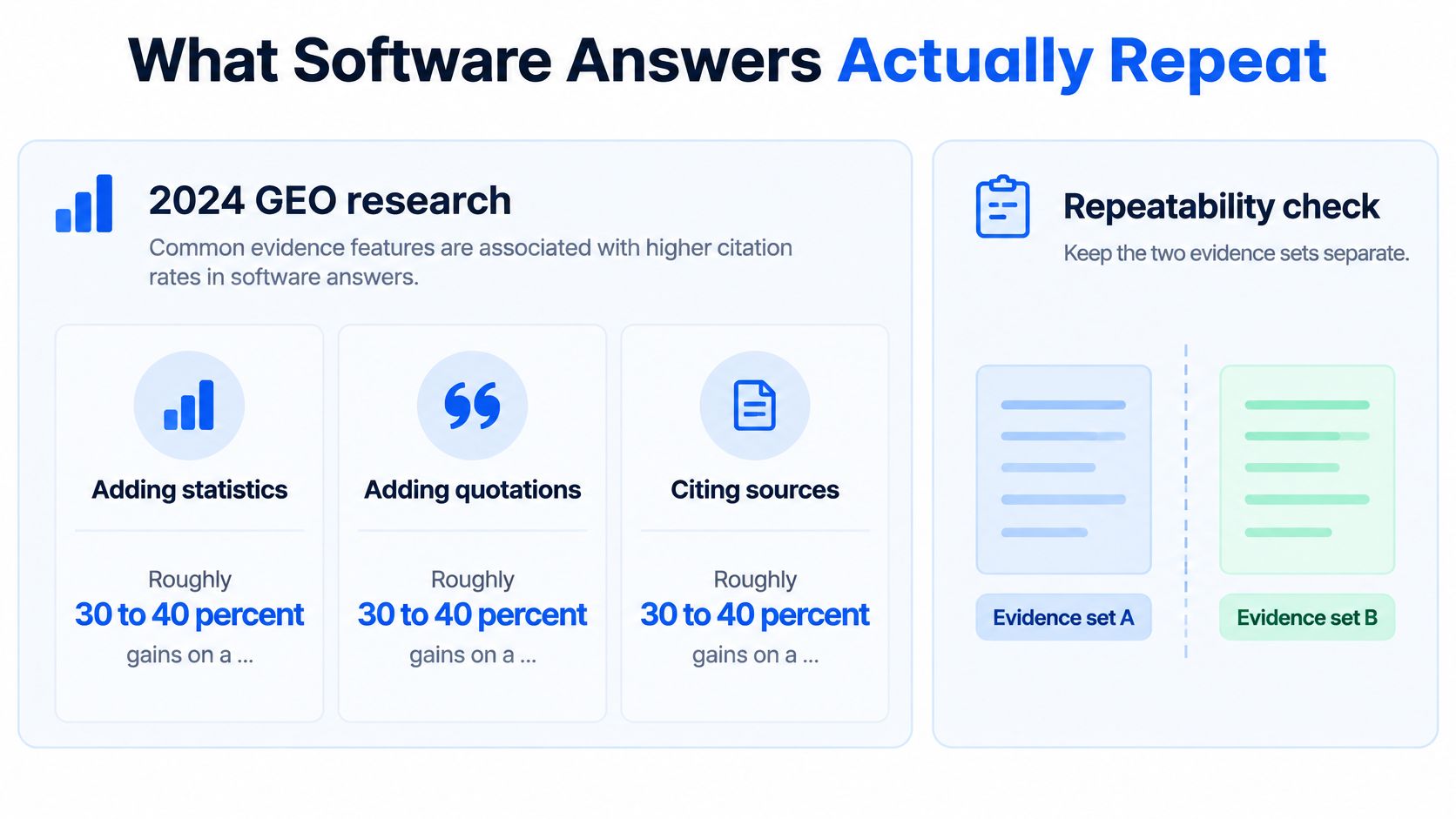
A 2024 GEO research evidence summary reports that adding statistics and citing sources each produced roughly 30 to 40% improvements on a position-adjusted word-count metric. A separate summary of the GEO experiment puts adding quotations at 41% on that same metric relative to the unmodified baseline.
Translated to a SaaS page, statistics means a checkable plan limit, price, or setup time, not a vague claim about saving hours. A quotation means a sentence a buyer could repeat, such as who the tool is built for and who should skip it. Citing sources means linking documentation or a comparison page a model can retrieve and verify. These lifts varied by method and domain, and none of them is a promise of revenue.
Repeat Runs of Software Questions#
The published ChatGPT software recommendations research from Kliqo asked 142 buying questions 4 times each on October 17, 2026, for 568 answers.
Kliqo ChatGPT software recommendation runs
| Measure | Result |
|---|---|
| Buying questions asked | 142 |
| Answers collected | 568 |
| First tool identical in all 4 runs | 81 of 142 questions |
| First tool changed at least once | 61 of 142 questions |
| No tool first in more than two runs | 30 questions |
| Average tools named per answer | 4.2 |
| Tools seen per question across 4 runs | 6.4 different tools, only 2.6 every time |
| Answers linking Reddit or YouTube | None of 568 |
| Answers linking G2 | 3 |
The leaderboard moves between runs, lists stay short, and in that set the links went to vendors' own sites rather than community or review platforms. So a single screenshot proves little, and a readable vendor page carries more weight than many founders expect.
Checks to Run and Measure Again#
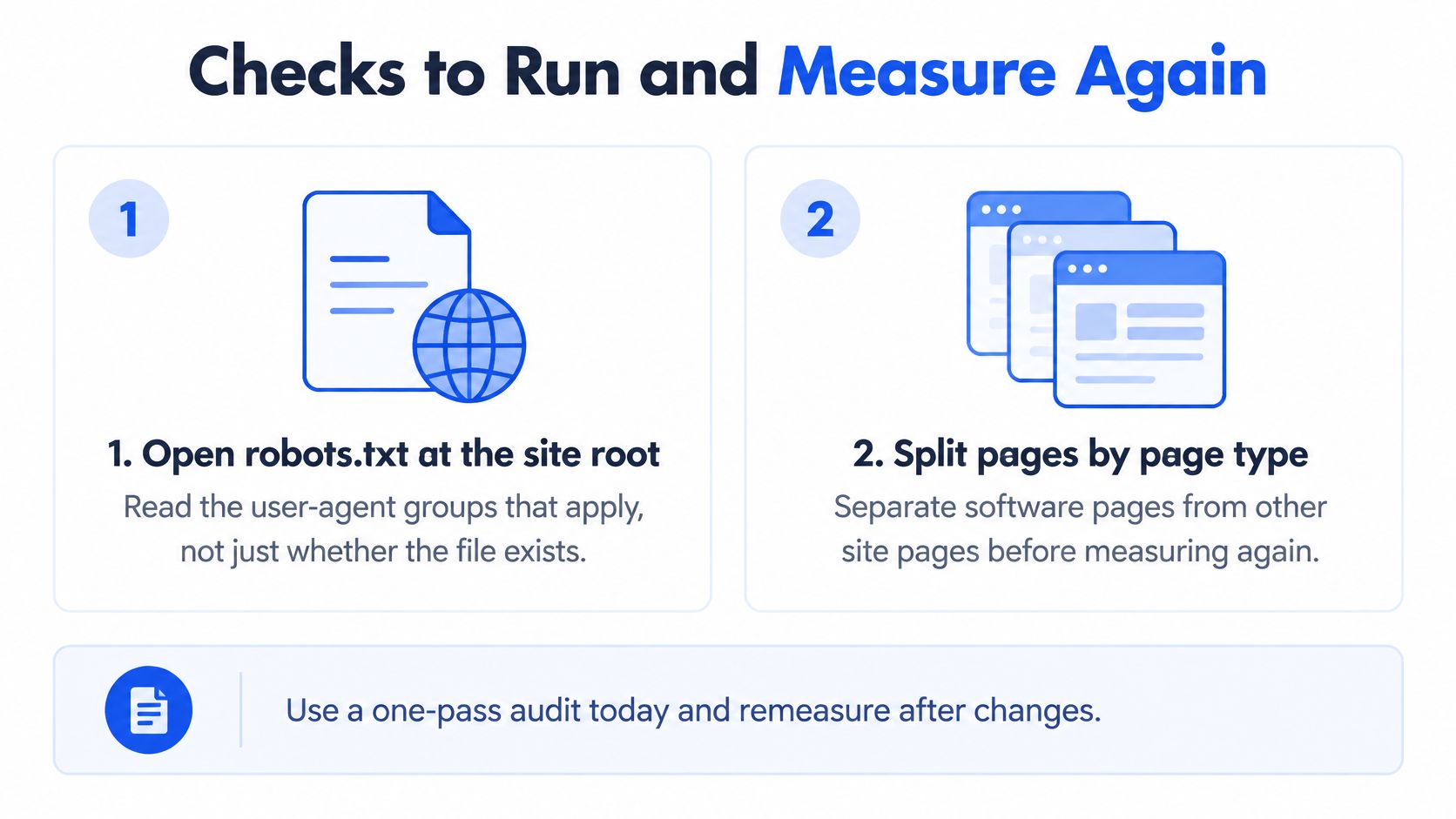
Run one pass today, in this order, using the software pages a buyer would land on.
The One-Pass Check#
- Open robots.txt at the site root. Read the user-agent groups that apply, not just whether the file exists. A stray disallow on a pricing or docs path can cut a page out before content quality matters.
- Split OpenAI's bots. The OpenAI bots documentation states that OAI-SearchBot surfaces websites in ChatGPT search features, while GPTBot relates to training foundation models. Sites opting out of OAI-SearchBot won't be shown in ChatGPT search answers, though they may still appear as navigational links. Blocking the search crawler by accident removes eligibility even when other access is allowed.
- Test the pages that sell. Confirm Googlebot and other wanted crawlers can fetch product, pricing, documentation, and comparison URLs. A disallow rule stops a crawler from requesting a path, but it doesn't by itself remove a URL from Google's index, so treat crawling and indexing as separate checks.
- Run automated checks. Use a free AI crawler access check for blocked bots and sitemap problems, then audit one key page for an empty homepage without JavaScript, weak titles, missing dates, and broken structured data.
- Write one comparison page. State in one sentence which team the product fits and where it doesn't. For example, a form builder might say it fits operations teams that need conditional logic without a developer, and isn't built for regulated clinical intake. That sentence gives an answer something quotable to repeat.
- Fix facts you control. Keep name, category, price, and plan limits identical on the site and on listings the company manages. Then get listed on third-party best-of pages that buyers and AI answers already cite, since a consistent claim repeated across sources is easier to trust than a claim on one page.
Change one input, save the exact answer and cited sources first, then compare a later run on identical wording. Skipping the saved baseline turns every improvement into a guess.
Measure One Gap on One Question#
Pick a single buyer question and diagnose the layer that's failing. Missing entirely means fix crawl access and the pages the answer needs. Named but not recommended means rewrite the comparison sentence so the fit is explicit. A wrong URL cited means align that page title and opening passage to the sub-question it should answer. Citations without clicks means the answer is influencing buyers without sending visits, so check AI referrals in analytics as their own line instead of folding them into organic search.
Re-ask the same wording after the change and compare named brands, recommendation language, and cited URLs against the saved answer. A practical routine for tracking brand mentions in ChatGPT follows the same logic across repeated prompts. Kliqo tracks ChatGPT, Google AI Overviews, Google AI Mode, Gemini, and Copilot, and shows which pages each AI engine cites in its answers.
FAQ#
Is generative engine optimization the same as SEO?#
No. SEO works to rank a page in link results, while GEO works to be accurately named, recommended, or cited inside an AI answer. A page usually still needs to be crawlable and indexable first, so GEO builds on SEO rather than replacing it.
Does getting cited mean more traffic?#
Not by itself. An AI summary can mention a brand while fewer people click through to any site. Track mentions, recommendations, citations, and referrals as separate numbers so influence isn't reported as traffic.
How often should a software team recheck the same question?#
Often enough to see that answers move between runs. Save the answer text, the brands named, and the URLs cited, then compare a later run on the same wording instead of trusting one screenshot.
What should be changed first if competitors keep getting recommended?#
Start with crawler access and one comparison page that states who the product fits. Then check third-party lists and confirm price and plan limits match everywhere the company controls them.
Kliqo AI shows what AI tells your buyers, which sources it trusts, and what to fix so AI recommends you. Visit Kliqo AI to see how your product appears across ChatGPT, Google AI Overviews, Google AI Mode, Gemini, and Copilot, and start closing the gap between being named and being recommended.