Short answer
A founder asks ChatGPT for the best help desk for a five-person team and sees a competitor recommended first. She runs the same question the next morning and a different vendor leads the answer. That swing is normal for software prompts, and it changes how ranking work gets judged.
On this page
- 1. Allow OpenAI's search crawlers in robots.txt
- 2. Make key pages readable without scripts and lead with the answer
- 3. Publish fair comparison pages for the products buyers shortlist
- 4. Earn accurate listings on review platforms and category roundups
- 5. Keep brand facts consistent across every site that describes the product
- 6. Publish original, citable data with a stated method
- 7. Find out which sources ChatGPT already cites for the category
- 8. Track recommendations on a fixed prompt set and measure changes over matched periods
- What each ChatGPT visibility step involves and what it trades off
- Start With Access, Then Measure the Change
- FAQ
There is no fixed position to climb. ChatGPT assembles each answer from sources it trusts in that moment, so a single favorable answer proves nothing and a single omission diagnoses nothing. Recommendations only become meaningful across repeated runs of the same prompt set.
That sets the working order. First confirm that OpenAI's crawlers can read your product, pricing and comparison pages. Then work on the third-party sources ChatGPT already cites when buyers ask shortlist questions in your category. Finally, track whether it names, cites and recommends your product over matched periods, because that is the only signal that separates real gains from answer noise.
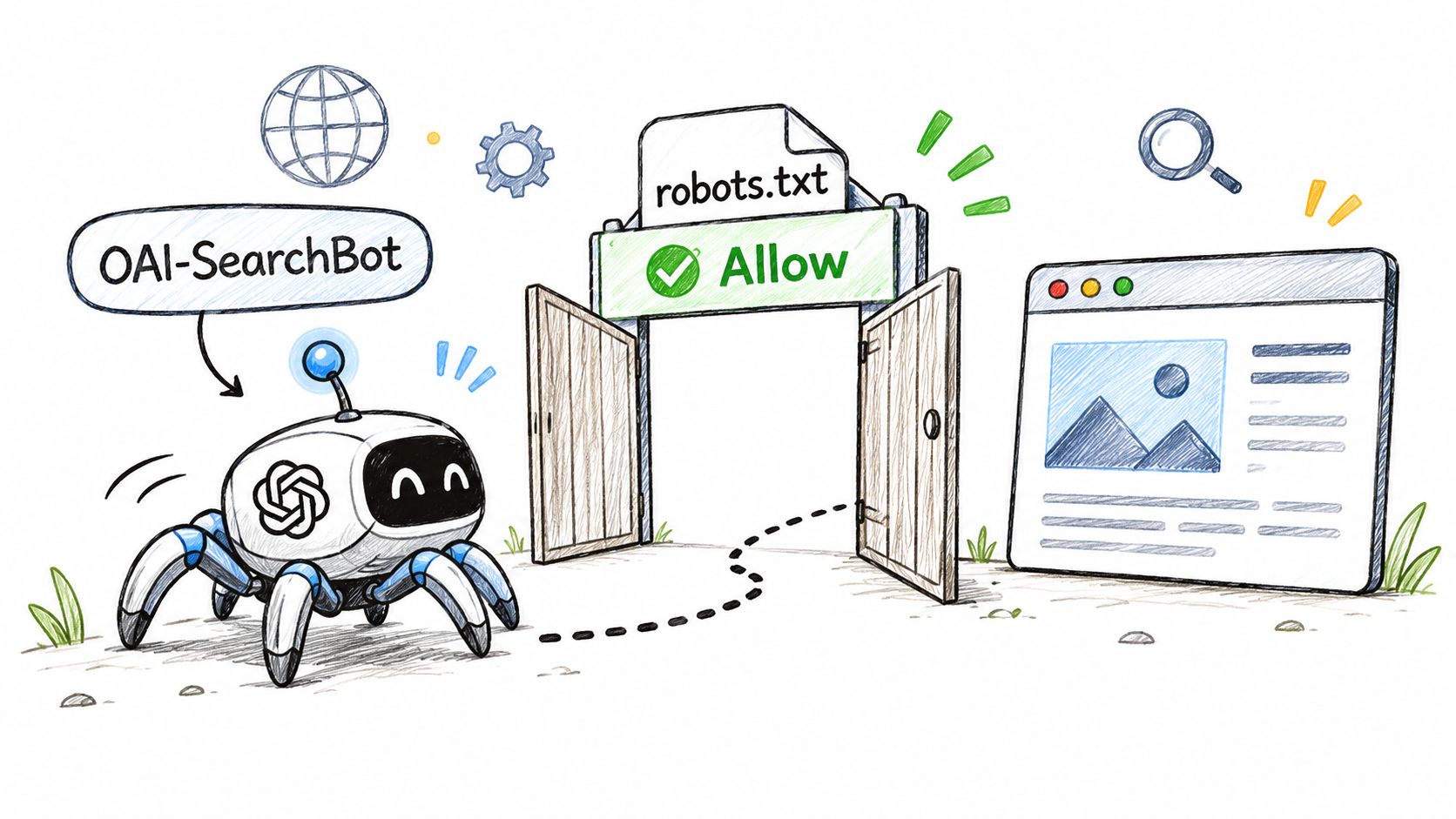
1. Allow OpenAI's search crawlers in robots.txt#
Crawl access comes before content improvements. A detailed software comparison won't help search visibility if the relevant crawler can't retrieve it.
OpenAI's ChatGPT Search guidance recommends allowing OAI-Searchbot and confirming that hosting providers and content-delivery networks permit traffic from its published IP addresses. It also states that search placement isn't guaranteed.
Teams should distinguish the agents before changing access rules. OAI-SearchBot supports search discovery, GPTBot concerns model training, and ChatGPT-User handles certain user-initiated fetches. Search access and training permission shouldn't be treated as the same decision.
- Inspect robots.txt. Check agent-specific rules and broad wildcard exclusions, using this robots.txt SEO guide to review rule behavior.
- Test important URLs. Run product, pricing, integration, and comparison pages through an AI crawler access checker.
- Verify actual requests. Check server logs and firewall events for blocked requests, challenges, and unexpected redirects.
For example, a SaaS team might discover that a staging-site exclusion remained after launch. Removing that rule fixes an eligibility problem, but doesn't establish that ChatGPT will recommend the product.
2. Make key pages readable without scripts and lead with the answer#
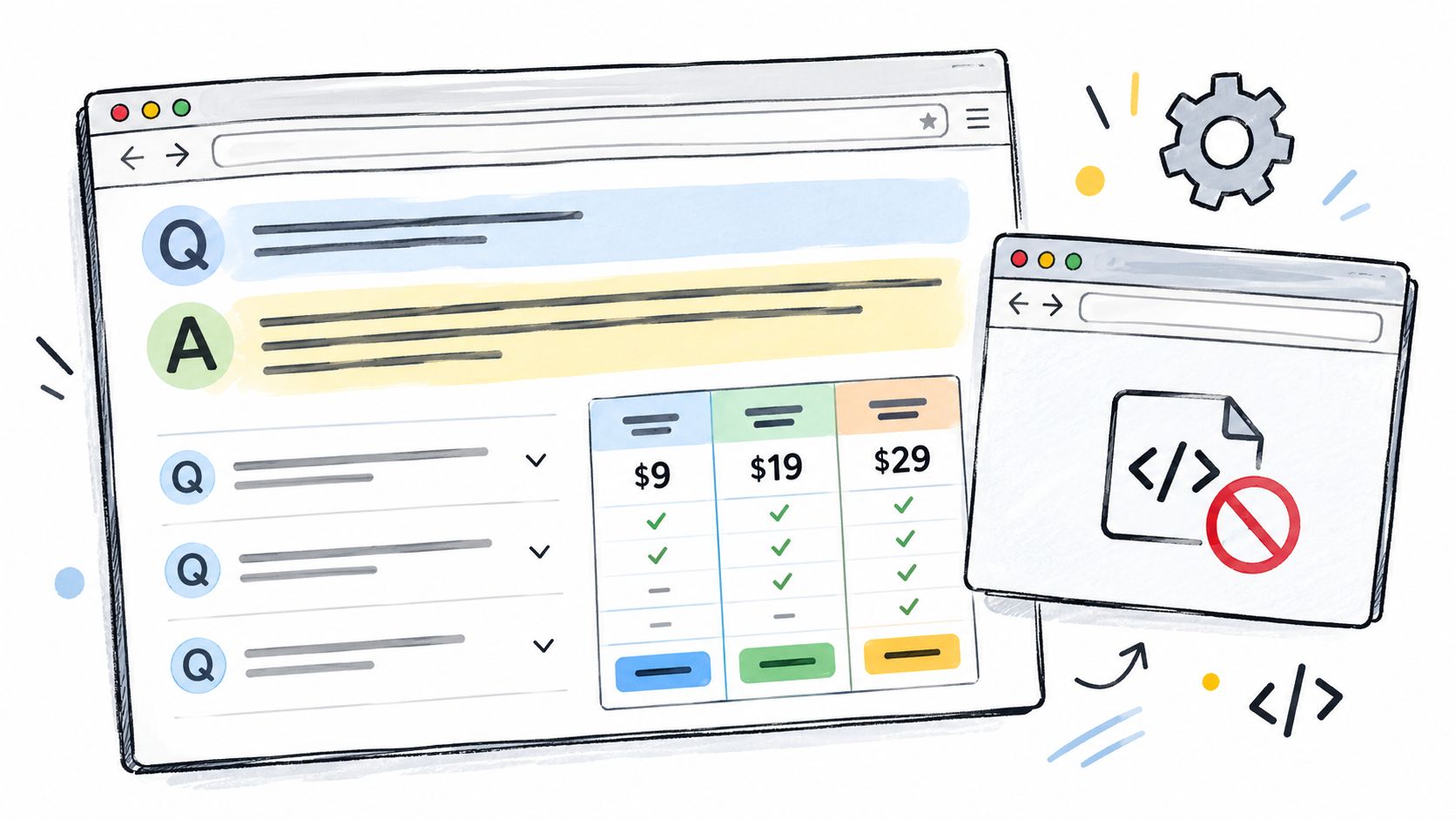
A project management vendor may display attractive pricing cards while serving almost no useful plan information in its initial HTML. Moving the pricing details into readable page content makes them easier to inspect without relying on an interactive widget.
Teams should load key pages with JavaScript disabled and compare the result with the normal browser view. Product purpose, pricing terms, feature availability, and integration names should remain understandable. An AI page audit can support this review, but the rendered page and underlying HTML still deserve inspection.
Put buyer-critical facts near the top#
The opening paragraph should state the product category, intended customer, and important limitation. A help desk page might explain that the software suits small support teams handling email tickets, while advanced workforce scheduling requires another product.
Practical rule: Publish the facts needed to evaluate the software before asking visitors to book a demo.
Useful headings include pricing, security, integrations, migration, and implementation. A short FAQ can address recurring sales questions without forcing readers to search through promotional copy.
3. Publish fair comparison pages for the products buyers shortlist#
A useful comparison helps a buyer reject an unsuitable product. Pages that declare the publisher superior in every category don't provide enough information for a serious software decision.
Start with competitors appearing in sales conversations and buyer prompts. For a help desk vendor, that might mean comparing its product with Zendesk or Freshdesk, rather than selecting an obscure alternative that's easy to beat.
Each page should explain meaningful differences:
- Buyer fit. Identify which team structure and workflow each product supports.
- Feature boundaries. Separate native functionality from integrations, add-ons, and enterprise-only features.
- Buying terms. Explain billing assumptions, implementation requirements, and relevant restrictions.
- Evidence. Link competitor claims to official documentation and record when they were reviewed.
For example, a smaller vendor might offer simpler administration while Zendesk better suits a complex support operation. That distinction is more useful than a vague claim about being easier and more powerful.
G2 and Capterra provide familiar comparison formats, but copying their layouts isn't the objective. The page needs specific, current information that supports the buyer's actual shortlist.
4. Earn accurate listings on review platforms and category roundups#
An accurate company website doesn't replace independent evaluation. Reputation questions require a different outreach plan from product-feature questions.
A Geeky Tech study published in 2026 examined 613 B2B queries in the United States and United Kingdom and found that review platforms supplied 36% of cited URLs for reputation queries, versus 6% for other intents. That finding supports prioritizing review profiles when buyers ask whether a software vendor is trustworthy.
Work backward from relevant citations#
A CRM team should identify the review platforms and category publications appearing in its own prompt results. It can then complete editable profiles, correct retired feature descriptions, and approach relevant editors with verifiable updates.
- Request genuine reviews. Use the platform's invitation process without requiring positive sentiment.
- Offer evaluation access. Give publishers enough access to assess the software independently.
- Check disclosures. Distinguish editorial recommendations from sponsored placements and affiliate arrangements.
For example, a vendor launching a native Salesforce integration can send documentation and evaluation access to a publisher covering its category. The editor decides whether that change warrants inclusion.
Paying for placement buys placement. It doesn't establish independent endorsement or guarantee a recommendation in ChatGPT.
5. Keep brand facts consistent across every site that describes the product#
A directory profile that lists a retired plan can undermine an otherwise accurate pricing page. Teams should correct the source of the outdated claim rather than merely publishing another announcement.
Create a maintained brand fact sheet covering category, customer fit, pricing structure, supported platforms, integrations, and important feature restrictions. Assign an owner to each fact so product changes trigger corresponding profile updates.
- Check owned pages first. Product pages, documentation, pricing, and FAQs should agree.
- Update editable profiles. Review G2, Capterra, partner directories, and marketplace listings.
- Request external corrections. Send publishers the incorrect statement and supporting documentation.
A SaaS vendor changing a plan name should update its pricing page and directory profiles together. Archived announcements can retain historical information, but should clearly identify it as historical where confusion is likely.
Use markup to reinforce visible facts#
Schema.org Organization and Product markup can express consistent names and product details in machine-readable form. It shouldn't contain claims missing from the visible page or imply capabilities the product doesn't offer.
A useful final check is to ask ChatGPT factual questions about the product, record the claims, and verify each against current documentation. An inaccurate answer is a lead for investigation, not proof of which source caused it.
6. Publish original, citable data with a stated method#
Original evidence gives a publisher something useful to contribute beyond rewritten advice. For SaaS companies, that could mean a reproducible import benchmark, an anonymized workflow analysis, or a documented integration test.
Google's February 2023 guidance on AI-generated content emphasizes original, high-quality information rather than rewarding content because automation produced it. That's guidance for Google, not a disclosed ChatGPT ranking formula, but it supports a sensible editorial standard.
A benchmark page should explain what was tested, how the test ran, when collection occurred, and what the result doesn't establish. The guide to getting recommended by ChatGPT provides related context for turning evidence into useful recommendation content.
- Describe the sample. Explain which accounts, workloads, or configurations were included.
- Expose assumptions. State whether caching, configuration, or paid add-ons affected results.
- Separate observation from interpretation. Distinguish measured performance from conclusions about buyer suitability.
For example, an integration vendor could publish a CSV import test with field mappings, failure conditions, and rerun instructions. A broad claim that the product has the fastest migration isn't defensible unless the test establishes that comparison.
7. Find out which sources ChatGPT already cites for the category#
Before commissioning more content, teams should inspect the pages already appearing in relevant answers. That often produces a more actionable backlog than a broad keyword export.
For a help desk category, prompts should cover small-team suitability, alternatives, migration, integrations, and pricing constraints. Record the full answer and every visible citation, then open the cited URLs to check what they say.
Build a source opportunity log#
The workflow in this AI citation tracking guide can be organized around these fields:
- Prompt and context. Preserve the wording, date, country setting, and search behavior.
- Domain and URL. Record the exact page, not just the publisher.
- Source type. Separate owned pages, review platforms, publications, and community discussions.
- Relevant passage. Identify the text supporting the recommendation or comparison.
Suppose competitor comparison pages repeatedly appear for small-team help desk prompts. The next task is to identify what those pages explain clearly, then address genuine information gaps on the vendor's own comparison page.
A citation identifies evidence in an answer. It doesn't prove that every claim on that page influenced the recommendation.
Teams should repeat prompts on different days and prioritize recurring, relevant sources over isolated appearances. Citation visibility also shouldn't be mistaken for a complete retrieval log.
8. Track recommendations on a fixed prompt set and measure changes over matched periods#
A brand can appear in an answer without being recommended. It can also receive a citation while another vendor gets the strongest endorsement.
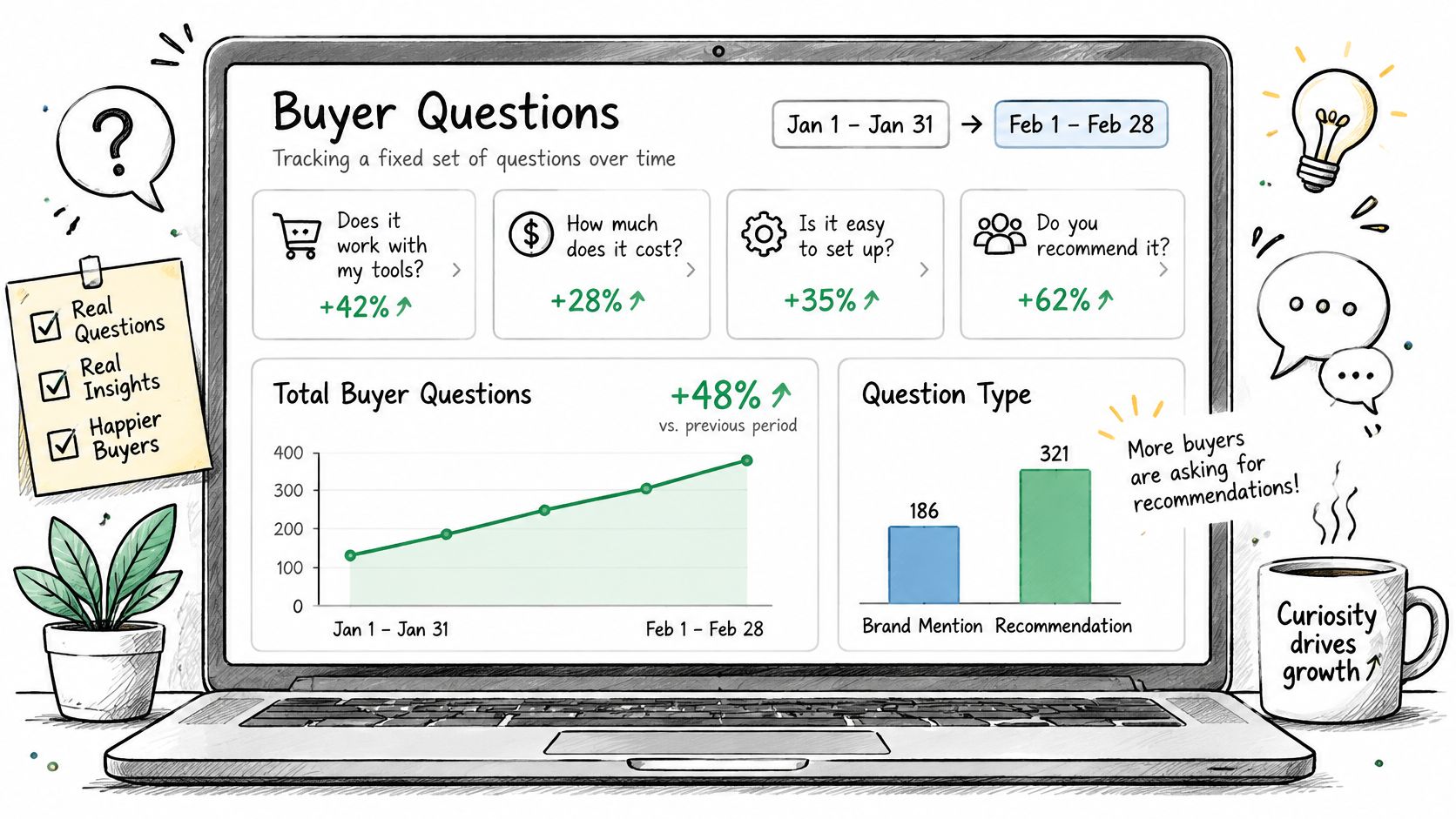
An analysis reported by Kompozy in 2026 examined 3,115 brand–question pairs across 57 comparison questions and found that citation presence didn't reliably translate into answer visibility. Teams therefore need separate records for mentions, citations, and explicit recommendations.
Use a fixed set of unbranded software-buying questions and a consistent schedule. This guide to tracking brand mentions in ChatGPT supports separating general visibility from recommendation outcomes.
- Keep conditions comparable. Preserve prompts, engines, country settings, and account context where possible.
- Record completed work. Log when a crawl fix, comparison update, or profile correction goes live.
- Compare matched periods. Review equivalent windows before and after the change, not selected favorable runs.
- Keep missing results separate. An unavailable answer isn't evidence that the brand was absent.
For example, a team updating its migration comparison should compare the same migration prompts before and after publication. A positive change suggests progress, but doesn't prove causation when other sources and product conditions also changed.
What each ChatGPT visibility step involves and what it trades off#
Every step buys something and costs something. Access fixes are cheap and fast, but they only open the door. The source and measurement work further down the list is slower, and it is where recommendations actually change.
| Item | Key Pro | Key Con |
|---|---|---|
| Allow OpenAI's search crawlers in robots.txt | Quick change that lets you control which sections AI crawlers can access | Allowing crawlers does not guarantee citations |
| Make key pages readable without scripts and lead with the answer | Improves readability for people and automated systems | Requires editorial time and review |
| Publish fair comparison pages for the products buyers shortlist | Matches buyer questions and builds trust through honest tradeoffs | Competitor details require ongoing updates |
| Earn accurate listings on review platforms and category roundups | Provides third-party validation beyond your own claims | Reviews and roundup placements are not fully under your control |
| Keep your brand facts consistent across every site that describes you | Reduces outdated or inaccurate claims in AI answers | Maintaining third-party listings takes repetitive work |
| Publish original, citable data with a stated method | Can earn citations and provide reusable material | Quality research takes time and budget |
| Find out which sources ChatGPT already cites for your category | Reveals which pages and sources to prioritize | Manual checks are time-consuming and results can vary |
| Track recommendations on a fixed prompt set and measure changes over matched periods | Makes visibility work measurable and helps surface errors | Requires a consistent process over time |
Read the table as a sequence, not a menu. The first two rows confirm that crawlers can read the site. A free AI crawler access check covers robots.txt health, the sitemap and the homepage without JavaScript, returns the exact fix, and runs without an account.
Rows three through six work on the sources ChatGPT already cites for software buyers. The last two rows turn that work into measurement. Asking each tracked prompt on multiple AI engines every night produces enough answers to compare matched periods, which is what separates a real trend from a lucky run.
Start With Access, Then Measure the Change#
The most useful starting point is a technical check, not another batch of articles. Confirm that search crawlers are allowed, inspect firewall behavior, and make sure product facts remain readable without scripts.
Then select a small, manageable set of changes. A team could correct a relevant directory profile, approach a publisher already cited for its category, and revise a comparison page that leaves buyer questions unanswered.
Each change needs a clear reason and a completion date. That makes later measurement more informative than an undifferentiated campaign of content updates.
- Access problems need technical fixes. Better copy won't resolve a blocked request.
- Information gaps need clearer evidence. More adjectives won't explain integration limits.
- Reputation gaps need independent coverage. Another owned landing page won't replace customer evaluation.
- Measurement gaps need repeated observations. A screenshot won't establish a durable trend.
Results should be judged on the same prompts, engines, and country settings over matched periods. Teams should inspect the underlying answers as well as summary metrics, especially when an apparent improvement comes from a generic mention rather than a buying recommendation.
FAQ#
Can a company guarantee the top position in ChatGPT?#
No. ChatGPT doesn't offer a guaranteed search position, and recommendations can vary between runs. Teams can improve eligibility and supporting evidence, then measure how often relevant answers recommend the product.
Does blocking GPTBot prevent ChatGPT search visibility?#
Blocking the training crawler isn't the same as blocking search access. Teams should evaluate OAI-SearchBot rules and infrastructure access separately from their training-permission policy.
Why does ChatGPT cite a page without recommending the brand?#
A cited page may support a feature description, limitation, or comparison rather than an endorsement. The recommendation can favor another product based on the buyer's stated requirements.
Is strong Google visibility enough to appear in ChatGPT?#
No. Conventional SEO can support discoverability, but a Google position doesn't guarantee inclusion in a ChatGPT answer. Relevant buyer prompts, accessible pages, and independent source coverage need separate evaluation.
How should teams measure progress after making changes?#
Teams should repeat a fixed prompt set under comparable conditions and compare matched reporting periods. Mentions, citations, explicit recommendations, and factual accuracy should remain separate measures.
Kliqo AI runs buyer prompts across ChatGPT, Google AI Overviews, Google AI Mode, Gemini, and Copilot, recording recommendations and cited sources. Teams can visit Kliqo AI to set up recurring monitoring and compare answers before and after crawl fixes, content updates, and source corrections.