Short answer
LLM SEO is the practice of making a brand's pages, facts and reviews easy for AI assistants and AI search features to find, read and recommend when buyers ask for software. Competitive intelligence supports it by showing which brands AI names, which sources it cites and where a brand is missing from the shortlist.
On this page
What LLM SEO Means and Why It Matters Now#
Say a 10-person sales team needs a CRM. A buyer asks an assistant for a recommendation and gets one short paragraph naming three tools, with a reason for each. A CRM left out of that paragraph doesn't get a demo, a trial or a second look, even if its website ranks well in ordinary search.
That pattern became mainstream when generative answers moved into core search. Google's October 2024 AI Overviews update says Google announced AI Overviews at Google I/O in May 2024 and that by October 2024 it was reaching more than 100 countries and territories. Exposure is now ordinary, not experimental. Pew Research Center analyzed browsing by 900 U.S. adults during March 2025 and found 58% conducted at least one search that produced an AI-generated summary, while 65% encountered an AI reference somewhere on a search-results page.
The risk is easy to miss in normal reporting. Rankings can hold steady while the generated answer above them names only competitors. Rankings also can't show whether an answer describes pricing, limits or features correctly.
Starting action: List five questions a buyer in the category would ask, put each one into three assistants, and note every brand named.
That first check takes less than an hour. It also gives a dated baseline, because later improvements only mean something when the same questions are asked again and compared against the original answers.
How LLM SEO Differs From Classic Search Tracking#
Classic SEO tracking asks where a page ranks for a keyword. LLM SEO tracking asks a different question: does an assistant name the brand, recommend it or leave it out?
A classic search for project management software returns ten ranked links, and the buyer opens them one at a time. An assistant asked for the best project management tool for a 20-person agency returns a short answer naming two or three vendors. Any vendor missing from that answer has to win attention somewhere else.
| Measure | Classic SEO tracking | LLM SEO tracking |
|---|---|---|
| Unit of success | Ranking position for a keyword | Named, recommended or missing in the answer |
| Result shown | Ranked list of blue links | One synthesized answer naming a few brands and sources |
| Main signal | Impressions, clicks and position | Mention rate, recommendation share and answer position |
| Source signal | Backlinks and on-page relevance | Cited URLs and the claims they support |
| Stability | Rankings move gradually | Answers vary between runs, so each prompt needs repeating |
| Who can appear | Pages on your own domain | Brands named from any source, including third-party sites |
The unit of success changes first. Position four in blue links is visible. Fourth place in an answer that only names three tools doesn't exist. The main signal changes too, because a mention without a recommendation ("Tool X exists, but many choose Tool Y") can hurt more than it helps.
Source signal and who can appear explain another surprise. Assistants draw on third-party lists, review sites and community threads, so a brand can appear without any page targeting the question, and can be absent despite strong pages nobody else references. Stability is the final trap. Answers vary between runs, so one screenshot proves almost nothing.
Keep rankings for traffic reporting, add answer measures beside them, and never read a drop in one as a drop in the other.
Tracking Competitors Across Buyer Prompts#
A sales lead at a CRM vendor asks an assistant for the best option for a 10-person team, and the answer names three rivals but not her product. That single answer tells her little on its own. A log of the same prompt across several weeks tells her exactly where she stands.
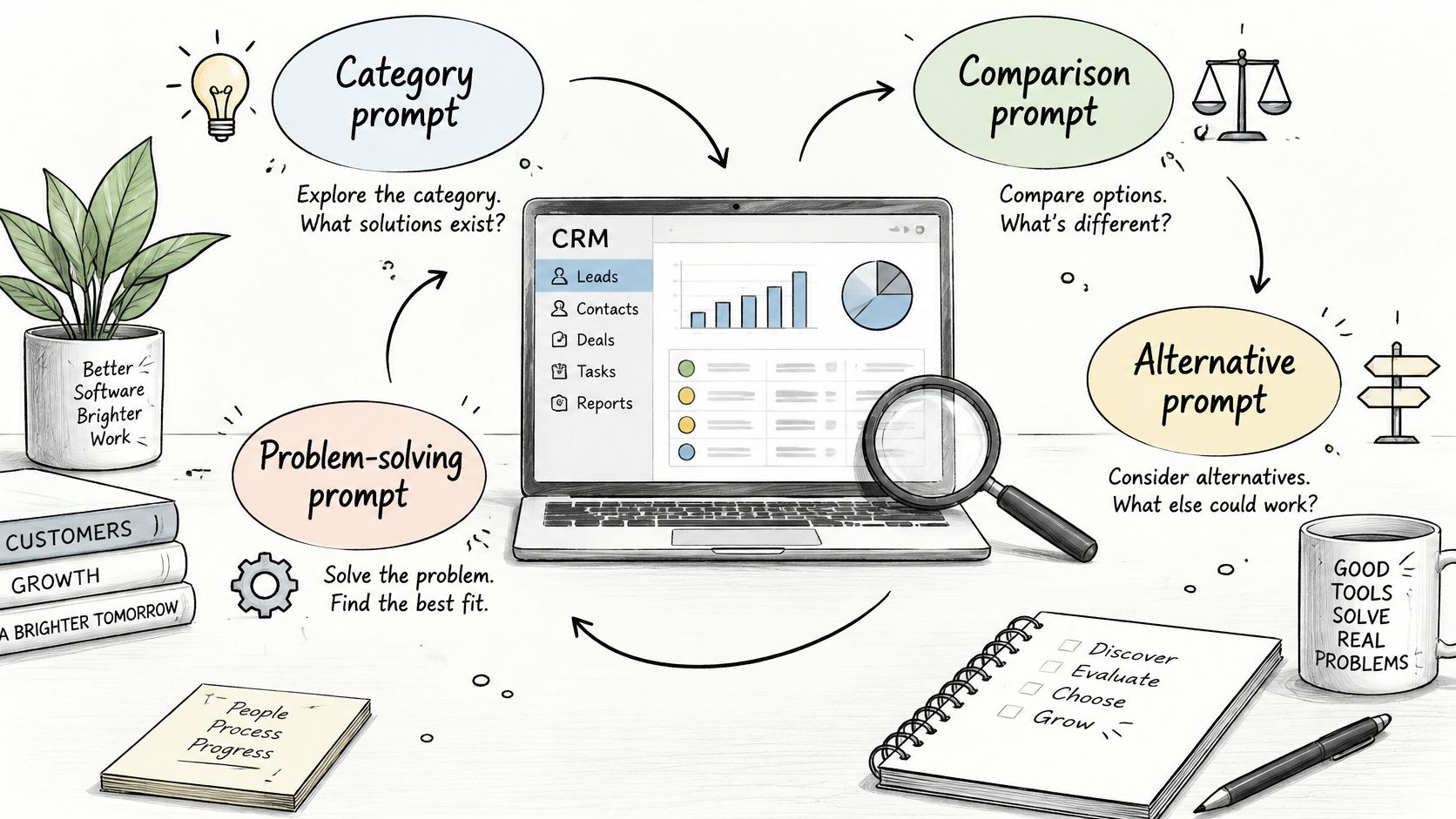
SaaS buyers ask four kinds of prompts that produce brand names:
- Category prompts: "Best CRM for a 10-person sales team"
- Comparison prompts: Two named tools placed side by side
- Alternative prompts: Options similar to a well-known product
- Feature prompts: "Help desk software with SMS support"
Prompts that ask which product, tool or service fits a need produce answers that name brands. General questions such as "how do I…" get advice instead and say little about visibility, so the tracked set should lean heavily toward the four types above.
A logging routine that holds up#
- List the field. Write down five to eight direct competitors plus the brand being tracked.
- Write the prompts. Draft 20 to 40 prompts spread across the four types, using the wording buyers use on sales calls.
- Run each prompt repeatedly. Run every prompt at least three times on each engine that matters, such as ChatGPT, Google AI Overviews, Google AI Mode, Gemini or Copilot.
- Log the details. Record every brand named, its position, whether it's recommended or only mentioned, and the pages cited.
Repetition is essential here. A single run can differ from the next, so identical prompts should be asked again at intervals before any pattern is trusted. For the logging mechanics themselves, this walkthrough on tracking brand mentions in ChatGPT covers the details step by step.
One run isn't a result. The log becomes useful only when identical prompts are repeated over time, so a change in the answers can be tied to work that shipped in between. And when a gap holds across several runs, it earns a place in the work plan with a date and a single owner, so the next check shows whether the fix moved the answer.
Checking the Sources Behind Competitor Answers#
Say an assistant states that a tool includes single sign-on and cites the vendor's help page. Opening that page shows single sign-on is limited to paid plans. The citation looks solid in the answer, but it doesn't support the claim as written.
That's common because assistants retrieve pages, then synthesize an answer from them. Microsoft's Bing search documentation describes generative answers as based on search results with references to source websites so users can verify the response. Verification matters because a URL's mere appearance doesn't prove the page supports the statement attached to it.
What to record for every prompt#
Record the answer claim, the cited URL, the exact supporting passage, the source domain, whether competitors appear, and whether the brand is merely mentioned or explicitly recommended. A structured approach to AI citation tracking keeps those fields consistent across runs.
| What the audit finds | What it usually means | Next step |
|---|---|---|
| Brand not named, competitors named | Missing from the shortlist | Compare the pages cited for competitors and build a matching page |
| Brand mentioned but not recommended | Known, but not chosen | Strengthen comparison evidence and clear decision criteria |
| Competitor cited, your page not cited | Source gap | Identify the page type cited and create or update an equivalent |
| Cited page blocked or not indexed | Access or eligibility failure | Fix crawl access and indexing, then re-run the prompt |
| Cited passage does not support the claim | Misattribution or weak source page | Record the claim, then correct the source page or the claim wording |
Access gets tested before content gets judged, since a blocked or unindexed page can't be selected no matter how good it is. Over repeated identical prompts, tracking should cover citation rate, source persistence, claim support, recommendation share and answer position. In Kliqo, each metric, gap and suggestion links to the answers and sources behind it, which makes before-and-after checks faster.
Rule of order: Fix an inaccurate claim at its source page before chasing more citations, because a wrong claim repeated in more answers creates more risk.
Turning Competitor Citations Into Your Opportunities#
Start with prompts where competitors get recommended and the tracked brand doesn't. Pull every cited URL from those answers and group the URLs by page type: comparison pages, best-of lists, review sites, community threads and documentation. Patterns show up quickly.
Say a project management tool keeps getting cited through a best-of list for agencies, while a help desk tool is cited through a side-by-side comparison with a rival. Those are two different gaps. The first calls for a listing on that roundup. The second calls for a comparison page of equal depth. A structured competitive gap analysis helps separate the two instead of treating every missing citation the same way.
Rank the gaps by prompt intent. Comparison and best-of prompts sit closest to a purchase, so they come first. Informational prompts matter, but they rarely decide a shortlist this week.
Three tactics that follow from the audit#
- Write the comparison page. State where the product fits in one clear sentence an assistant can repeat, then back it with honest side-by-side criteria, including cases where a rival is the better fit.
- Contact list and review owners. Send accurate facts and ask for a correction or a listing. Outdated pricing on a third-party page is a frequent, fixable problem.
- Align the facts everywhere. Keep name, category, pricing, limits and dates identical across the site, directories and profiles so assistants don't pick up conflicting claims.
A citation doesn't guarantee a click or a sale. After acting on a gap, check whether improved answers for those prompts coincide with more branded searches or sign-ups over the same period.
Every opportunity gets one owner and one review date. A citation nobody owns stays a spreadsheet row, not a change in what buyers read.
Practical Steps to Take This Week#
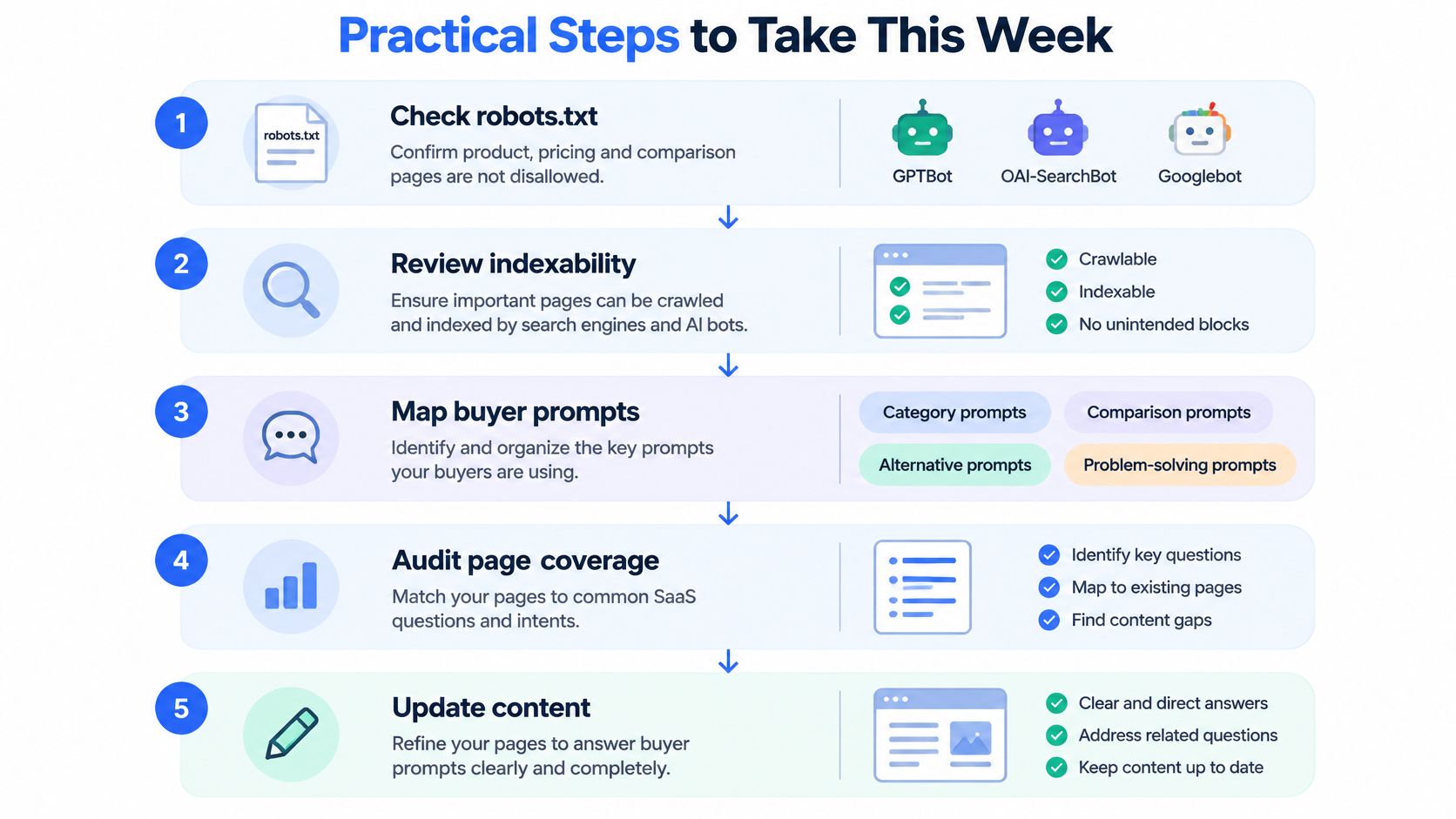
- Check robots.txt. Look for OpenAI crawlers such as GPTBot and OAI-SearchBot and for Googlebot, and confirm product, pricing and comparison pages aren't disallowed. A rule blocking a whole directory often goes unnoticed for months. The free AI crawler checker shows whether ChatGPT, Claude, Perplexity, Google and other AI crawlers can read a site, covering robots.txt health, the sitemap and the homepage without JavaScript, with the exact fix.
- Confirm indexing. Check each key page in Google Search Console and confirm it can show a normal snippet, because pages supporting AI Overviews have to meet that bar first.
- Check text without JavaScript. Confirm key pages show their main text in plain HTML. Text that loads late through scripts can be missed entirely, and the same checker covers this test.
- Publish one comparison page per main competitor. Include a clear sentence on where the product fits, honest criteria and current pricing.
- Contact three third-party lists or review sites. Send accurate facts and ask for corrections or a listing. Old prices left on a listing are a common slip.
- Align core facts. Match name, category, pricing, limits and dates across the site, directories and profiles so no two sources disagree.
- Re-run the same prompts two weeks later. Use the same prompt set on the same engines and compare logs before and after, because one run isn't a result.
A scheduled tracker such as Kliqo can run this re-check loop if manual checks become too slow.
FAQ#
Is LLM SEO just SEO with new keywords?#
No. It's measured by named recommendations and cited sources, not by ranking position alone. Crawlable pages and clear content still underpin both, but the scoreboard is different.
Which AI engines should a team track first?#
Start with the engines buyers use, typically ChatGPT and Google AI Overviews. Answers differ from one engine to another, so strong visibility in one doesn't guarantee visibility in the rest.
Does being cited mean buyers will click?#
Not necessarily. A citation can build familiarity without producing a visit. Check branded search volume and sign-ups for the same period to see whether visibility is turning into demand.
How long before changes show up in AI answers?#
Timing varies by engine and by how quickly source pages get recrawled. Compare matched periods over several weeks and expect noise between individual runs before calling a change real.
Kliqo AI tracks buyer prompts across ChatGPT, Google AI Overviews, Google AI Mode, Gemini and Copilot, records which brands get named and recommended, and shows the cited sources behind each answer. Teams that want competitor citation checks on a schedule instead of manual spot checks can start at Kliqo AI.