Short answer
A software brand gets mentioned by AI when crawlable pages and third-party lists answer the buyer question in a sentence an assistant can repeat. A mention isn't the same as a recommendation, so both outcomes need separate tracking from the first baseline.
On this page
How to Get Your Brand Mentioned by AI#
The practical answer to how to get your brand mentioned by AI starts before any new copy gets written. An assistant names a software brand when a buyer question retrieves crawlable pages and independent write-ups that already name it, and when those pages state who the product fits in one clear sentence. A name buried in a list still isn't a recommendation, so competitor coverage needs scoring before pages get added.
Say a buyer asks for the best help desk for a five-person SaaS team. The answer names three products, explains the fit for each one, and skips a fourth vendor entirely. That missing vendor doesn't have a slogan problem. It has an evidence problem, because the retrieved pages gave the assistant no repeatable reason to include it for that team size, budget, or workflow.
Why clicks mislead the plan#
The exposure is often the answer itself. The 2025 Pew Research Center behavioral study of 68,879 Google searches by 900 U.S. adults found that a link inside an AI summary was clicked on 1 percent of visits, and any conventional result was clicked on 8 percent of searches with a summary versus 15 percent without one. Sessions ended after a summary 26 percent of the time, compared with 16 percent without one. A team that judges AI visibility by referral clicks alone will undercount being named and miss being passed over.
That shifts the goal toward concise, verifiable, extractable material. Product facts, comparisons, qualifications, dates, prices, and policies give an assistant something it can summarize and cite. Vague positioning copy doesn't.
The scorecard for week one#
The week-one order is confirm crawl access, save the buyer questions where rivals are named, list every URL those answers cite, mark claims those pages make that owned pages don't, and log mention versus recommendation before editing copy. A fuller version of that sequence sits in the guide to getting recommended by ChatGPT. Crawl access comes first, and a check of robots.txt, the sitemap, and a homepage readable without JavaScript can run through the AI crawler checker.
Scorecard for getting a software brand into AI answers
| Check | What to inspect | Pass signal |
|---|---|---|
| Crawl access | robots.txt, sitemap, and the homepage without JavaScript | AI crawlers are allowed and the page text is in the HTML |
| Buyer prompts | Discovery, comparison, alternatives, pricing, use case, and objection questions | The same software-buying prompts are saved for every rerun |
| Cited sources | Domains and URLs under the answer | The pages that supported the rival shortlist can be named |
| Comparison sentence | Who the product is for, price, limits, and setup | One sentence states the fit without an unsupported superlative |
| Measurement | Mention, recommendation, position, and citation logged separately | A baseline exists before any page is changed |
Once that scorecard exists, the competitor pages behind each lost answer become the content plan.
Score Competitor Pages for Coverage Gaps#
A small, fixed prompt set beats a large, shifting one. The audit below fits in a spreadsheet and gives a content lead a gap list that later work can be measured against.
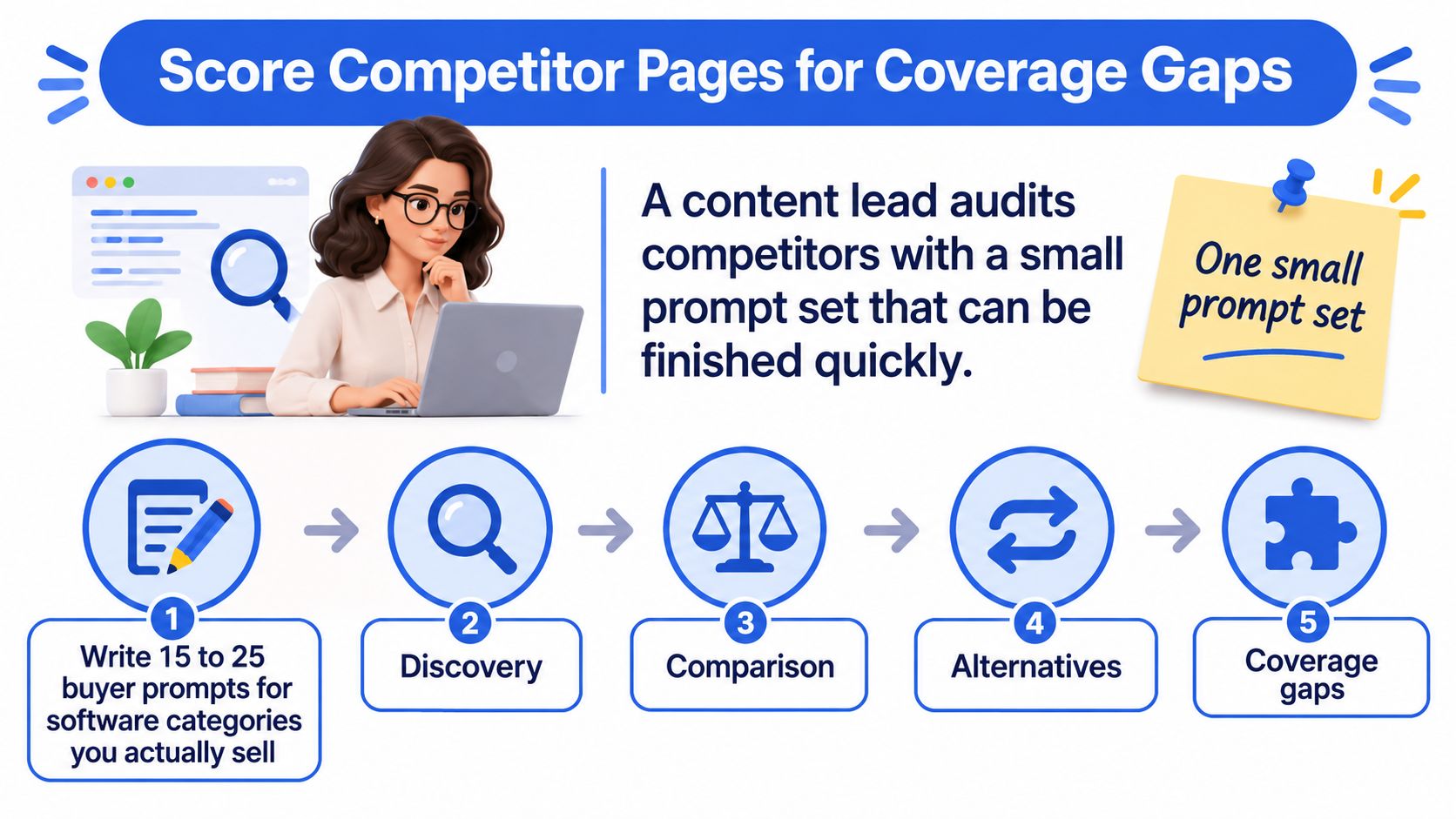
Six steps in order#
- Write 15 to 25 buyer prompts: Cover only software categories sold, split across discovery, comparison, alternatives, pricing, one use case, and one objection. Real buying questions matter because prompts that ask which product, tool, or service fits a need produce answers that name brands. General questions such as "how do I" prompts get advice instead and say little about visibility.
- Run each prompt twice: Use ChatGPT with search and Google AI Overviews, then save the full answer, date, country, engine, every named brand, and whether the tracked brand was missing, named, or recommended. Don't summarize from memory, because wording and order change between runs.
- Copy every cited URL: OpenAI's ChatGPT Search help page explains that ChatGPT Search can transform a request into one or more search queries, retrieve relevant web results, and use those results to generate an answer with links to sources. A cited page the tracked brand lacks is therefore a retrieval gap, not only a wording gap.
- Name the page type behind each rival win: Mark whether the evidence came from docs, a pricing page, a comparison page, a best-of list, a review, or a community thread. Page type decides whether the fix is an owned page or outreach.
- Classify the missing evidence: Use four labels, factual, comparative, technical, and reputational, and attach a software example to each lost prompt. A help desk rival that publishes seat limits and integrations in a pricing table creates a factual gap. A rival named in an independent roundup creates a reputational one.
- Keep prompt wording fixed: Identical wording between runs means each gap reflects the same question, so later movement can be attributed to a shipped change rather than a rewritten prompt.
What a defensible baseline records#
That discipline matters because GEO still lacks standardized evaluation methods and is affected by algorithmic opacity, a limitation noted in a 2026 journal article on GEO evaluation. The same source reports first-run visibility of 73% for global household brands, 44% for established mid-market brands, and 11% for niche brands in a large 2026 dataset. Brand maturity is a major confounder, so early numbers work as direction, not universal benchmarks.
For each prompt, the record should hold the complete answer, cited URLs, source domains, date, country, engine, and competitor appearances. Mention rate, recommendation rate, citation share, average answer position, and sentiment then get calculated separately. A structured approach to that comparison is laid out in this competitive gap analysis method.
Practical rule: The output of this audit is a gap list, not a content calendar. Nothing gets scheduled until each gap has a label and a cited page behind it.
Common errors waste the work quickly. Changing prompts between tests, treating zero observations as zero visibility, mixing engines into one score, and counting mentions without recommendation context all hide what moved.
Track Mentions Separately From Recommendations#
Four counts on the same prompt set tell four different stories. Mention rate shows how often a brand is named. Recommendation rate shows how often it is the suggested pick. Average position shows where it sits among named tools, and citation share shows how often its own domain supports the answer. A brand can be named in every answer and still never be the pick, so each count gets logged separately for every engine. A mention only counts when the brand name appears as a name, not as a common word in the text.
A worked example: one prompt, four runs#
Say a five-person SaaS team tracks "best invoicing software for freelancers" and runs it four times over a month. The same rival is the first pick in three runs. In the fourth, a brand nobody on the team tracks takes the top spot. Read as planning input, the pattern is simple: the rival's lead is stable enough to target, the new entrant belongs on the tracked list, and one screenshot of any single run would have told the wrong story. The logging fields that make this rerunnable are covered in the guide on how to track brand mentions in ChatGPT.
Typical results across four runs of one software prompt
| Result | Planning implication |
|---|---|
| Same first pick in all 4 runs | A stable shortlist that can be targeted directly |
| Same first pick in 3 of 4 runs | Confirm with a rerun before calling a win |
| No tool first more than twice | One screenshot is not a baseline |
| The top pick changes between runs | Keep the prompt text fixed so movement stays attributable |
| A tool named in one answer only | Shortlists are short, so every naming counts |
| Several distinct tools across 4 runs | Flicker is normal and expected |
| An untracked brand keeps appearing | Add it to the tracked list; AI treats it as a competitor |
| Answers linking a named tool's own site | The product site still has to be crawlable |
| Reddit, YouTube or G2 links absent | Plan around the sources that do appear, not the ones you expected |
Matched reruns, not screenshots#
After a page or listing ships, the identical prompts get rerun over a window that matches the baseline period. Recommendation movement across the whole set then gets compared, rather than one favorable answer. Scheduled runs make that practical: Kliqo, for instance, sends each tracked prompt to three AI models every night, so the before and after sets come from the same questions asked the same way.
The caution matters because correlation is easy to overclaim. A study on arXiv examining informational queries across dozens of organizations found that brands cited in AI answers showed higher click-through rates, while explicitly noting the results did not prove citation caused the increase. Being named, being recommended, and earning the click are three separate events.
The reporting line stays narrow. Report recommendation movement and the sources behind it. Don't claim a citation caused pipeline.
Turn Each Gap into a Page You Can Ship#
One gap maps to one page. The competitor pages that already get cited are the brief, and each gap type calls for a different spec. That constraint stops a team from answering a pricing gap with a generic blog post, or a reputational gap with another owned article no independent source corroborates.
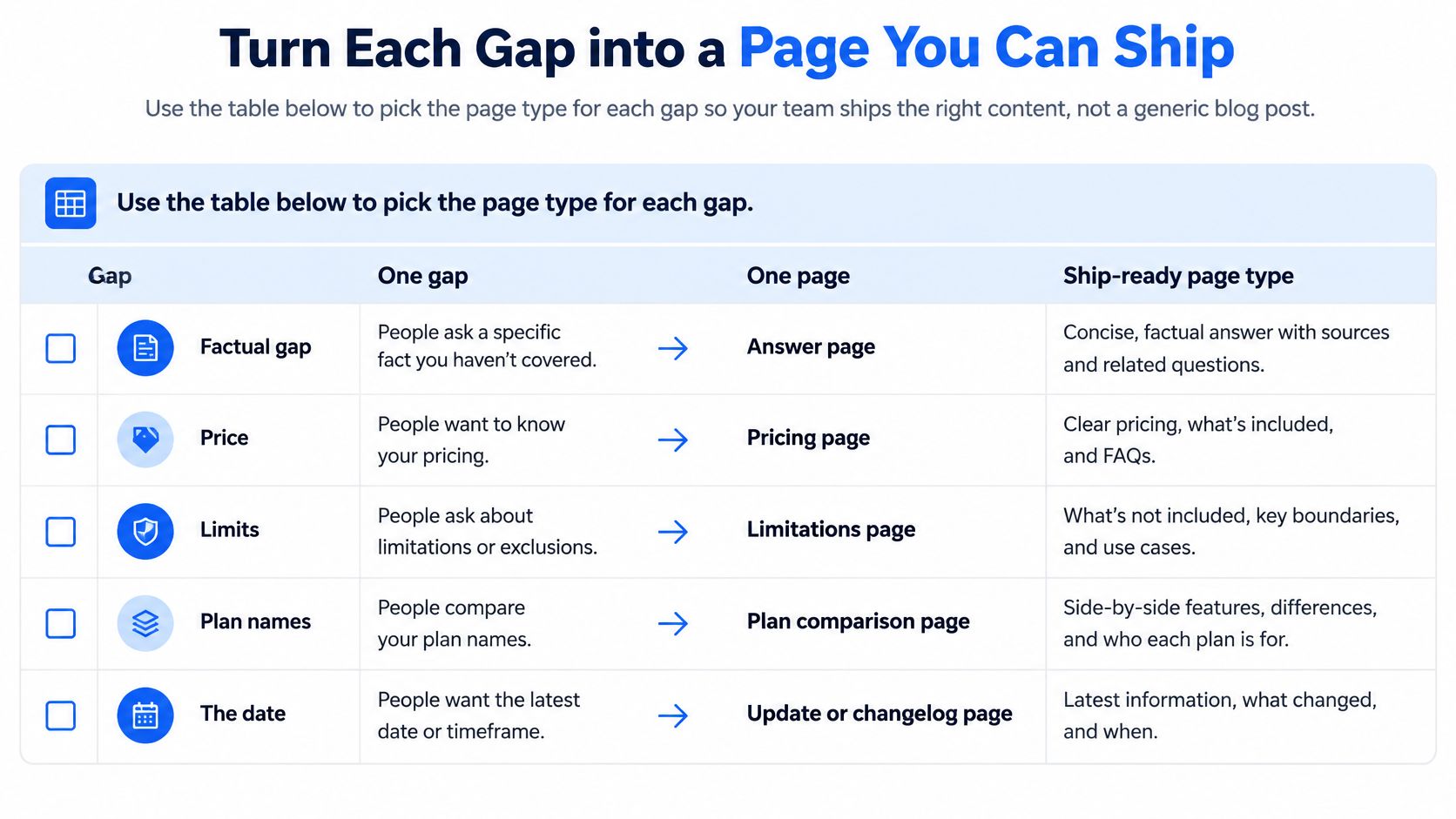
Gap type and the page to ship
| Gap type | What the competitor page shows | Page to plan |
|---|---|---|
| Factual | Dated price, seat limits, integrations, and implementation time | Product facts page with those fields in plain sentences |
| Comparative | Sentence on who the tool fits and who should pick something else | Comparison page against the named rival |
| Technical | Setup steps, API scope, or admin controls a buyer asked about | Use-case page answering that implementation question |
| Reputational | Review roundup, journalist piece, or specialist list | Outreach target, not another owned blog post |
Page specs by gap type#
A factual gap gets price, limits, plan names, and the date updated in the first screen, because the first screen is the part that gets quoted. No pricing teaser, no "contact sales" wall where a number belongs. If a rival's table states seats per plan and an owned page doesn't, the assistant has a quotable source for one brand and silence for the other.
A comparative gap gets a page titled against the rival the answers already name, matching how buyers phrase the question. It carries one sentence on fit, such as a shared inbox and simple pricing for a five-person SaaS team, and one sentence on when a larger suite is the better buy. That second sentence matters. An answer engine needs a boundary, not a claim that one tool suits every team.
A technical gap gets the implementation question answered directly, with setup steps, required permissions, and limits a buyer can check before a demo call. Marketing copy about ease of use doesn't substitute for the steps.
The shared build rules#
Every page states its answer near the top and attaches each material claim to a dated spec, primary source, or named methodology. Comparison tables appear where values are compared, each number says which product and which period it covers, and the URL stays stable. Internal links from high-authority pages point to the evidence page, and each new page gets checked as readable text with the AI page audit.
There is experimental support for building pages this way. The Princeton GEO benchmark by Aggarwal et al., published at KDD 2024, as summarized in a GEO research paper on arXiv, associated quotations, statistics, and citations with roughly 25 to 40 percent higher visibility in its experiment. Technical SEO still matters as an input here: crawlable, indexable pages are the entry requirement, while sourcing is what gives an assistant something to quote. Add provenance to the pages the audit flagged rather than to every URL on the site.
Schema alone isn't the plan. Crawlable pages with dated, sourced claims do the work, and markup only helps once that text exists.
Skip unsupported best-in-class lines, duplicated thin alternatives pages, undated statistics, and testimonials that can't be verified. Each one creates citation risk, because an assistant can repeat an unverifiable claim at scale.
A clean facts page can earn the mention. The fit boundary and the sourced spec are what turn it into a recommendation, and the click is the page's own job after that. Ship the single gap that appeared on the most lost prompts first, then rerun.
Get Listed Where AI Already Looks#
Owned pages cover only part of the audit. The cited domains from lost prompts show where assistants already look, and those domains set the outreach list.
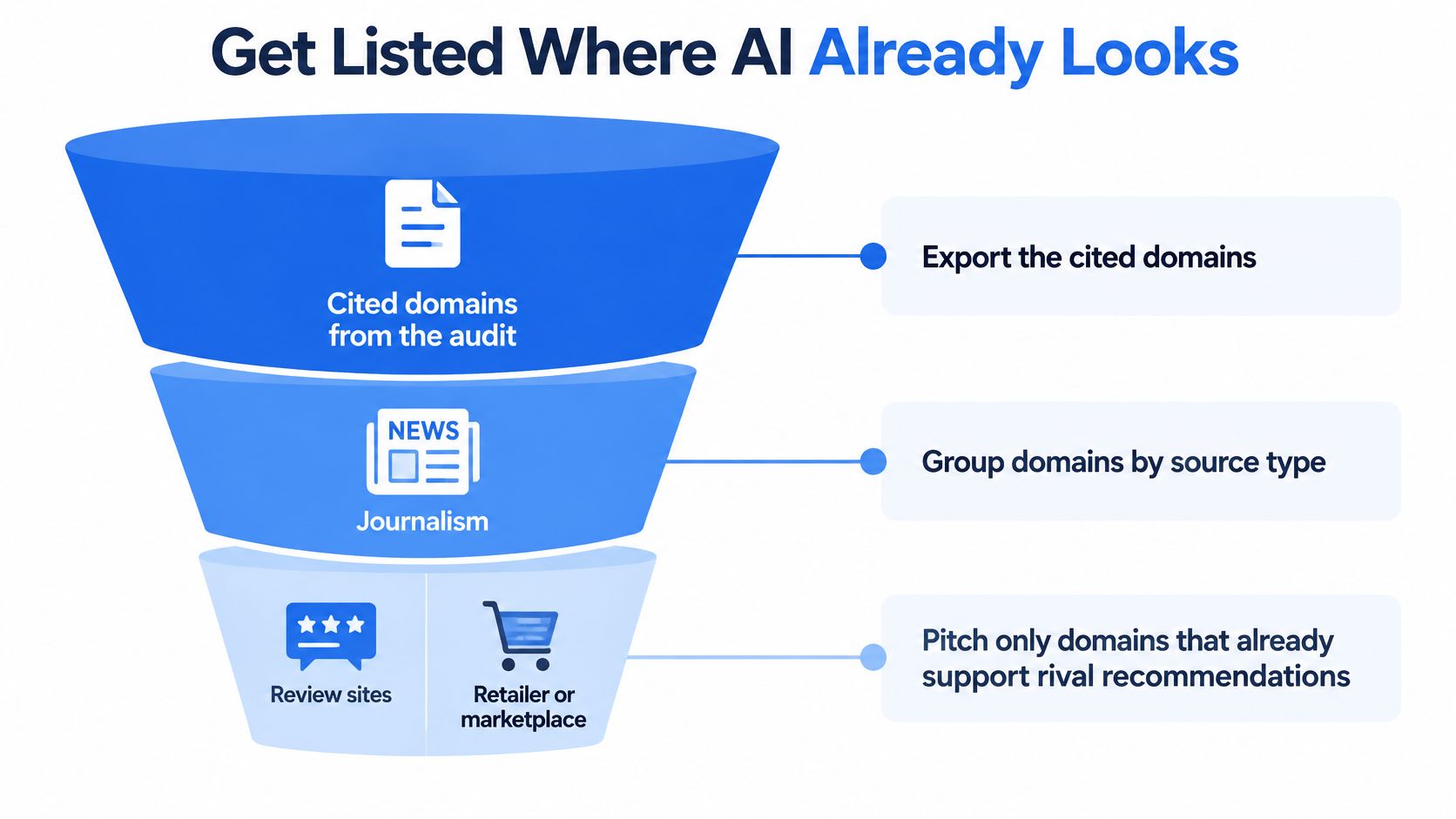
Export the cited domains and group them into journalism, review sites, retailer or marketplace pages, and specialist communities. Mark which group accounts for the prompts being lost. Then pitch only domains that already support rival recommendations, because a domain an assistant never cites offers a backlink, not corroboration inside an answer.
Why earned coverage carries weight#
Muck Rack research reported in Press Gazette's coverage of AI Overviews and search clicks found that more than 95 percent of generative AI citations came from unpaid media, 85 percent of those from earned sources, and half of AI responses included at least one earned-media citation. The same coverage reports Digital Content Next data showing median year-over-year Google referral declines of 10 percent for premium publishers and 14 percent for non-news publishers, plus Authoritas findings that per-query click-through fell 47.5 percent on desktop and 37.7 percent on mobile when an AI Overview appeared. A listing therefore shouldn't be judged by the traffic it sends. Its job is independent confirmation that an answer can quote.
The target placement is a software roundup, specialist review, or documented comparison that states team size, price band, and one limitation. A purchased link with none of those details gives an assistant nothing to repeat. Before pitching, it's worth confirming the tracked site itself passes a basic access check through the AI crawler checker, since a listing that points to an unreadable page wastes the placement.
Wrong claims on cited pages deserve a correction with a dated fact, such as a current plan limit with the date it changed. Asking several sites to repeat the same slogan manufactures a false consensus and tends to read as one. Stop when three real domains are chosen, pitch those well, and don't promise that a listing will move recommendation share.
Decide What to Publish This Week#
Pick the prompt cluster where a rival is recommended and the tracked brand is missing. That's the only decision that matters this week, and the cited URLs make it for the team.
If the cited URLs are mostly the rival's own site, ship the matching facts or comparison page. If they're third-party lists, pitch those domains with a dated fit sentence. If the crawler check failed, fix robots.txt and the HTML text before either of those, because neither a new page nor a listing helps a site assistants can't read.
Three measurement mistakes cause the test to mislead. Changing the prompt between runs mixes two different questions. Counting a blank run as zero visibility invents a failure that wasn't observed. Mixing ChatGPT and Google AI Overviews into one score hides which engine moved.
The one-week stack keeps it small. Day one covers the crawler check and prompt list, days two and three cover the gap labels, and day four ships one page or one listing pitch. A rerun on the same prompts follows after the page has been live long enough to be fetched.
One lost buyer question, one cited URL, one page or pitch. That is the plan.
FAQ#
How long after publishing should prompts be rerun#
There's no fixed number of days to wait. Once a crawler check or server logs show the page was fetched, rerun the identical prompts over a matched window and compare against the baseline.
Should AI crawlers be blocked to prevent scraping#
Blocking removes the pages assistants can retrieve and cite. Teams that want citations allow the relevant crawlers and confirm robots.txt plus a homepage that reads cleanly without JavaScript.
Is a conventional top 10 ranking required for a citation#
Not always. The cited domains from a prompt audit show what assistants use for a given category, which is a better guide than assuming rank predicts citation.
Is a paid tool required to run this process#
No. A spreadsheet with a fixed prompt list produces a first baseline, and the same fields apply whatever runs the prompts. Automation only matters once manual reruns stop being sustainable.
Teams that want the same buyer prompts logged nightly can use Kliqo to compare mentions and recommendations across ChatGPT, Google AI Overviews, Google AI Mode, Gemini, and Copilot.
Kliqo AI runs buyer questions nightly across major AI engines and reports whether a brand is named, recommended, or missing, along with the sources behind each answer. That turns the audit, gap labels, and matched reruns described here into a standing record instead of a one-off spreadsheet. Start tracking real buyer prompts at Kliqo AI.