Short answer
AI share of voice compares how often a brand appears in AI-generated answers with how often competitors appear. A LumoHQ article on AI search market share reports estimates of 0.25% for ChatGPT and 93.5% for Google. Those figures describe estimated search volume, not AI share of voice.
On this page
What AI Share of Voice Means for Your Brand#
An AI assistant creates a shortlist in words. A software vendor might make that list, appear at the top with an explicit endorsement, or never appear at all. AI share of voice helps marketing teams measure those outcomes across a consistent set of buyer questions.
A basic answer-presence formula is:
Answer presence = answers that name the brand ÷ all tracked answers
For example, if a software company appears in 30 of 100 tracked answers, its answer presence is 30%. The calculation is meaningful only when the prompts, AI engines, locale and competitor group stay consistent between measurement periods.
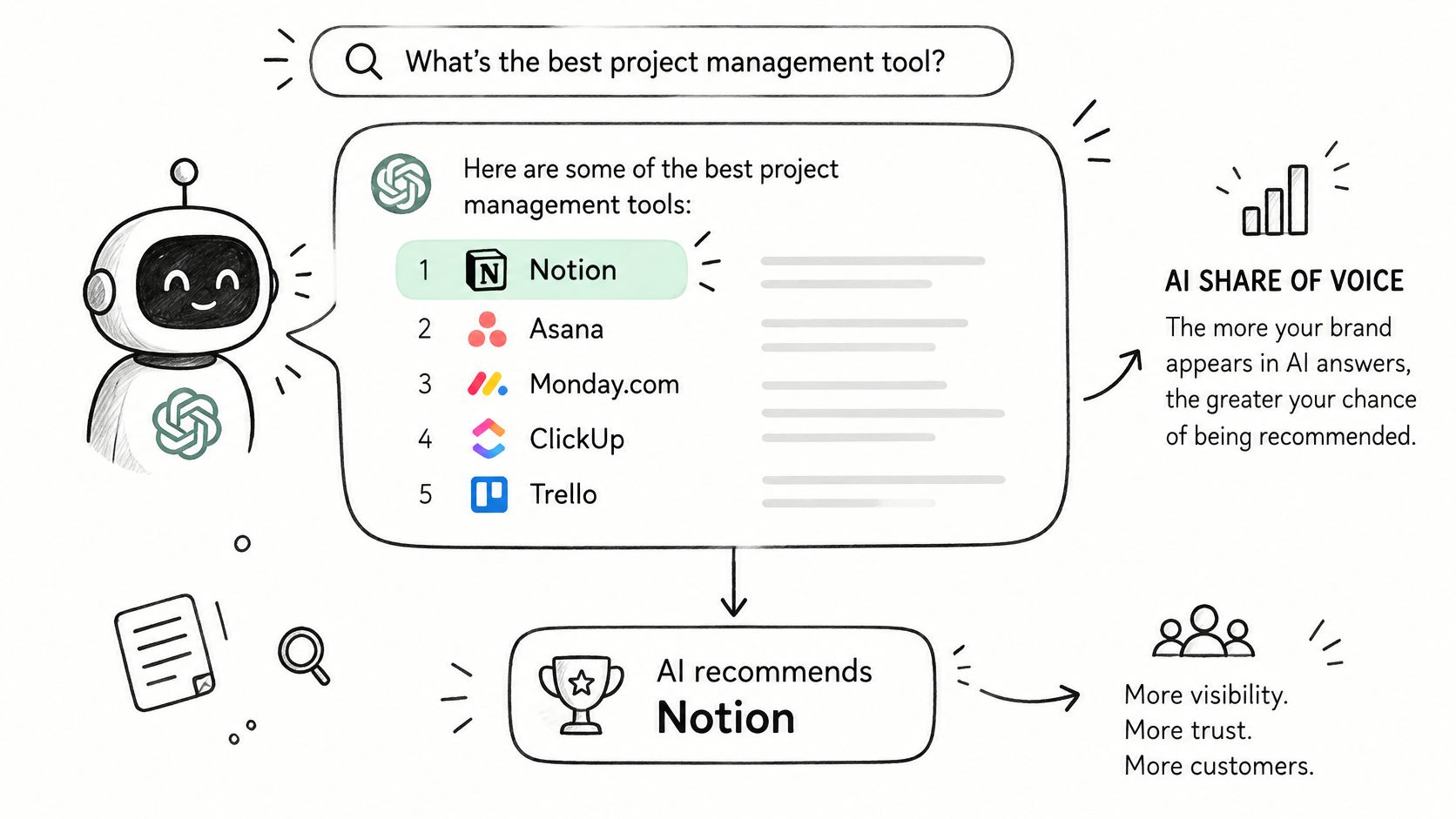
Traditional search share of voice typically relates to a brand's visibility in search results. AI share of voice instead tracks what appears inside generated answers. It doesn't directly measure how many people saw an answer, visited a website or bought a product. Those outcomes require separate evidence.
A useful measurement therefore answers three questions: Was the brand present? Was it recommended? Was its own content cited? The rest of the guide explains how to count each outcome, why prompt type changes the result and how to connect visibility with business signals without treating a mention as proof of preference.
The Metrics Behind AI Share of Voice#
A single visibility score can hide important differences. A brand might show up often in neutral explanations but rarely receive an explicit recommendation. A 2026 analysis of 8,392 AI responses to 300 non-branded buying prompts found that models mentioned at least one brand in 97.0% of answers but explicitly recommended a brand in only 47.6% (the analysis of AI visibility versus recommendation).
Use five measures to separate these outcomes:
| Measure | What it counts | Calculated from |
|---|---|---|
| Answer presence | Brand named in the answer | All tracked answers in the prompt set |
| Recommendation share | Answer explicitly favors the brand | Answers that recommend any brand |
| Citation share | Brand's own domain cited as a source | Answers that cite at least one source |
| Average answer position | Typical place when the brand is named | Answers that name the brand |
| Sentiment | Tone of each mention | Brand mentions |
Answer presence counts whether the brand appears, not whether the answer favors it. Recommendation share asks how often the brand is favored among answers that recommend at least one product. Citation share records whether the brand's own website is cited, while position and sentiment add context about placement and tone.
Practical rule: Keep mention, recommendation and citation results separate. They describe different kinds of visibility.
For example, an answer that names a CRM in a list but advises the buyer to choose a competitor counts toward the CRM's answer presence, not its recommendation share. Teams can learn more about structuring these measures in Kliqo's guide to AI search analytics. Every measure needs a fixed prompt set and a named competitor group, since changing the questions changes the denominator and can shift the result.
How to Measure AI Share of Voice Step by Step#
A repeatable measurement starts with a stable test, not a handful of casual prompts. The following process makes the calculation auditable and keeps teams from comparing mismatched results.
-
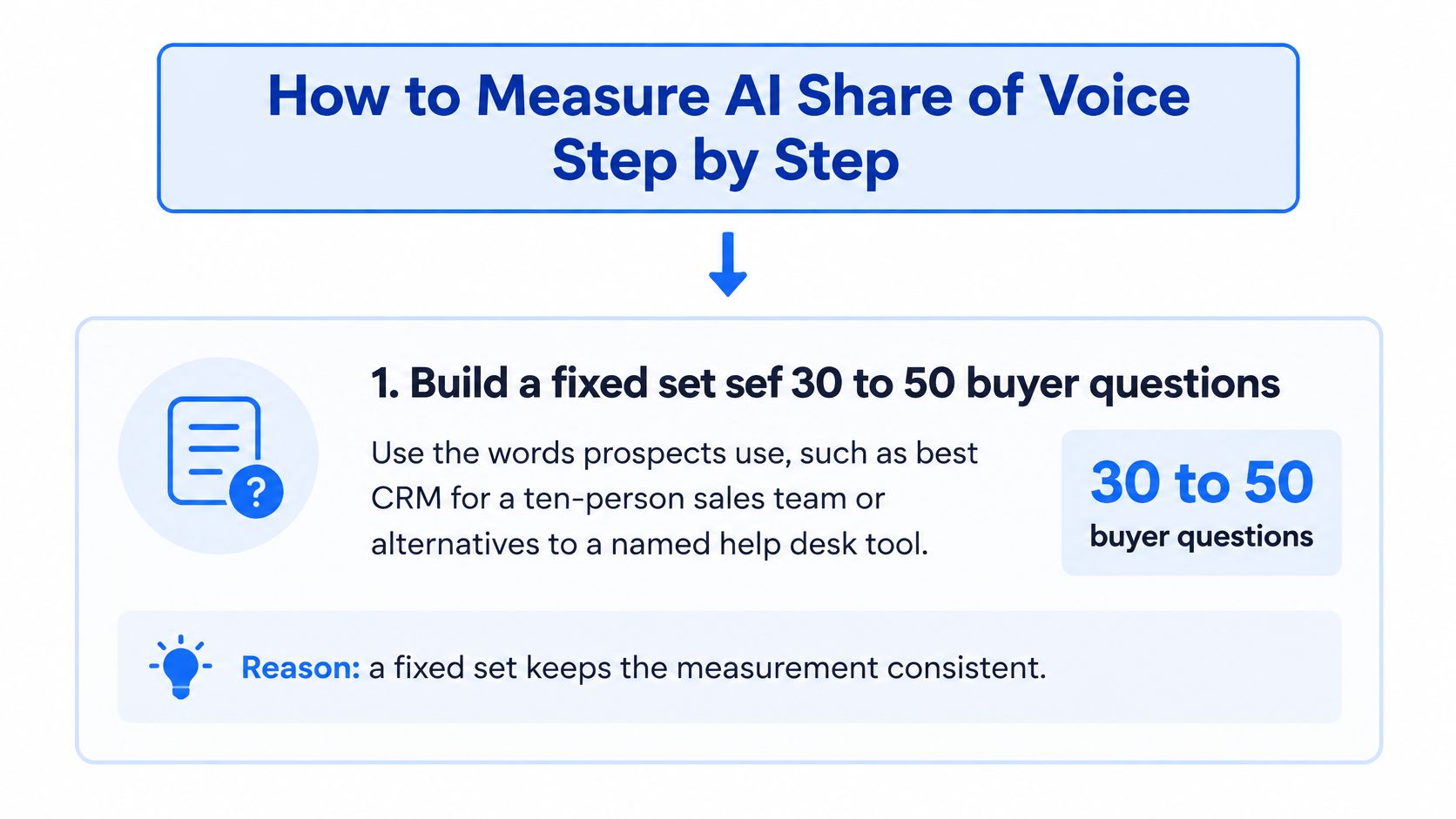
Build 30 to 50 buyer questions. Use wording prospects use, such as “best CRM for a ten-person sales team” or “alternatives to [named help desk tool].” A fixed set keeps the denominator stable. Teams can use this guide to tracking brand mentions in ChatGPT to help plan what to record.
-
Choose the engines and locale. A team might track ChatGPT, Google AI Overviews, Google AI Mode, Gemini and Copilot. Record country and language settings too, because the same prompt can produce different brand lists across locales.
-
Name a competitor group. Select four to six relevant brands, then keep that list fixed for the test. Share is only interpretable relative to a consistent group.
-
Repeat the prompts. Run every prompt on every engine several times. AI answers can vary between runs, so a single response can give a misleading snapshot.
-
Record the evidence in each answer. Log every brand named, which brands are recommended, brand order and cited domains. These details support the five separate measures.
-
Calculate each share with its own denominator. Answer presence is brand answers divided by all tracked answers. Recommendation share is answers that recommend the brand divided by answers that recommend any brand.
Hypothetical example: Forty prompts across five engines produce 200 answers. If a brand appears in 58, its answer presence is 58 ÷ 200 = 29%. If 30 answers favor that brand and 90 answers recommend any brand, its recommendation share is 30 ÷ 90 = 33%.
-
Mark unavailable answers as missing. Don't record an engine that returned no answer as a zero. A zero would lower the measured share even though the prompt wasn't answered.
-
Compare matched runs. After a page change, rerun the same prompts on the same engines with the same competitor group. That way, a change in the score is less likely to come from a changed test.
Why Answer Type Changes the Number#
The prompt's intent affects how many brands appear in an answer. In the 2026 Presenc.ai multi-engine visibility study, product-recommendation answers named an average of 4.2 brands, while best-of lists named 6.8 (Presenc.ai's study of brand visibility in AI answers).
| Answer type | Average brands named per answer |
|---|---|
| Best-of list | 6.8 |
| Category exploration | 5.1 |
| Product recommendation | 4.2 |
| General information | 3.3 |
| Problem-solution | 2.9 |
| Brand comparison | 2.4 |
A project-management product named once in a four-brand recommendation answer competes for a different share of attention than one named once in a six-brand list. Position also matters: the study found the first-listed brand received 38% of user follow-up questions, compared with 6% for brands listed fourth or later. Average visibility for the same brand varied by a factor of 4.1 across five AI platforms.
The wording of the question signals what the appearance means. A project tool named in an answer to “best project management tool for agencies” appears in a buying context. The same tool mentioned while an assistant explains Gantt charts appears in an educational context.
Group prompts by buyer, comparison and education intent, then report a separate share for each group. One blended score can conceal whether the brand is present in high-intent recommendations or mostly in general explanations.
Citations Are Not Recommendations#
A citation shows that an answer draws on a source. It does not show that the answer prefers the brand. Citation share counts how often an answer links to the brand's own domain; recommendation share measures how often answers recommend the brand.
Brands with more web mentions tend to appear in more AI Overview citations, according to Search Engine Land's analysis of backlinks and AI visibility. That relationship makes web mentions relevant to citation visibility, but citation counts and search rankings cannot substitute for recommendation data.
A help desk vendor might be cited through a review site's comparison page instead of its own pricing page. The source may provide evidence about the category without the answer recommending that vendor.
A citation supports a claim only when the cited page backs that specific claim.
For each citation, check whether the page substantiates what the answer says and whether the answer recommends the brand. A page that merely names a vendor does not support a product claim. Record each answer's prompt, engine, locale, cited URL and domain, recommendation status, and date. Kliqo's guide to tracking AI citations explains how to record sources separately from brand mentions.
Connecting AI Share of Voice to Traffic and Revenue#
Clicks alone don't capture every way an AI answer may influence a buyer. A recent enterprise dataset across 10 industries found AI referrals accounted for 1.08% of total website traffic. Adobe reported that AI-referred visitors spent 59% more time on site and had a 16% year-over-year increase in conversion rate, while conversion from non-AI traffic fell 38%; the figures are reported in Conductor's AEO and GEO benchmarks report.
A panel study of 900 U.S. adults covering 68,879 Google searches found that users clicked a traditional result in 8% of visits when an AI summary appeared, compared with 15% when no summary appeared. Links inside summaries were clicked in only about 1% of visits, according to Forbes Advisor's report on Google AI Overviews.
A useful reporting funnel begins with answer presence, recommendation share and citation share. The outcome layer then tracks measurable referrals alongside possible after-answer signals, such as branded-search lift, direct traffic and conversion quality. Those later signals may have several causes, so a report should label what is observed and what is inferred.
For example, a CRM vendor might have almost no measurable referral visits while appearing in three tracked shortlist answers. If prospects also mention the vendor on sales calls, that call feedback is an observed signal; attributing it to AI answers is an inference unless the buyer confirms the connection. Low referral volume alone can't establish that AI visibility has no influence.
Start Tracking Your AI Share of Voice This Week#
The first measurement doesn't need a large platform rollout. The person running it can build a practical baseline with a fixed set of buyer prompts, careful access checks and a record of the answers.
-
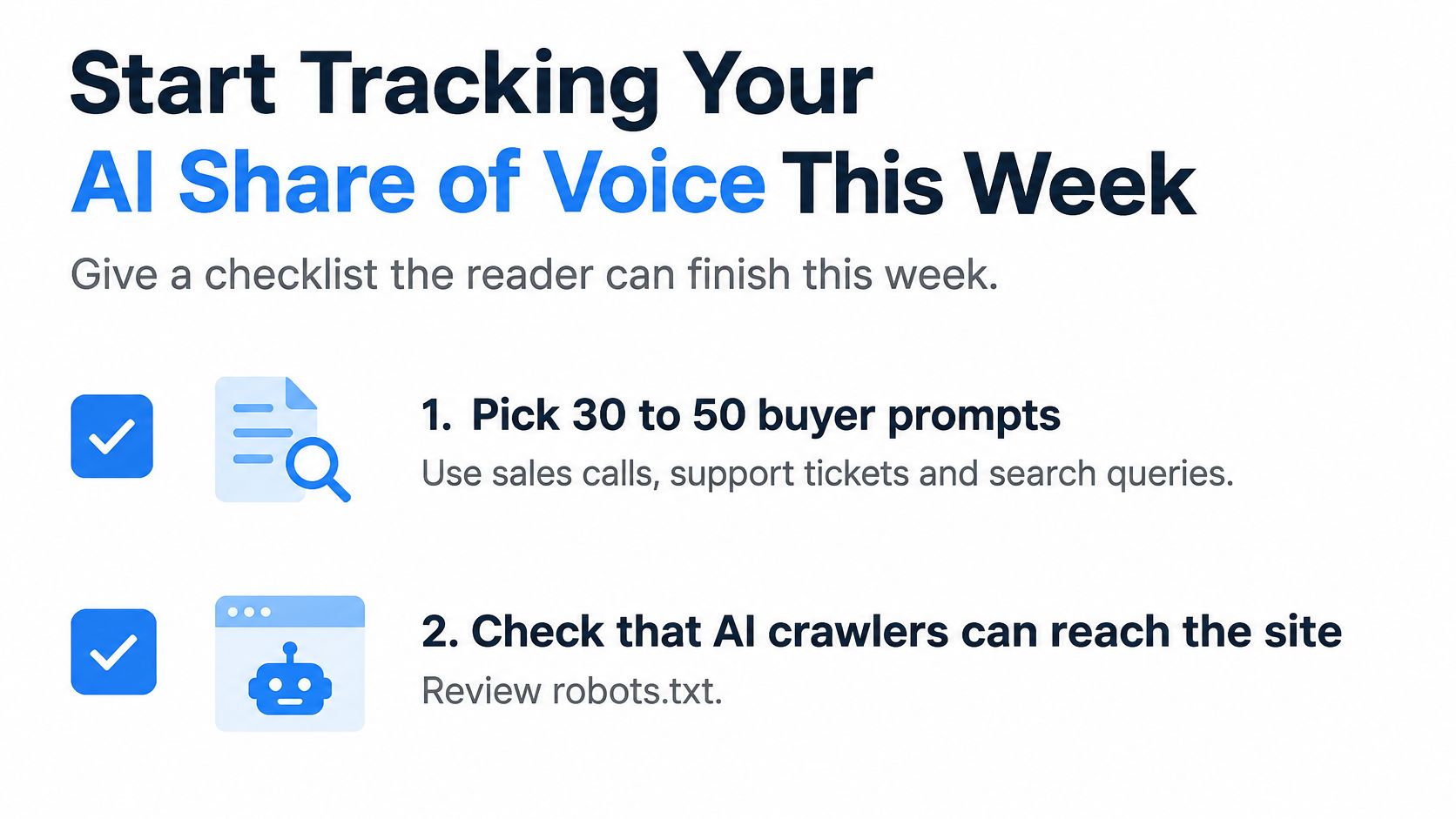
Pick 30 to 50 buyer prompts. Pull real questions from sales calls, support tickets and search queries, then keep the wording in a shared document.
-
Check crawler access. Review
robots.txtand use the AI crawler checker to check that pricing, product, comparison and alternatives pages can be reached. -
Audit buyer-facing pages. Run the pricing, product, comparison and alternatives pages through the AI page audit. A clean audit doesn't guarantee a recommendation, since assistants can also draw on reviews, lists and comparison posts elsewhere on the web.
-
Find third-party coverage. Identify the best-of lists and review sites that AI answers cite for the category, then pursue accurate inclusion where appropriate.
-
Make product fit clear. Add a comparison page with a direct sentence explaining which customer and use case the product suits.
-
Rerun the measurement. After 30 days, use the same prompts and engines to record answer presence, recommendation share, citations, position and sentiment.
A spreadsheet works for a small prompt set, while a tool such as Kliqo can schedule and log larger ones.
FAQ#
What is a good AI share of voice?#
There's no universal benchmark for a good score. Compare the brand with a fixed competitor group using the same prompts and engines, then watch whether its share moves over time.
How often should the same prompts be rerun?#
Rerun them at least monthly and after a significant change to buyer-facing pages. Repeated, matched runs make it easier to distinguish a lasting shift from ordinary answer variation.
Which engines should a team track?#
Choose the assistants buyers use, such as ChatGPT, Google AI Overviews, Google AI Mode, Gemini and Copilot. Keep the engine set fixed between runs so the comparison stays consistent.
Does one strong answer mean the brand's share is high?#
No. One answer is only one observation, so it can't establish a reliable share. Compare results across several prompts and engines before drawing a conclusion.
Kliqo AI monitors how AI assistants describe, cite and recommend brands across tracked buyer questions, with competitor comparisons and recorded answers to support analysis. Visit Kliqo AI to see how its monitoring can help teams measure AI share of voice.