Short answer
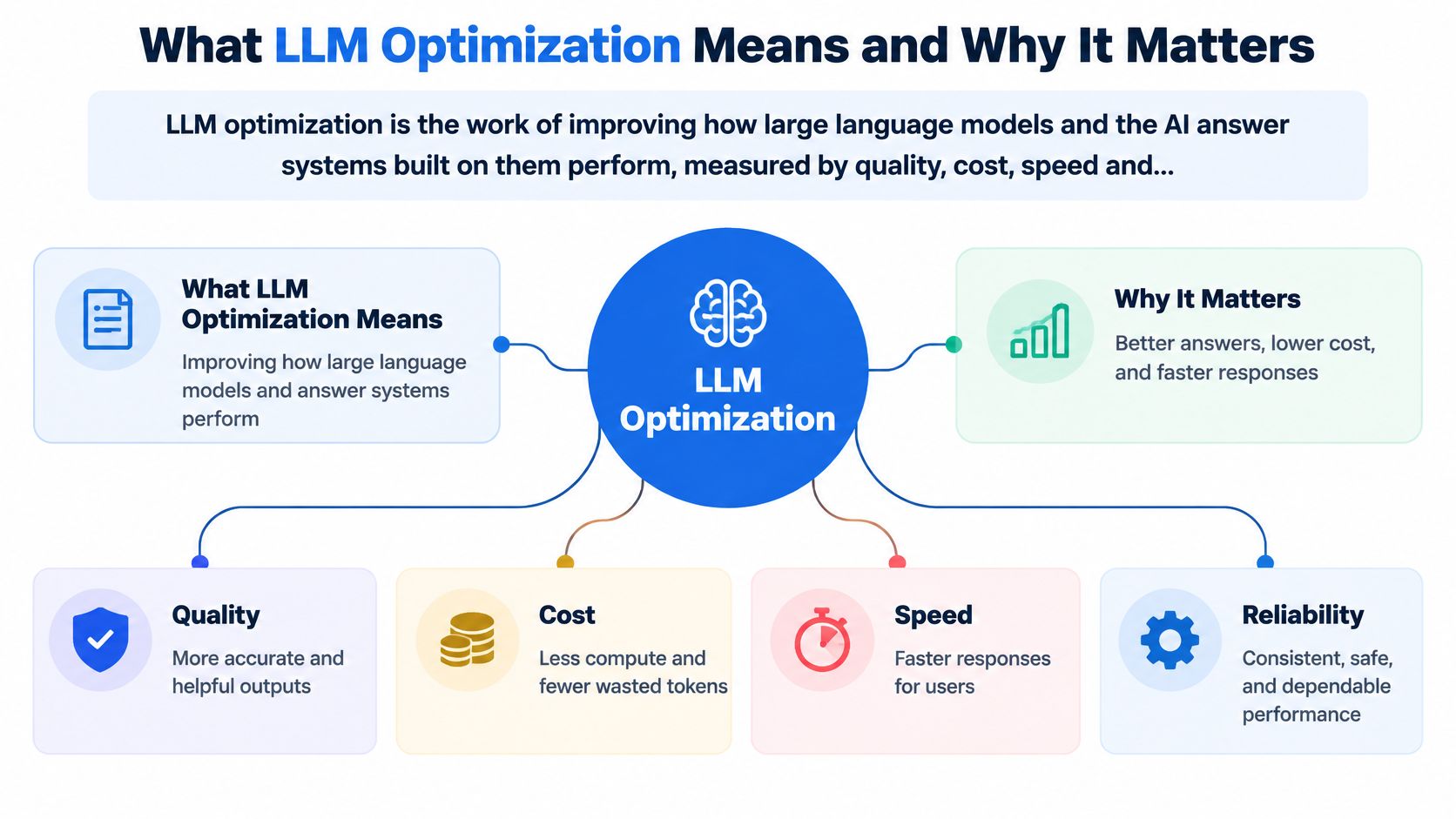
LLM optimization is the work of improving how large language models and the AI answer systems built on them perform, measured by quality, cost, speed and reliability. For brands, it means being retrieved, cited, mentioned and recommended accurately when a buyer asks an AI assistant which software to choose.
On this page
If a software company ranks well in search but never appears in an AI buying recommendation, what exactly needs fixing? The answer starts with separating model engineering from brand visibility, then identifying where the product disappears from the answer process.
What LLM Optimization Means and Why It Matters#
LLM optimization has two meanings, and confusing them leads marketing teams toward the wrong work.
In model engineering, optimization involves model size, training data, quantization, caching, and retrieval. The scaling-laws overview describes the shift from increasing model size toward balancing parameters, data, and computation. Engineers also optimize inference, the process of generating answers after training, because repeated serving costs make efficiency important. A marketer improving a comparison page is not doing this engineering work.
The meaning that matters to software brands#
For founders and marketing teams asking what is LLM optimization, the practical meaning is improving how AI answer systems discover and represent a product. That includes accessible pages, clear product facts and evidence that supports a buying recommendation.
Say a founder asks an assistant for help desk software suitable for a small support team. The answer might recommend a competitor, list the founder's product without endorsing it, or cite a review without naming the product at all.
Those are different outcomes:
- Mention: The product's name appears in the answer.
- Recommendation: The assistant names the product as a suitable pick.
- Citation: The assistant uses a page from the brand's site or a third party as a source.
Accurate representation matters alongside all three. A recommendation based on an integration the product doesn't offer isn't a useful win.
Practical rule: Diagnose the missing outcome before commissioning more content.
The objective isn't to make an assistant repeat a brand name. It's to make relevant, supported recommendations more likely while recognizing that the brand doesn't control the final answer.
How LLM Optimization Differs from SEO#
LLM optimization builds on technical SEO rather than replacing it. Crawlability, indexing, clear page structure and accurate content remain useful foundations, but the desired result shifts from a page position to a product's role inside an answer.
LLM optimization and SEO compared
| Aspect | Classic SEO | LLM optimization |
|---|---|---|
| Main goal | Rank a page in the results list | Get named, cited or recommended inside a generated answer |
| Unit of success | Position and clicks | Mention, citation, recommendation and answer accuracy |
| Query handling | One query, one results page | Query fan-out into several related searches |
| Access requirement | Indexed and crawlable | Indexed, snippet-eligible and retrievable by the AI system |
| Content need | Keyword relevance and links | Consistent facts, clear fit statements and third-party evidence |
| Measurement | Rank tracking and analytics | Repeated prompt runs with recorded answers and sources |
The access row needs an important qualification: requirements differ by system. Google's AI features documentation says supporting pages must be indexed and eligible for a search snippet, and that AI Overviews and AI Mode may use query fan-out, issuing related searches across subtopics and sources.
A buyer question can require several kinds of evidence#
Consider an agency evaluating CRM software. Its question may involve implementation effort, reporting, integrations, security and pricing, even when those requirements aren't expressed as separate searches.
A useful product page should address those needs clearly and link to detailed supporting pages. A comparison page should explain trade-offs rather than repeat category keywords.
A high-ranking page isn't a guarantee that an assistant will name the product.
An SEO team can keep its existing search tools and analytics. The additional task is recording whether generated answers mention, recommend and correctly describe the product, including when another site's page supplies the evidence.
Finding the Stage Where Your Brand Drops Out#
Retrieval optimization and answer-generation optimization solve different problems. An AI system may use separate components to find documents, judge relevance and compose its response.
The ACM information-retrieval survey describes the semantic gap between retrieval systems and language models and the role of relevance judgments. Document selection isn't a matter of matching the buyer's wording to a page.
A diagnostic chain makes these distinctions usable. It's a checklist, not a claim that every system exposes every stage or follows an identical sequence.
Stages where an AI answer can drop your brand
| Stage | Test question | What a failure usually points to |
|---|---|---|
| Retrieved | Did the assistant fetch a page from your site or a third-party page about you? | Blocked crawler access or pages the search index does not hold |
| Cited | Does the answer's source list include a page that describes your product? | Few strong pages about your category on your site or on third-party lists |
| Mentioned | Is your product name in the answer at all? | Category language that does not connect your name to the buyer's need |
| Recommended | Is your product named as a pick, not just listed? | Missing fit statements that tell the assistant which buyer your product suits |
| Accurately represented | Are the price, limits and category stated correctly? | Conflicting facts across your site, reviews and directories |
Use the chain as a hypothesis, not a verdict#
A missing citation doesn't prove that a page wasn't retrieved. When retrieval logs aren't available, record that stage as unknown, rather than treating absence from the source list as proof of an access failure.
Suppose a project management product's page is retrieved, but the answer describes pricing from an outdated review. The immediate problem is conflicting evidence or interpretation, not crawler access.
Clearer claims and corrected listings are sensible remedies. If a competitor repeatedly earns the recommendation instead, a competitive gap analysis can help organize differences in buyer fit and supporting sources.
Visibility without recommendation is a different problem from recommendation with incorrect facts.
Before changing pages, apply the test questions to a small set of real buyer prompts. Preserve the answers and label uncertain observations. A single visibility score can't explain which intervention is appropriate.
Tracking AI Answers Across Repeated Runs#
A single answer is an observation, not a stable measure of market visibility. A sensible test repeats the same buyer question rather than assuming the initial result will persist.
Keep the prompt and testing conditions consistent. Record whether web search was active, which assistant was used and whether conversation history could have influenced the response.
Count sources separately from brand names#
Microsoft's Copilot citation definition applies to SharePoint documents, pages and news posts used as sources: each content item counts once per prompt response, even when referenced repeatedly. That scope matters, since it isn't a universal definition imposed on every public AI service.
A marketing team can nevertheless adopt the same counting convention for its public-site tracking. Repeated references to the same source item within an answer shouldn't inflate the citation count.
Metrics to record for each AI answer
| Metric | What it tells you | How to record it |
|---|---|---|
| Mention | Your name appears in the answer | Yes or no per answer, counted once per run |
| Recommendation | Your product is named as a pick | Yes or no, with its position in the list |
| Citation | A page is used as a source | Count each source item once per response, not each reference |
| Answer position | Where your name appears among the tools | First, second, later or not named |
| Sentiment and accuracy | Whether the description is favorable and correct | Short note with the claim and a check against your own facts |
Store the date, assistant, exact prompt, cited URLs and original answer alongside these metrics. A favorable description and a factually correct description deserve separate judgments.
Inspect the visible search path#
The Microsoft Copilot web-search documentation explains that Copilot Chat can display generated Bing queries and searched sites, although that capability isn't available in the Copilot pane inside applications such as Word or PowerPoint. Where available, those queries help reveal whether an assistant interpreted a buyer's needs differently from the marketing team.
A spreadsheet is sufficient for a manageable prompt set. A documented AI citation tracking process becomes useful when tests repeat on a fixed schedule and colleagues need comparable records.
Steps to Take This Week#
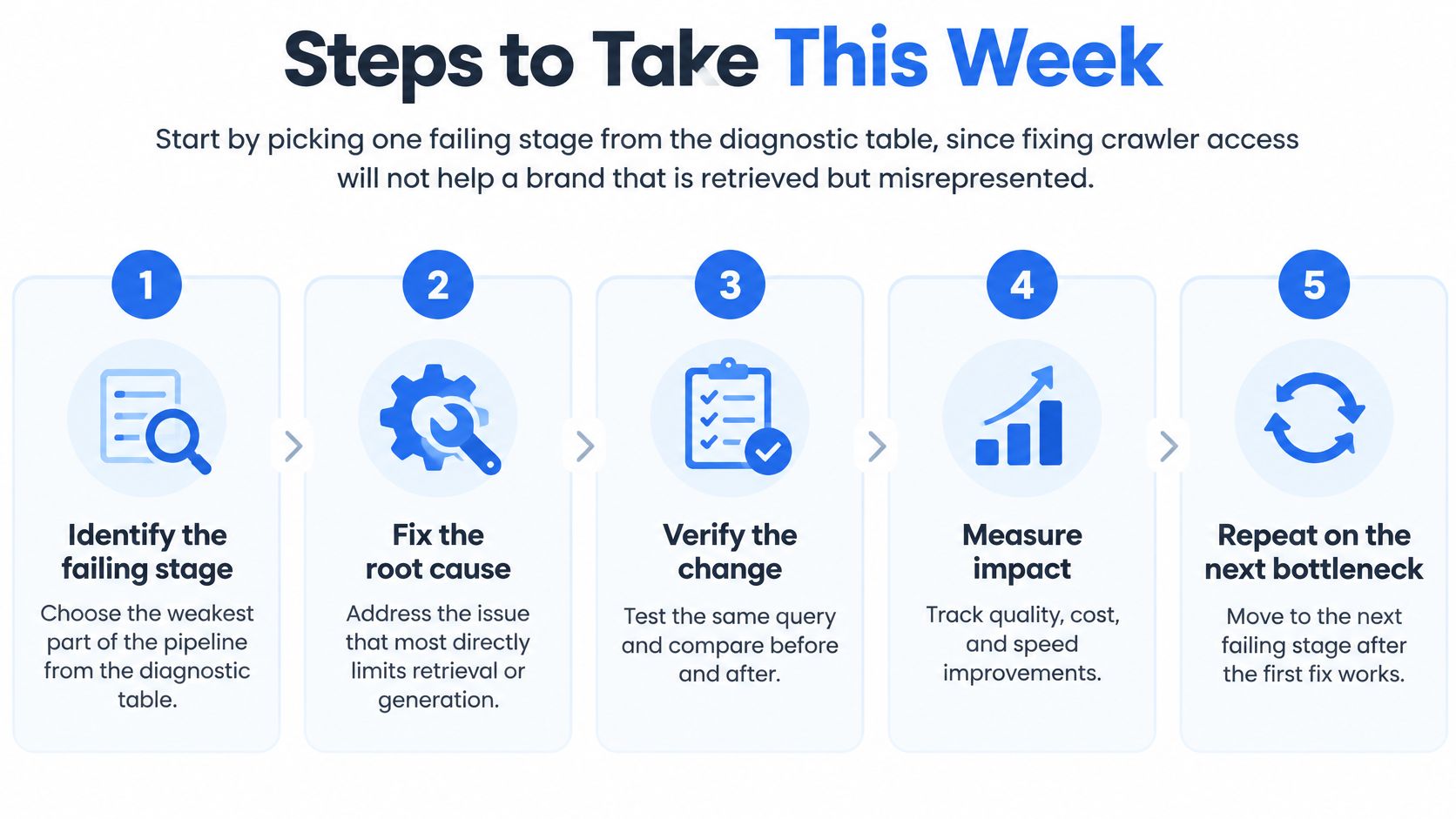
Start by picking one failing stage from the diagnostic table, since fixing crawler access will not help a brand that is retrieved but misrepresented. Assign an owner to the change and retain the original answer as a baseline.
Start with access and evidence#
-
Check search-crawler permissions. Inspect robots.txt and server-side restrictions for the crawler used by the search experience being tested. The ChatGPT search eligibility documentation says search access requires allowing OAI-SearchBot and its published crawler traffic, while GPTBot training access is a separate decision. Sites opted out of OAI-SearchBot won't appear in search answers, although navigational links may still appear. For a help desk vendor, the practical check is whether product and comparison pages are accessible, not merely the homepage.
-
Verify the important buying pages. Check pricing, integrations, security and comparisons for indexing restrictions, snippet restrictions, broken canonical references and content hidden behind sign-in screens. Use Google Search Console's URL Inspection tool to examine indexing status, then inspect the rendered page. For example, an integration page should state whether the connection is native, partner-built or available through an automation service. A logo alone doesn't answer that question.
-
Write a concrete buyer-fit statement. Each comparison page should explain which buyer the product suits and the relevant limitations. A useful hypothetical statement is: This help desk suits small software support teams that need shared inbox workflows but don't require enterprise workforce management. Support that statement with feature documentation. Avoid unsupported best-in-category claims or comparisons that describe competitors unfairly.
Correct the surrounding sources#
-
Pursue relevant third-party coverage. Inspect the lists, directories and reviews already cited for the category. Submit accurate product information where editorial submissions are accepted, and invite genuine customers to leave reviews without scripting their opinions. A CRM vendor absent from an agency-software directory should check the directory's inclusion criteria before requesting a listing. Inclusion is an opportunity for consideration, not a guaranteed recommendation.
-
Reconcile facts across public pages. Compare the brand name, category, pricing basis, usage limits and update dates across the official site and important directories. Correct discrepancies at their source. For a scheduling platform, confusing per-user pricing with per-workspace pricing can make an otherwise positive recommendation misleading. Preserve legitimate differences between plans rather than forcing unlike offers into identical descriptions.
Change-control note: Record exactly which page or listing changed so later answer differences can be investigated, not automatically credited to the edit.
Treat machine-readable files as supporting documentation, not guaranteed access passes. A guide to what llms.txt is can help teams evaluate the file without confusing it with crawler permissions or indexing eligibility.
Set a manageable baseline#
For a first-week test plan, run 10 real buyer questions four times each across ChatGPT, Google AI Overviews, Gemini and Copilot. These are suggested testing quantities, not a statistical guarantee; record when an AI Overview doesn't appear rather than fabricating an answer.
Check product and comparison-page access, then update one comparison page to match current listings. Keep the prompt list fixed during the next comparison period.
Manual records work for a small test. For repeated scheduled runs, Kliqo AI shows where competitors are chosen instead, which sources to win and a ranked list of fixes, then measures how answers change after action. Its free AI visibility files check also writes an llms.txt and Organization, WebSite and FAQ structured data from the live site, plus robots.txt lines when a change is needed.
Answers can change as sources change. Ongoing observation matters more than a favorable screenshot.
FAQ#
Is LLM optimization the same as SEO?#
No. It overlaps with technical SEO but evaluates mentions, recommendations, citations and factual accuracy inside generated answers. Search rankings remain useful context, not a substitute for examining the answers themselves.
Does LLM optimization change the AI model itself?#
For brands, no. It changes accessible evidence and how product facts appear across public sources, while techniques such as quantization belong to model engineering. Publishing a comparison page doesn't retrain an assistant.
Should companies block AI crawlers in robots.txt?#
Not by default when AI search visibility is a business goal. Search-crawler access and training-crawler access should be evaluated separately, with permissions checked against the specific service's documentation and the company's content policies.
How long before AI answers change?#
There's no fixed timeline established by the sources discussed here. Teams should repeat tests over several weeks, retain source records and avoid attributing every answer change to the latest page edit.
Kliqo AI offers monitoring of how AI assistants describe, cite and recommend software brands, with evidence for investigating gaps. Visit Kliqo AI to assess recurring buyer-prompt tracking and identify which part of the answer process needs attention.