Short answer
Does a strong Google ranking mean a software brand appears in the answer buyers read? Google AI Mode SEO share of voice estimates how often a brand is named, cited, or recommended against competitors by repeatedly running the same buyer prompts and logging the resulting answers.
On this page
What Share of Voice Means in Google AI Mode#
Say a buyer asks AI Mode for the best help desk tool for a five-person SaaS team. The answer names several products, cites rival review sites, and favors one product for its straightforward setup.
Those are different outcomes:
- Mention: The product's name appears.
- Citation: An owned URL appears as a supporting source.
- Recommendation: The answer explicitly favors the product for the buyer's needs.
A review site can support a recommendation without the recommended vendor receiving an owned-domain citation. Conversely, Google can cite a vendor's documentation without recommending its product.
Share of voice is a sampled estimate, not a measurement of every buying conversation. Its scope is the chosen prompts, competitors, engine, country, and observation period. One answer offers little basis for a strategic decision.
The stakes extend beyond rankings. Pew Research Center's March 2025 study found that 58% of U.S. adults conducted at least one Google search triggering an AI summary, as reported by Search Engine Land. Seer Interactive's 2025 analysis of 3,119 queries across 42 organizations found informational organic click-through rates with AI Overviews fell from 1.76% to 0.61%, according to PPC Land.
These are AI Overviews findings, not AI Mode measurements. They explain why answer-level visibility deserves attention, not how much traffic AI Mode removes.
A useful measurement program connects answer signals to access checks, source evidence, and specific corrective work.
The Signals That Estimate Your Share of Voice#
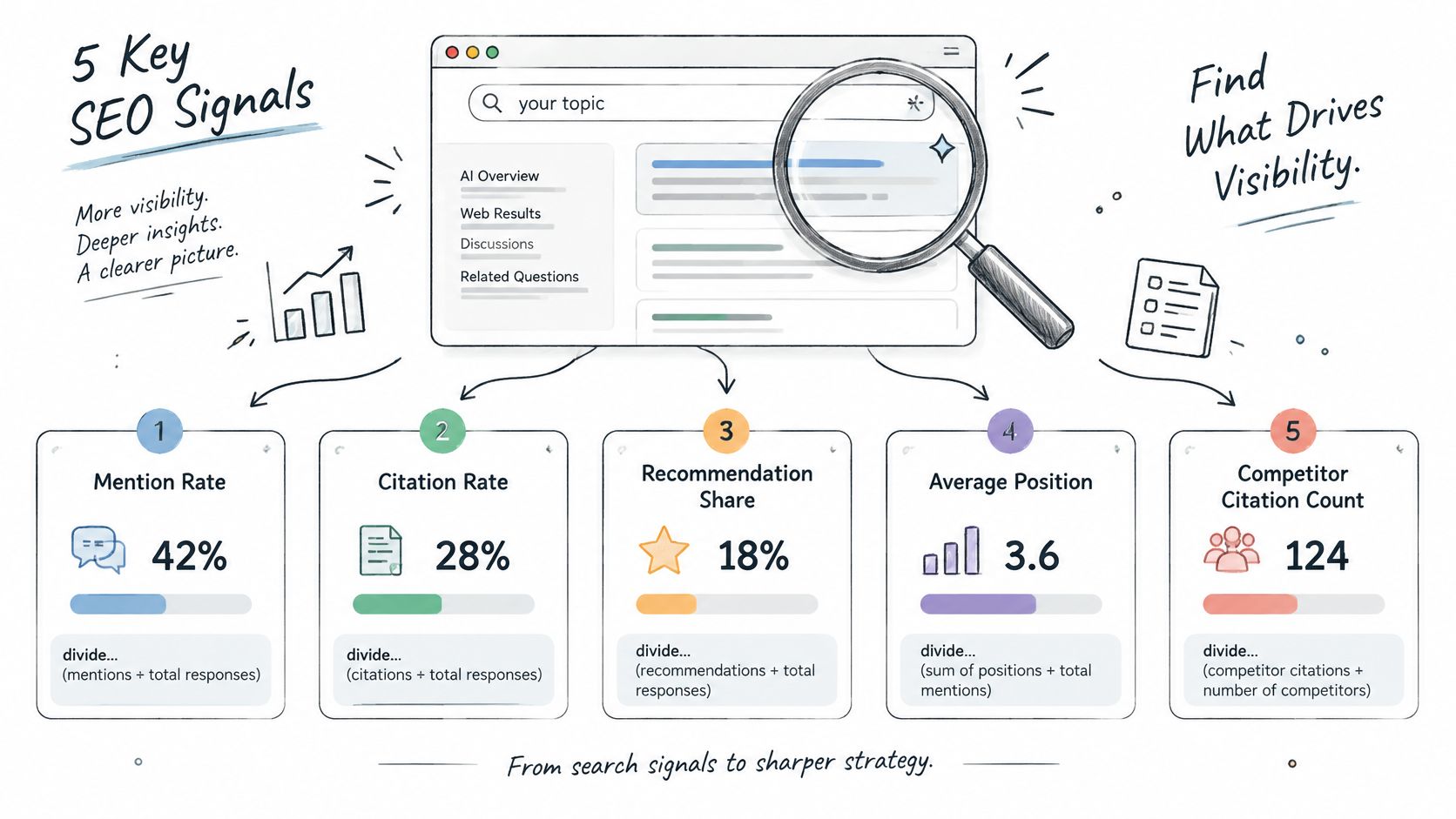
For mention, citation, and recommendation rates, the formula is qualifying answers ÷ valid tracked answers × 100, using the same prompt set and engine. Position and citation counts use different units and shouldn't be converted into percentages.
Signals for estimating share of voice in AI Mode
| Signal | What it measures | How to calculate |
|---|---|---|
| Mention rate | Share of tracked answers naming the brand | Answers naming the brand divided by total valid answers, expressed as a percentage |
| Citation rate | Share of answers linking an owned URL as a source | Answers citing the domain divided by total valid answers, expressed as a percentage |
| Recommendation share | Share of answers explicitly recommending the brand | Answers recommending the brand divided by total valid answers, expressed as a percentage |
| Average position | Where the brand first appears | Mean first-appearance position across answers naming the brand |
| Competitor citation count | Rival-domain pages used as sources | Count cited rival URLs per competitor across the same prompt set |
In a hypothetical worked example, 40 prompts produce 40 valid answers. A brand named in 18 answers has a 45% mention rate, cited in nine has a 22.5% citation rate, and recommended in six has a 15% recommendation share.
Keep the denominators separate#
Several brands can appear in the same answer, so their mention rates can add up beyond the whole answer set. For a competitive share that sums to a whole, the calculation is brand appearances ÷ appearances across all tracked brands. Each brand should count once per answer.
Position adds context, but an early appearance doesn't prove preference. A brand might appear first in an alphabetical list or a warning.
Missing stays missing: A failed run isn't an answer without a mention. Record failures separately and disclose completion coverage.
If mentions rise while recommendations stay flat, exposure improved but preference didn't. If citations rise without mentions, the answer may use the company's information without identifying the company.
Check Crawl Access Before You Measure#
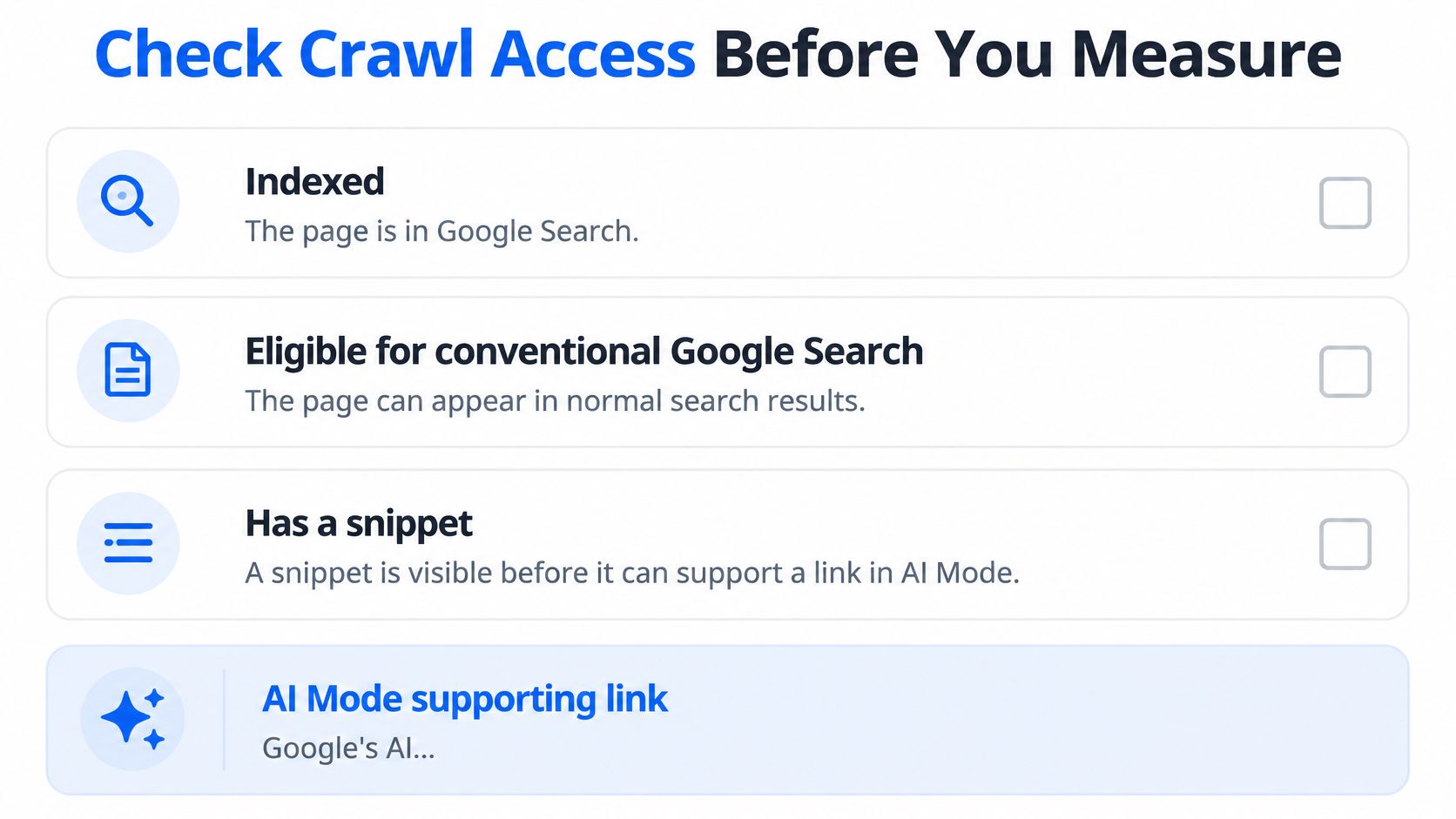
Google Search Central's AI features in Search guidance establishes the eligibility sequence: a supporting page must be indexed and eligible to appear in conventional Google Search with a snippet. Access makes retrieval possible; it doesn't guarantee selection.
Google also says no special AI text file or schema.org markup is required. Structured data must match the visible page rather than introduce claims absent from it.
An access checklist for product pages#
- Inspect robots.txt. Confirm that Googlebot isn't blocked from the relevant product, pricing, comparison, or documentation path.
- Test the response. Confirm an HTTP 200 response without redirect loops, including through the site's CDN or security layer.
- Check indexing. Search the exact page title as an initial check, then use Search Console URL Inspection for confirmation. Absence from a title search alone doesn't establish exclusion.
- Inspect readable content. Disable JavaScript and check whether the product name, features, limits, and prices remain available. Missing text warrants a rendered-content investigation, not an automatic conclusion that Google can't index it.
- Reconcile structured data. Compare prices, product details, and other marked-up values with the visible text.
- Test crawler access. Run the AI crawler access check alongside the Google-specific checks.
The decision rule is practical: failed eligibility checks require access work before content attribution. When those checks pass, an absent citation becomes a retrieval or source-selection question rather than immediate evidence of weak messaging.
How AI Mode Splits Questions and What to Log#
Google's AI optimization guide describes a custom Gemini system using real-time web information and query fan-out. AI Mode searches related subtopics and data sources before synthesizing an answer, while remaining rooted in core Search ranking, quality, safety, and anti-spam systems.
For a help desk buying question, relevant subquestions might concern seat pricing, shared inbox features, help center tools, Slack integration, setup time, and alternatives. Each can lead to a different source: a pricing page, integration document, comparison page, or independent review.
Independent research summarized in Ahrefs' AI Mode analysis found an average of 9–11 fan-out queries per prompt, with some reaching 28; the same analysis describes a Moz study of roughly 40,000 queries in which only about one in ten AI Mode citations matched a traditional top-ten URL. These are findings from particular studies, not a fixed specification for every answer.
Citation attribution isn't rank tracking. A ranking report can establish conventional search visibility, but it can't identify the passage supporting an AI Mode verdict.
A repeatable logging procedure#
The following is a starting protocol, not a statistically validated minimum sample size.
- Choose 30 to 50 buyer prompts. Mix broad category questions with specific software requirements across three to five intent categories, such as selection, alternatives, integrations, security, and implementation.
- Fix the environment. Record country, language, account state, and device context. Keep logged-out testing consistent where available; otherwise, document the account conditions rather than treating sessions as equivalent.
- Capture each run. Save the exact prompt, engine, date, and full answer. Distinguish a fresh conversation from a follow-up within an existing conversation.
- Annotate the evidence. Record named brands, explicit recommendations, first-appearance position, every cited URL and domain, the claim each citation supports, and competing products. Preserve the answer so another analyst can review ambiguous classifications.
- Repeat weekly for four weeks. Keep the baseline prompt wording unchanged. New prompts belong in a separate exploratory group until there's a comparable history.
- Compare matched periods. Calculate the signals for completed answers, inspect prompt-level changes, and disclose missing runs. Compare equivalent prompt groups rather than blending different mixes of buying intent.
Repeated runs are necessary because a single observation can't establish answer stability. The recorded answers, not an assumed level of consistency, should determine how cautiously the result is described.
Separate observed evidence from inferred subquestions#
A citation can reveal which page supports a claim. It doesn't necessarily reveal every search Google issued or prove that the cited passage caused the recommendation.
The log should distinguish observed citations from analyst-inferred subquestions. For example, a cited integration document can support an integration gap diagnosis without proving that Google issued a particular integration query.
A defensible report says the brand gained recommendations on the tracked integration prompts. It doesn't claim the brand gained market-wide preference.
Reading Your Share of Voice Against Competitors#
Competitive comparisons require the same prompts, engine, conditions, and periods. Read mentions first, recommendations second, citations third, then investigate the sources accompanying competitor wins.
Consider a hypothetical project-management software sample. Brand A has a higher mention rate than Brand B, but Brand B receives more explicit recommendations. Brand A's immediate problem isn't only insufficient exposure: analysts should inspect the requirements and verdicts behind the lost choices.
That distinction prevents an expensive mistake. Publishing more general category content may increase appearances while leaving the buyer's deciding concern unanswered.
Inspect the evidence behind competing verdicts#
For answers favoring a rival, group cited domains into review sites, comparison pages, forums, and the rival's own pages. Then record what each source supports.
A review discussing implementation time suggests different work from a rival's pricing page. The former may require an accurate third-party listing and better implementation evidence; the latter may call for clearer plan limits.
The broader LLM SEO guide provides adjacent context, while Kliqo's AI visibility tools comparison offers options for evaluating monitoring software. Different teams may prefer different tools, but answer exports and transparent denominators make any comparison easier to audit.
Share of voice patterns, likely causes and next steps
| Pattern | What it usually means | Next step |
|---|---|---|
| Named often, rarely recommended | The brand appears in lists, but answers favor other options | Strengthen comparison and verdict content explaining product fit |
| Competitor cited in most answers | A rival's page is repeatedly selected as a source | Investigate the cited pages and pursue accurate inclusion on relevant lists and reviews |
| Owned domain cited, brand not named | Answers use company information without identifying the brand | Make the brand and category explicit on cited pages |
| Low citations despite strong rankings | Pages may miss the relevant subquestions | Improve missing subquestion coverage and recheck eligibility |
| Stable share across matched periods | Visibility is holding on the tracked prompt set | Test a separate prompt set before generalizing |
These patterns identify investigation priorities, not proven causes. One period provides a trend signal; a consistent pattern across matched observations provides stronger grounds for action.
Actions That Raise Your Share of Voice#
Start with the AI page audit and the crawler access check described earlier. Together, the checks help separate a page-level interpretation problem from a site-access problem before editorial work begins.
The priority is not producing more content indiscriminately. It's correcting the weakness visible in recorded buyer answers.
A prioritized work queue#
- Repair access failures first. Blocked or unindexed pages need eligibility work before their absence can be interpreted as a content failure. The repair should be verified on the affected URL.
- Clarify product fit. Comparison and category pages should state which teams benefit and which requirements the product doesn't satisfy. A help desk page might describe its suitability for a small SaaS team needing a shared inbox, provided that description is accurate.
- Pursue relevant third-party inclusion. The target list should come from pages cited in competing answers, not a generic directory spreadsheet. Listing text, category placement, and feature claims need accuracy checks.
- Reconcile product facts. Names, categories, prices, limits, and update dates should agree across owned pages and third-party profiles. Conflicts belong in a correction queue.
- Fill specific evidence gaps. A missing security answer calls for accessible security documentation, not another broad product overview. Each page should answer the buyer's concern with verifiable details.
- Retest against the baseline. After the planned observation period, compare the same prompts and inspect the answers behind changed metrics. A simultaneous improvement doesn't, by itself, prove that the edit caused it.
The guide to getting cited in Google AI Overviews addresses a related citation workflow, but AI Overviews and AI Mode results should remain separate in reporting.
FAQ#
Can a page appear in AI Mode without ranking on page one?#
Yes, AI Mode can cite sources outside conventional page-one results. Section 4 explains why citation evidence should supplement, rather than replace, ordinary ranking checks.
How many prompts are needed for a reliable estimate?#
Section 4's suggested starting range is an operating protocol, not a guarantee of statistical reliability. Confidence depends on intent coverage, repeated observations, completion rates, and how narrowly the conclusion is stated.
Is llms.txt or special schema required for AI Mode?#
No, Google doesn't require a special AI text file or special schema.org markup for eligibility. Section 3 identifies the access and indexing checks that deserve priority, including consistency between structured data and visible content.
How often should the prompt set run?#
Section 4 proposes weekly runs during an initial comparison period. Monthly monitoring can support ongoing review, although infrequent observations offer less detail about when answers changed.
Kliqo AI tracks answers across ChatGPT, Google AI Overviews, Google AI Mode, Gemini, and Copilot. Teams building an AI Mode baseline can visit Kliqo AI to evaluate monitoring against their buyer prompts, then judge visibility changes using the recorded answers rather than rankings alone.